

How centuries of herding along the Anglo-Scottish border shaped the canine brain fastest at learning commands, decoding human cues, and solving problems—and what science reveals about the price of that cognitive power
Summary
- Evolutionary and functional origins: The Border Collie was shaped in the rugged hills between Scotland and England to control livestock across vast distances without barking or biting, tracing its modern foundation to a landmark working dog named Old Hemp, born in 1893.
- The engineering of instinct: Selective breeding amplified the early stages of the canine predatory sequence (orienting, stalking, and circling) while genetically inhibiting the final killing bites, producing the breed’s signature hypnotic stare.
- What science actually measures: While psychologist Stanley Coren ranked the breed first in working and obedience intelligence, modern comparative cognition shows that canine intelligence is multidimensional—the Border Collie excels specifically in cooperative cognition and human-guided associative learning.
- The thousand-word dogs: Controlled experiments with extraordinary individuals such as Rico and Chaser—alongside research from the Genius Dog Challenge—demonstrated that some Border Collies can memorize hundreds or more than a thousand object names and infer unfamiliar words through exclusion.
- The paradox of a hyperactive mind: The same neural responsiveness that makes the breed unmatched at working tasks demands structured daily mental engagement; without purposeful cognitive outlets, a Border Collie is prone to anxiety and compulsive behaviors.
Introduction
The Border Collie: Inside the Mind of the World’s Most Intelligent Dog Breed
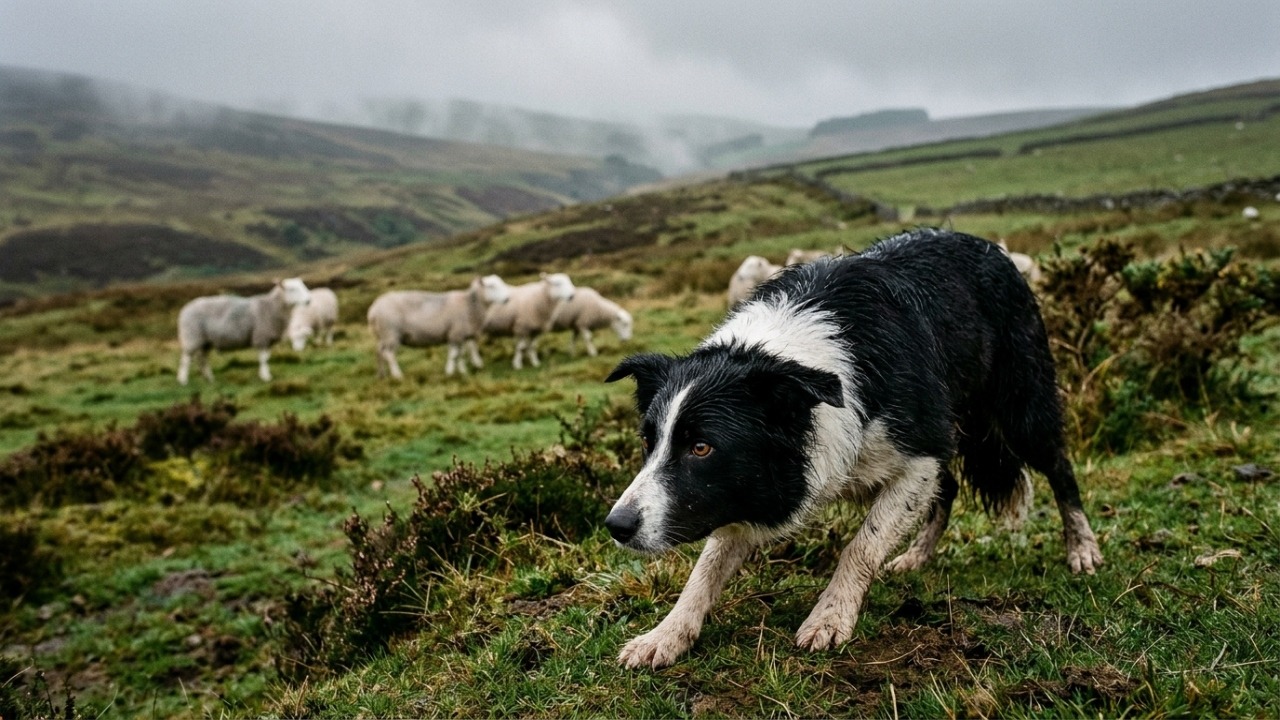
Across the windswept hills straddling the border between Scotland and England, a black-and-white dog creeps low to the ground, shoulders dropped and eyes locked onto a flock of sheep hundreds of yards away. He does not bark, growl, or lunge erratically. When the shepherd lets out a short, sharp whistle, the dog sweeps in a wide arc along the slope, adjusts his pace to the movement of a single straying ewe, and settles the entire flock using nothing more than the silent pressure of his posture.
That scene encapsulates one of the most sophisticated experiments in behavioral selective breeding ever conducted by humankind. Over generations, breeders did not select for show-ring beauty, imposing size, or brute strength; they selected almost exclusively for a specific kind of mind. The result was the Border Collie, widely recognized by researchers, trainers, and kennel organizations as the dog breed with the highest capacity for rapid learning and functional cooperation with humans.
Yet what does it actually mean, in practical and scientific terms, to call a dog the “most intelligent in the world”? Far from being a small furry human, the Border Collie possesses a highly specialized cognitive architecture—one sculpted by geography, the economic demands of pastoralism, and precise modifications to neural circuits inherited from its wolf ancestors.
Born on the Borders: How Geography and Work Shaped a Brain
The breed’s name serves as its birth certificate. Border Collies originated in the Anglo-Scottish Borders, the mountainous, weather-beaten region dividing Scotland and England. Unlike flat agricultural plains where fences and pens simplified livestock management, those steep, fog-draped, rock-strewn hills required a single shepherd to move hundreds of semi-feral sheep across miles of broken terrain.
No human could outrun a flock across that landscape. The shepherd needed a partner capable of working hundreds of yards out, interpreting subtle acoustic signals carried on the wind, and making split-second autonomous decisions whenever ridges blocked line of sight between handler and dog.
During the nineteenth century, several varieties of herding dogs worked across Britain, many of them noisy and prone to nipping at sheep’s heels to drive them forward. The historical turning point arrived in September 1893 with the birth of a dog named Old Hemp, bred by Adam Telfer in Northumberland in northern England. Unlike his contemporaries, Old Hemp worked in complete silence. He used an intense gaze and calculated body angles to control sheep with surgical precision, never panicking or injuring the flock.
Old Hemp’s performance in sheepdog trials was so dominant that he became the primary founding sire of the modern breed—virtually every registered Border Collie alive today traces its pedigree back to him. The decisive factor in this history is that breeding remained governed by working performance rather than purely cosmetic standards far longer than in most other dog breeds. Every pairing prioritized memory, sustained attention, self-control, and speed of response.
The Engineering of Instinct: “The Eye” and a Reprogrammed Predatory Sequence
Anyone watching a Border Collie at work immediately notices its most famous visual signature: a fixed, piercing, almost hypnotic stare paired with a crouched, stalking posture. In the herding world, this trait is known simply as “the eye.” Although it can look almost mystical, it is the direct outcome of genetically reprogramming the canine predatory sequence.
As evolutionary biologists Raymond and Lorna Coppinger demonstrated in their research on working dogs, wolves and primitive canines follow a hardwired motor sequence when hunting:
- Orient toward the prey.
- Fix the gaze and stalk stealthily.
- Chase at high speed.
- Grab-bite to immobilize.
- Deliver the kill-bite.
For a shepherd, a dog that executes the final two steps is an economic disaster. Conversely, a dog with zero predatory drive simply ignores the flock. The brilliance of Border Collie breeding lay in editing that biological chain: the opening stages—orienting, staring, and circling—were amplified to an extreme degree, while the concluding biting stages were genetically suppressed.
When a Border Collie locks eyes on a sheep, its brain is firing ancestral hunting circuitry, yet an inherited inhibitory brake prevents it from attacking. Instead of lunging to bite, the dog channels all of that neural tension into maintaining strategic distance, blocking escape routes, and moving the flock as a cohesive unit. That is why, even in suburban neighborhoods without a single sheep in sight, many Border Collies instinctively try to “herd” children at the park, bicycles, other dogs, or even windblown leaves: the underlying neural program never stops running.
What Science Actually Measures When It Says “The Smartest”
The Border Collie’s global reputation as the smartest dog crystallized in 1994, when psychologist and canine researcher Stanley Coren published The Intelligence of Dogs. Coren compiled evaluations from hundreds of obedience trial judges across the United States and Canada to rank breeds along one specific dimension: working and obedience intelligence.
In that assessment, the Border Collie claimed the undisputed top spot. The data showed that typical individuals of the breed can grasp a new command in fewer than five repetitions and obey the first signal 95 percent of the time or better.
Comparative cognitive science has evolved substantially since the 1990s, however, and contemporary researchers such as Brian Hare, Ádám Miklósi, and Juliane Kaminski caution against measuring animal intelligence on a single linear scale. Just as in humans, distinct cognitive domains exist across dog breeds:
- Cooperative and social intelligence: The ability to read human intentions, follow communicative gestures, and learn tasks in partnership. In this domain, the Border Collie is virtually unmatched.
- Spatial cognition and independent problem-solving: The capacity to navigate physical obstacles or manipulate mechanisms without human guidance. In these tasks, more independent breeds—such as certain Nordic dogs or terriers—sometimes show greater solo persistence, precisely because a Border Collie tends to look back at its human partner for direction when confronted with an unfamiliar impasse.
- Olfactory intelligence and tracking: A domain led by scent hounds such as the Bloodhound, whose sensory architecture prioritizes chemical mapping of the environment over sustained visual attention toward a handler.
The modern scientific consensus is therefore nuanced: the Border Collie is not a universal genius across every conceivable task, but it sits at the very pinnacle whenever a challenge involves rapid associative learning, working memory, inhibitory control, and communicative cooperation with humans.
Chaser, Rico, and the Mystery of the Thousand Words
If rapid obedience already impressed trainers, it was in the realm of human language comprehension that two Border Collies rewrote animal cognition textbooks in the early twenty-first century.
The first breakthrough gained worldwide attention in 2004, when researchers Julia Fischer, Juliane Kaminski, and Josep Call of the Max Planck Institute for Evolutionary Anthropology in Germany published a study in the journal Science on a Border Collie named Rico. Rico knew the names of more than 200 different toys and reliably retrieved the requested item from another room.
Even more remarkable than his vocabulary size was the cognitive mechanism Rico demonstrated. Researchers placed a completely unfamiliar object among seven toys Rico already knew and asked him to fetch an item using a brand-new word. On the majority of trials, Rico bypassed the familiar toys and retrieved the novel object. Weeks later, he still remembered the new item’s name. In developmental psychology, this process of inference by exclusion is called fast mapping—a core mechanism through which human toddlers rapidly expand their vocabulary.
A few years later, a female Border Collie named Chaser pushed that boundary to an unprecedented level. Studied over more than a decade by psychologists John Pilley and Alliston Reid at Wofford College in South Carolina, Chaser learned and retained the proper names of 1,022 distinct toys.
To ensure Chaser was not merely responding to unconscious visual cues from her handlers—a phenomenon known in science as the Clever Hans effect—researchers conducted double-blind trials in which the toys remained in a separate room out of the speaker’s line of sight. Chaser succeeded consistently, while also displaying two additional linguistic capacities:
- Category comprehension: Beyond knowing each toy’s individual proper name, she understood common nouns such as “ball” and “frisbee,” grouping unfamiliar objects by shape or function.
- Basic verb-noun combinations: Chaser distinguished instructions such as “take,” “paw,” and “nose” applied to the very same objects, demonstrating that she processed the action and the target as separate units of information.
Subsequent international research led by Claudia Fugazza and Ádám Miklósi at Eötvös Loránd University in Budapest through the Genius Dog Challenge added an essential caveat to these findings. Scientists identified a rare subset of canines termed Gifted Word Learners. The vast majority of dogs tested worldwide cannot easily learn object names, even after months of training. Among the select few individuals capable of rapidly mastering dozens or hundreds of words, however, Border Collies appear in overwhelming numbers. This suggests the ability is not automatic across every member of the breed, but arises from a rare genetic predisposition unlocked by intensive early environmental enrichment.
Mind Reading in Motion: Fine-Tuned Attunement to Humans
To understand why a Border Collie absorbs cues at such extraordinary speed, it helps to look inside its skull and examine how it perceives the human body.
In 2019, a landmark neuroimaging study led by neuroscientist Erin Hecht and colleagues, published in the Journal of Neuroscience, analyzed MRI brain scans across dozens of domestic dog breeds. The team discovered that human selective breeding has not merely reshaped canine muzzles and leg lengths; it has physically reorganized neural networks in the canine brain according to each breed’s working function. In breeds selected for visual herding and distance responsiveness, researchers observed pronounced specialization in brain regions governing visual processing, fine motor control, and sensorimotor integration.
In daily life, that neural wiring translates into hyper-attunement to human behavior. A Border Collie continuously tracks its handler’s gaze direction, shoulder angle, hand motion, and subtle shifts in vocal pitch.
In traditional sheepdog work, a handler uses a standardized whistle repertoire—variations in frequency and duration signaling commands such as “go right” (away to me), “go left” (come-bye), “lie down,” or “walk up.” The Border Collie’s brain decodes those acoustic patterns in fractions of a second while simultaneously calculating flock velocity, distance to the gate, and the reaction of individual sheep. It is real-time spatial computation under dynamic conditions.
The Price of a Hyperactive Mind: When Intelligence Becomes a Challenge
A widespread misconception among people who bring home a Border Collie after watching viral trick videos is that a smarter dog means less work. In reality, the exact opposite is true.
A mind engineered to solve complex problems for hours on end across rugged hillsides does not come with an off switch when placed in a quiet suburban yard or city apartment. When a Border Collie is deprived of cognitive challenges matched to its neural bandwidth, it invents its own jobs—and they rarely align with household peace.
Veterinary behaviorists clinically observe that the breed carries an elevated predisposition to repetitive, compulsive behaviors when subjected to chronic boredom or sensory overload. Among the most documented patterns are:
- Light and shadow fixation: Spending hours staring at smartphone reflections, headlights sweeping across a wall, or shifting tree shadows, attempting to “control” their movement as if they were livestock.
- Car, bicycle, or jogger chasing: Unchecked activation of the stalk and chase circuit triggered by fast-moving street stimuli.
- Hypervigilance and sound reactivity: The very auditory acuity designed to catch a whistle half a mile away can amplify stress in unpredictable urban soundscapes.
Trying to solve these issues through physical exhaustion alone—such as throwing a tennis ball repetitively for an hour—usually backfires. It builds an athlete with even greater cardiovascular endurance whose brain remains starved for structured problem-solving.
Living With a Canine Strategist: What This Mind Truly Needs
Understanding how a Border Collie thinks transforms the way humans live alongside one. Rather than treating the dog merely as an athlete that needs to burn calories, an informed owner acts as a coordinator of cognitive work.
| Type of Stimulation | Practical Example | Cognitive Mechanism Engaged |
| Scent work and named retrieval | Hiding specific named toys around the house or yard for targeted search | Associative memory, inhibitory control, and olfactory processing |
| Multi-step problem-solving | Layered puzzle feeders or indoor/outdoor obstacle sequences | Motor planning and sequential decision-making |
| Concept and cue discrimination | Teaching object differentiation, left/right directions, and chained actions | Neural plasticity and joint attention with a human partner |
| Impulse-control training | Practicing sustained stays around moving toys or unpredictable distractions | Regulation of predatory drive and emotional self-regulation |
Ten to fifteen minutes of structured cognitive training—requiring the dog to think, discriminate cues, and restrain impulses—tires a Border Collie far more deeply and healthily than a long, mindless run. Canine sports such as agility, rally obedience, disc dog, and recreational herding thrive with this breed precisely because they recreate the ancestral partnership its brain was built for: active collaboration, rapid signal reading, and purposeful decision-making.
Looking inside the mind of a Border Collie is like gazing into a mirror of human ingenuity. Across centuries, we shaped this animal to read our intentions, anticipate our gestures, and collaborate with us on intricate tasks. In return, we created a companion whose brilliant mind demands respect, purpose, and continuous engagement—reminding us that an extraordinary intellect only flourishes when given a world worthy of exploration.
What the Evidence Allows Us to Conclude
- Well-established by scientific and historical evidence:
- Historical functional selection (anchored by the founding sire Old Hemp, born in 1893) shaped Border Collie behavior by amplifying the opening stages of the canine predatory sequence while suppressing the final biting stages.
- In standardized evaluations of obedience and human-guided associative learning, Border Collies consistently outperform the average across domestic dog breeds.
- Controlled laboratory studies (such as Rico and Chaser) and multicentric research (Genius Dog Challenge) confirm that exceptional individuals of the breed can associate hundreds of verbal labels with distinct objects and deduce novel names via exclusion (fast mapping).
- Neuroimaging studies demonstrate that selective breeding for working function has measurably altered anatomical brain networks across domestic dog breeds.
- Supported by limited evidence or requiring contextual nuance:
- Learning hundreds of object names is not a uniform trait across all Border Collies; it is a rare phenomenon (Gifted Word Learners) that occurs disproportionately in the breed but depends on individual genetic predisposition paired with intensive training.
- Breed intelligence rankings (such as Stanley Coren’s) measure working and obedience intelligence specifically rather than capturing every domain of canine cognition.
- Still under active investigation:
- The exact genetic markers that distinguish word-learning gifted Border Collies from breed peers that do not develop large object vocabularies.
- The precise extent of abstract syntactic processing in dogs—specifically, whether verb-noun combinations reflect proto-grammatical understanding or sophisticated contextual association chains.
FAQ
1. Can every Border Collie learn hundreds of words like Chaser?
No. Research such as the Genius Dog Challenge shows that rapidly memorizing dozens or hundreds of object names is rare even among Border Collies. While the breed accounts for the majority of documented gifted word learners, most Border Collies excel at learning action cues and working routines rather than building vast noun vocabularies without rare genetic aptitude and intensive training.
2. Why do Border Collies stare so intensely at other animals, people, or objects?
This behavior, known as “the eye,” is a genetic adaptation of wolf hunting behavior. Through selective breeding for herding, shepherds intensified the “orient and stalk” phase while inhibiting the urge to bite. The dog uses its fixed gaze as a tool of spatial control and psychological pressure to move livestock smoothly without physical contact.
3. Is the Border Collie the smartest dog breed in every single area?
It ranks first in working intelligence, obedience, and communicative cooperation with humans. However, comparative cognition research shows that other breeds can outperform Border Collies in specific domains, such as independent physical problem-solving without human cues or complex scent tracking.
4. Can a Border Collie thrive in an apartment?
Yes, provided its cognitive and physical needs are met consistently every day. The decisive factor for a Border Collie’s well-being is not square footage, but structured mental work, obedience training, scent games, and purposeful outdoor activity. A large backyard without mental stimulation will still leave a Border Collie bored and prone to destructive habits.
5. Why do some Border Collies become obsessed with lights, shadows, or cars?
Because the breed combines acute visual sensitivity to motion with a powerful herding drive. When a Border Collie lacks a structured mental outlet, moving stimuli—such as light reflections or passing vehicles—can trigger repetitive, compulsive circuits that are difficult to interrupt without targeted behavioral management.
Glossary
- Clever Hans effect: A scientific phenomenon in which an animal appears to answer complex questions or understand language, but is actually responding to subtle, involuntary body cues given by its trainer or observer.
- Cooperative cognition: An animal’s capacity to interpret intentions, gestures, and communicative signals from another species (such as humans) to solve tasks collaboratively.
- Fast mapping: A cognitive process in which an individual infers the meaning of an unfamiliar word by associating it with a novel object placed among familiar items (learning by exclusion).
- Gifted Word Learners: A term used by ethologists and cognitive scientists to describe rare dogs capable of rapidly memorizing the proper names of dozens or hundreds of distinct objects.
- Predatory sequence: The hardwired behavioral chain observed in predators such as wolves (orient, stalk, chase, grab-bite, kill-bite), selectively modified across domestic dog breeds.
- The eye: The Border Collie’s hallmark herding posture, characterized by an unbroken, intense gaze, lowered head, and stealthy movement used to guide livestock without physical contact.
References
- Coppinger, R., & Coppinger, L. (2001). Dogs: A Startling New Understanding of Canine Origin, Behavior & Evolution. Scribner.
- Coren, S. (1994). The Intelligence of Dogs: Canine Consciousness and Capabilities. Free Press.
- Fugazza, C., Dror, S., Sommese, A., Temesi, A., & Miklósi, Á. (2021). Word learning dogs (Canis familiaris) provide an animal model for studying exceptional performance. Scientific Reports, 11, 14070.
- Hecht, E. E., Smaers, J. B., Dunn, W. D., Kent, M., Preuss, T. M., & Gutman, D. A. (2019). Significant Neuroanatomical Variation Among Domestic Dog Breeds. Journal of Neuroscience, 39(39), 7748–7758.
- International Sheep Dog Society (ISDS). Historical records on the founding of the breed and the lineage of Old Hemp (1893).
- Kaminski, J., Call, J., & Fischer, J. (2004). Word Learning in a Domestic Dog: Evidence for “Fast Mapping”. Science, 304(5677), 1682–1683.
- Pilley, J. W., & Reid, A. K. (2011). Border collie comprehends object names as verbal referents. Behavioural Processes, 86(2), 184–195.
Related posts:

The Helicopter: The Incredible Machine That Conquered The Skies

Kings of the Sky: How Fighter Jets Reshaped Warfare, Technology, and the Future of Aviation

Tyrannosaurus Rex: The Life, Anatomy, and Secrets of the King of Dinosaurs

Passenger Cars

Why Do People Procrastinate? The Psychology Behind Putting Things Off

Leave a comment