

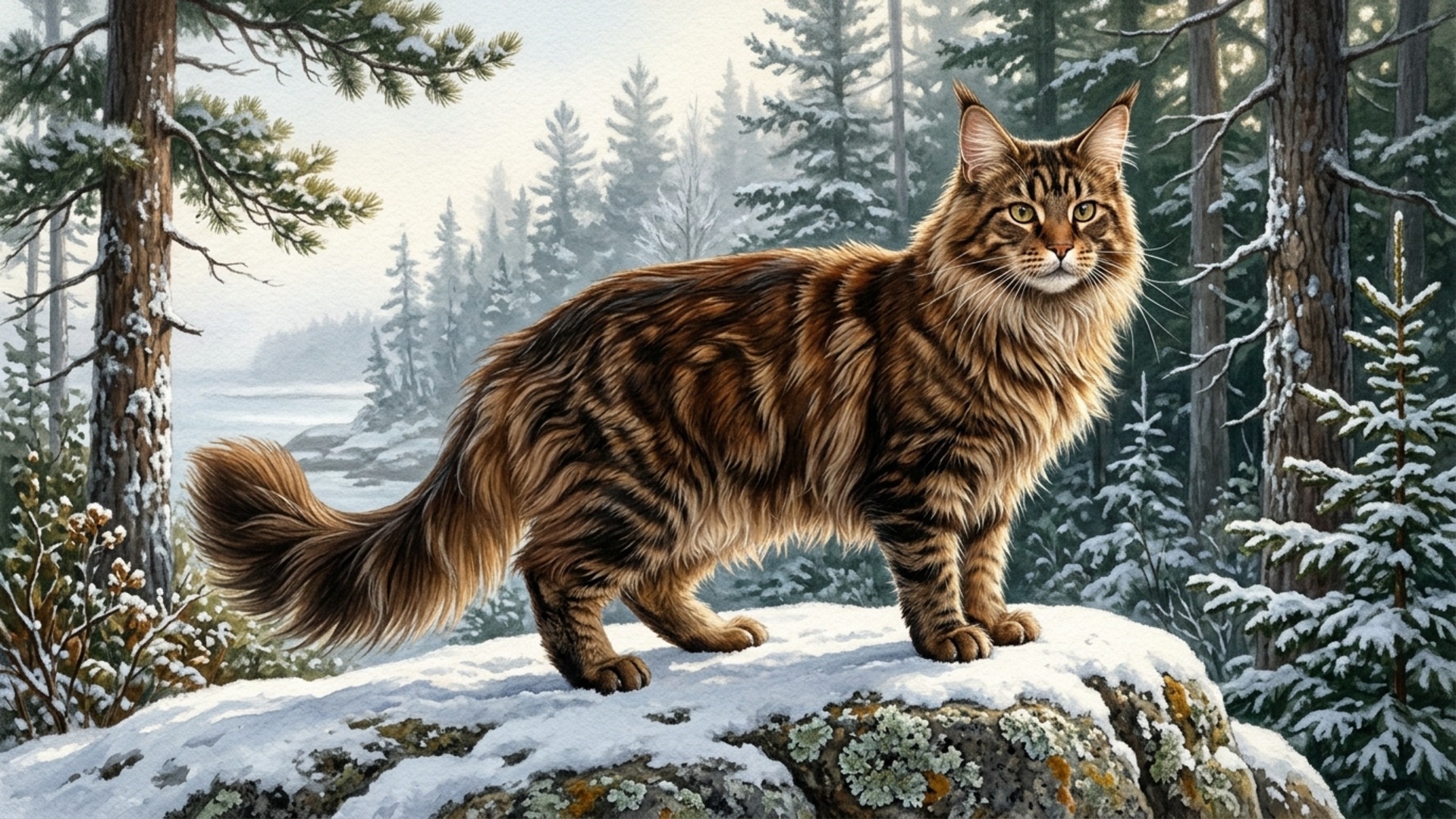
How harsh New England winters, natural selection, and specific genetic mutations shaped the world’s largest natural domestic cat.
Summary
The Maine Coon is the world’s largest natural domestic cat breed and a remarkable example of adaptive evolution shaped by environment. Originating in the nineteenth-century northeastern United States from crosses between local short-haired cats and long-haired felines brought aboard European merchant ships, the breed developed specialized biological engineering to survive New England blizzards. This article unpacks the true historical origins of the Maine Coon—separating documented records from folklore such as raccoon hybridization—explains the genetic mechanisms behind its water-repellent coat, polydactyly, and hereditary heart conditions, and details a distinctive anatomy defined by a skeletal growth curve that takes up to five years to complete.
Introduction
Few domestic encounters create as striking a contrast as standing face-to-face with a full-grown Maine Coon. At first glance, its silhouette commands respect: broad shoulders, a deep ribcage, large ears crowned with lynx-like tufts, and a tail so thick it looks as though it belongs to a wild predator of the boreal forest. Watch its behavior for a few minutes, however, and it becomes immediately clear why the breed earned the nickname “gentle giant.” Instead of the sharp meow typical of most house cats, a Maine Coon usually communicates through soft chirps and musical trills, trailing its owners from room to room with the cooperative curiosity of a companion dog.
This rare combination of colossal build and even temperament was not crafted in modern selective breeding labs or aristocratic salons. The Maine Coon is a natural breed—meaning it was sculpted first by environmental pressure, the unforgiving climate of the northeastern United States, and working selection on farms and ships long before any official show standard existed. Understanding this feline requires looking past its majestic exterior to examine the maritime history, evolutionary biology, and genetic code that ensured its survival.
From New England Farms to New York Show Halls: The Breed’s True History
The documented history of the Maine Coon begins in the state of Maine, in the far northeastern corner of the United States—a region defined by punishing winters, dense woodlands, and an economy historically tied to agriculture and maritime trade. Throughout the nineteenth century, skilled mousers were indispensable working animals both in rural barns and in the cargo holds of merchant vessels crossing the North Atlantic.
It was in New England’s bustling seaports that the breed’s genetic foundation took shape. Domestic short-haired cats already established in North America bred spontaneously with long-haired felines brought aboard ships arriving from Europe and the Near East. In that harsh environment, where temperatures plunged well below freezing for months at a time, natural selection acted without mercy: only the sturdiest kittens with the densest coats, heaviest bone structure, and strongest cold tolerance survived to pass on their genes.
The earliest widely recognized written mention of a Maine cat dates to 1861, when author Frances Simpson recorded in her book The Book of the Cat an account by F. R. Pierce describing a black-and-white long-haired cat from Maine named Captain Jenks of the Horse Marines. Over the following decades, local agricultural fairs began holding informal contests to crown the “Maine State Champion Cat.” National recognition arrived in May 1895 at North America’s first major cat show, held at Madison Square Garden in New York City. At that event, a brown tabby female named Cosey defeated dozens of competitors to win Best in Show, earning a silver collar and medal that remain in the collection of the Cat Fanciers’ Association today.
Between Maritime Legends and Biological Impossibilities
The Maine Coon’s wild appearance, combined with the lack of formal pedigree registries during its earliest centuries, fueled a host of colorful origin myths. The most famous is embedded in the breed’s very name: the popular belief that Maine Coons resulted from matings between semi-feral domestic cats and native raccoons, inspired by the cat’s ringed tail, tabby markings, and habit of dunking food or dabbling its paws in water.
From a biological standpoint, that hypothesis is completely impossible. Domestic cats belong to the family Felidae and carry 38 chromosomes, whereas raccoons belong to the family Procyonidae—evolutionarily closer to bears and coatis than to felines—and possess the same chromosome count but entirely incompatible genetic architecture and reproductive barriers at the taxonomic family level. The visual resemblance to a raccoon is simply an aesthetic coincidence tied to the classic brown tabby coat pattern.
Another romantic legend credits the breed’s origins to French Queen Marie Antoinette. According to the tale, during the French Revolution she sent her six prized Angora cats to America aboard Captain Samuel Clough’s vessel bound for Wiscasset, Maine, where the animals supposedly escaped and bred with local cats. While maritime trade between France and the Maine coast in the late eighteenth century is historically plausible, no primary documentation exists to verify the existence or shipment of the queen’s cats.
A third theory, far more credible through the lens of population genetics, suggests that ancestors of modern Scandinavian forest cats—the forebears of the Norwegian Forest Cat—reached North American shores centuries earlier aboard Viking ships led by Leif Erikson around the year 1000, or later with Scandinavian mariners. Modern feline genetic studies, including research conducted by Leslie Lyons and colleagues at the University of California, Davis, confirm that the Maine Coon shares strong genetic affinity with Western and Northern European cat populations, reflecting multiple waves of transatlantic maritime migration.
Twentieth-Century Decline and Genetic Rescue
Despite Cosey’s triumph in 1895, the Maine Coon’s prestige suffered a steep decline in the early decades of the twentieth century. The importation of exotic breeds—particularly the Persian and the Siamese—captured the attention of breeders and show judges across the United States and Europe. Viewed as an ordinary “farm cat” compared to the glamour of Eastern breeds, the Maine Coon was steadily pushed aside on the show circuit.
By the 1950s, the situation had grown critical: registrations fell so low that specialist publications declared the breed virtually extinct. Its rescue became possible only through the founding of the Central Maine Cat Club in 1953 by Alta Smith and Ruby Dyer, who organized local exhibitions dedicated exclusively to preserving original farm lineages across the state. Over more than two decades, committed breeders worked to document pedigrees and stabilize the morphological standard without sacrificing the breed’s rugged vitality. Their efforts culminated in 1976, when the Cat Fanciers’ Association restored full championship status to the Maine Coon, and in 1985, when the Maine State Legislature designated it the official state cat.
Functional Anatomy: Biological Engineering Built for Snow
Every physical detail of the Maine Coon solves a practical challenge imposed by subarctic winters and rugged terrain. Nothing about its anatomy is merely decorative; rather, it forms an integrated suite of mechanical and thermoregulatory adaptations.
Bone Structure, Musculature, and a Five-Year Growth Curve
The Maine Coon holds the title of largest non-hybrid domestic cat breed on Earth. While an average house cat weighs between 8 and 11 pounds (3.5 to 5 kilograms), adult Maine Coon males routinely weigh between 15 and 24 pounds (6.8 to 11 kilograms), with exceptionally large individuals exceeding 26 pounds (12 kilograms) of lean muscle and heavy bone. Females are smaller, typically weighing between 10 and 15 pounds (4.5 to 6.8 kilograms). Total body length from the tip of the nose to the end of the tail frequently surpasses 40 inches (one meter).
To support that mass without sacrificing a hunter’s agility, its skeleton features long, dense bones, sturdy joints, and a distinctly rectangular body frame with a broad chest and well-developed pectoral and lumbar musculature. Its muzzle is square and prominent—an anatomical design that houses powerful jaws suited for grasping and holding larger outdoor prey.
One of the breed’s most fascinating physiological traits is its growth timeline. Most domestic cats reach their adult size and weight around 12 months of age. The Maine Coon, by contrast, undergoes remarkably slow skeletal and muscular maturation, requiring three to five years to achieve full physical development. During its first two years, the cat grows primarily in length and height, often sporting a lanky, somewhat gangly appearance; only between its third and fifth year does the chest broaden, musculature fill out, and the neck ruff reach full volume.
Water-Repellent Coat, Snowshoe Paws, and a Thermoregulating Tail
The Maine Coon’s thermal protection operates like a layered outdoor garment engineered to handle wet snow, biting wind, and dense underbrush:
- Asymmetric coat gradient: Unlike the Persian, which grows uniformly long fur over its entire body, the Maine Coon has shorter hair across the shoulders and head that lengthens progressively along the flanks, belly, and hind legs (forming shaggy “britches”), paired with a thick ruff around the neck. This smart layout prevents the cat from snagging on twigs and brambles while moving through woods, while preserving vital insulation over core organs.
- Natural water resistance: The coat consists of a dense, soft undercoat that traps warm air close to the skin, overlaid by long, silky, naturally oily guard hairs. This outer layer sheds rain and melting snow, preventing moisture from reaching the skin and causing hypothermia.
- Snowshoe paws: The paws are large, round, and fitted with long tufts of fur growing between the toes and beneath the paw pads. In terms of locomotion mechanics, these tufts expand the surface area in contact with the ground without adding weight, distributing the cat’s body mass much like natural snowshoes that keep it from sinking into deep powder.
- Insulated ears: Large and set high on the head to detect faint rustling beneath snowpack, the ears feature dense interior furnishings that shield the ear canal from freezing gusts and frostbite, topped by vertical lynx tips that help channel sound waves and deflect falling snow.
- Tail as a heat exchanger: Often equal in length to the torso, the tail is covered in long, flowing fur. Beyond serving as a counterbalance during leaps and sprints, it plays a vital role at rest: when sleeping in subzero temperatures, a Maine Coon curls tightly and wraps its thick tail across its face, creating an insulating pocket that warms and humidifies frigid air before it reaches the lungs.
Maine Coon, Norwegian Forest Cat, and Siberian: Evolutionary Convergence
Across different regions of the Northern Hemisphere, geographic isolation and harsh winters shaped three natural breeds of large, heavy-coated cats that are frequently confused with one another: the Maine Coon (North America), the Norwegian Forest Cat (Scandinavia), and the Siberian (Russia). Together, they represent a classic case of evolutionary convergence mediated by domestication—similar climates selected for comparable anatomical solutions, yet each lineage retained a distinct morphological signature.
| Trait | Maine Coon (United States) | Norwegian Forest Cat (Norway) | Siberian Cat (Russia) |
| Body Frame | Long, rectangular, heavy-boned, broad-chested | Long and athletic, with hind legs slightly higher than front | Compact, muscular, and rounded (barrel-shaped) |
| Facial Profile | Gentle concave curve (slight stop) below the eyes | Completely straight profile from brow to nose tip | Soft curve along the nasal bridge, shorter and rounder head |
| Muzzle Shape | Square and prominent | Triangular, forming an equilateral triangle with the ears | Rounded and full, with prominent cheekbones |
| Coat Structure | Uneven length (shorter at shoulders, longer on flanks), silky and oily | Very dense double coat with woolly undercoat and coarse outer guard hairs | Extremely dense triple coat adapted to dry continental cold |
| Physical Maturation | Very slow (3 to 5 years) | Slow (3 to 4 years) | Slow (up to 5 years) |
The Giant’s Genetic Code: Mutations, Polydactyly, and Hereditary Health
The very genetic toolkit that equipped the Maine Coon for wilderness survival also carries specific mutations that attract intense interest in developmental biology and modern veterinary medicine.
The Genes Behind Long Fur and Extra Toes (Polydactyly)
The breed’s signature long coat is governed by the FGF5 (Fibroblast Growth Factor 5) gene. In mammals, the protein encoded by this gene acts as a molecular signal telling the hair follicle when to stop growing and enter its resting phase. Maine Coons carry recessive mutations in FGF5 that dampen this stop signal, extending the active growth phase of the hair shaft (the anagen phase) and allowing fur to grow substantially longer than in short-haired cats.
Another historic genetic hallmark of the breed is polydactyly—the presence of extra toes on the front paws, hind paws, or both. While standard cats have five toes on each front paw and four on each back paw, polydactyl Maine Coons commonly have six or seven digits per paw, creating the look of “mitten paws” or “hamburger paws.” Historians estimate that roughly 40 percent of early nineteenth-century Maine Coons were polydactyl.
At the molecular level, this trait stems from point mutations inherited in an autosomal dominant pattern within a regulatory DNA region known as ZRS (ZPA Regulatory Sequence), which controls expression of the Sonic Hedgehog (SHH) gene during embryonic limb development. The altered switch keeps SHH active slightly longer or across a marginally broader zone of the developing limb bud, prompting the formation of extra, fully functional digits complete with bones, tendons, and claws.
During the age of sail, seafarers prized polydactyl cats, believing the extra toes gave them superior grip on slick rolling decks and better dexterity for catching rats, while also acting as even wider snowshoes on land. Ironically, for much of the twentieth century, polydactyly was banned from show rings out of unfounded fears that it was linked to severe skeletal deformities. Modern genetic research has confirmed that the breed’s ZRS variant does not compromise health, and major registries such as The International Cat Association (TICA) now officially recognize the Maine Coon Polydactyl class in championship competition.
Hypertrophic Cardiomyopathy (HCM) and Other Monitored Conditions
As happened in many purebred populations that experienced genetic bottlenecks—such as the Maine Coon’s near-extinction in the 1950s—the breed’s closed gene pool concentrated certain inherited mutations that require careful screening by ethical breeders and veterinarians:
- Feline Hypertrophic Cardiomyopathy (HCM): The most prevalent heart disease in cats, HCM is characterized by progressive thickening of the muscular walls of the left ventricle, which reduces chamber volume and impairs the heart’s ability to relax and pump blood efficiently. In 2005, veterinary geneticist Kathryn Meurs and her team identified a specific mutation in the MYBPC3 gene (known as the A31P variant), which encodes cardiac myosin-binding protein C. Cats inheriting two copies of this mutation (homozygous) face a significantly elevated risk of developing severe, early-onset HCM. However, because HCM can also occur in cats lacking the A31P variant due to other genetic factors still under investigation, best-practice breeding protocols combine DNA testing with regular echocardiograms.
- Spinal Muscular Atrophy (SMA): This inherited neuromuscular disorder follows an autosomal recessive pattern and is caused by a deletion affecting the LIX1 and LNPEP genes. The defect leads to progressive degeneration of spinal cord motor neurons controlling skeletal muscles in the trunk and limbs. Affected kittens develop muscle weakness and an unsteady gait around three to four months of age, yet the condition is non-painful and typically stabilizes, allowing strictly indoor cats to live normal lifespans. Simple DNA screening prevents pairings between carriers.
- Hip Dysplasia: Because of their heavy body mass and extended skeletal growth period, Maine Coons carry a higher predisposition to malformation of the hip joint, in which the femoral head fails to seat snugly within the pelvic socket, potentially leading to early osteoarthritis. Careful weight management during the growth years and radiographic hip evaluations of breeding cats help lower its incidence.
Behavior and Vocalization: Why Do They Act Like “Dogs in Cat Suits”?
The Maine Coon’s reputation as a “dog in a cat suit” traces directly to its evolutionary background. Unlike felines bred strictly as lap ornaments in royal courts, the Maine Coon’s ancestors worked alongside farming families and ship crews for generations. Surviving in shared human spaces favored individuals that were highly sociable, tolerant of handling, inquisitive, and cooperative, while weeding out extreme territorial aggression.
That heritage shines through in unmistakable behavioral traits. Rather than demanding constant lap time, a Maine Coon prefers proximity: it follows household members from room to room, watches everyday chores intently, and readily learns to play fetch or walk on a harness and leash.
Its famous fascination with water—often pawing at its water bowl before drinking or joining owners near the shower—is frequently linked both to its seafaring past and, more practically, to the physical comfort afforded by its oily, water-repellent coat. Because water beads off the outer guard hairs without soaking the skin, getting its paws or back wet triggers none of the thermal discomfort most domestic cats experience.
Finally, its vocal repertoire reflects both its anatomy and its social nature. Despite possessing broad chests, Maine Coons rarely produce loud, piercing meows. Instead, they rely primarily on chirps, trills, and low, resonant murmurs—sounds that mother cats in the wild use to call and reassure their kittens, and that adult Maine Coons repurpose as a nuanced tool for social bonding with humans.
Conclusion
The Maine Coon stands as living proof that nature and human history, working in concert, can produce extraordinary results without complex artificial engineering. Every feature of this feline tells part of its journey: the tufts between its toes and its water-shedding coat recount harsh winters across New England forests and harbors; variations within its genome reveal the subtle molecular switches governing hair growth, limb patterning, and cardiac health; and its affable temperament and melodic voice reflect centuries of quiet partnership with fishermen and farmers. Looking closely at its history, genetics, and anatomy transforms the Maine Coon from a mere spectacle of feline size into what it truly is—a masterpiece of biological adaptation.
What the Evidence Allows Us to Conclude
- Well-established by science and history:
- The breed’s nineteenth-century North American origin in the state of Maine, formed by interbreeding between local domestic short-haired cats and long-haired cats carried aboard European merchant vessels.
- The absolute biological impossibility of hybridization between domestic cats (Felis catus, family Felidae) and raccoons (Procyon lotor, family Procyonidae).
- The role of recessive mutations in the FGF5 gene in producing the breed’s long coat, and point mutations in the ZRS regulatory region of the SHH gene in causing benign polydactyly.
- The strong association between the A31P mutation in the MYBPC3 gene and elevated risk of Hypertrophic Cardiomyopathy (HCM), as well as the LIX1/LNPEP deletion responsible for feline Spinal Muscular Atrophy (SMA).
- The breed’s delayed skeletal maturation, requiring three to five years to reach full physical size.
- Supported by preliminary or partial evidence:
- Direct genetic contribution from cats carried aboard Viking expeditions (ancestors of the Norwegian Forest Cat) around the year 1000. While genomic studies confirm close affinity between Maine Coons and Northern European cat populations, current evidence cannot isolate whether that gene flow occurred during the Viking Age or exclusively through seventeenth- to nineteenth-century colonization and maritime trade.
- Myths or unsubstantiated claims:
- The story that Maine Coons descend from Angora cats shipped by Marie Antoinette during the French Revolution lacks primary historical documentation and remains regional folklore.
- The outdated belief that polydactyl cats inevitably suffer from severe limb or spinal deformities has been refuted for the ZRS variant characteristic of the breed.
FAQ
1. Are Maine Coons actually related to raccoons? No. Although the word “Coon” comes from raccoon and many Maine Coons display ringed tails and brown tabby coats, interbreeding between cats and raccoons is biologically impossible. They belong to distinct taxonomic families (Felidae and Procyonidae) separated by tens of millions of years of evolution.
2. At what age do Maine Coons stop growing? Unlike most domestic cats, which reach their adult size around one year of age, Maine Coons grow slowly and do not complete their skeletal and muscular maturation until they are three to five years old.
3. Do all Maine Coons have extra toes (polydactyly)? No. While roughly 40 percent of early nineteenth-century Maine Coons were polydactyl, today the trait appears only in specific bloodlines carrying the dominant mutation in the ZRS regulatory sequence. Most modern Maine Coons have the standard toe count (five in front and four in back).
4. What does it mean to call the Maine Coon a “natural breed”? It means the breed’s core physical traits—large body frame, water-resistant layered coat, tufted paws and ears, and cold hardiness—emerged through natural selection and environmental adaptation to New England’s climate rather than through artificial crossbreeding designed to invent a novel look.
5. How can prospective owners reduce the risk of hereditary health problems? Responsible breeders perform DNA testing on breeding cats to screen out carriers of mutations linked to Hypertrophic Cardiomyopathy (MYBPC3 A31P variant), Spinal Muscular Atrophy (SMA), and Pyruvate Kinase Deficiency (PKDef), alongside annual echocardiograms and hip radiographs.
Glossary
- Anagen Phase: The active growth stage of a hair follicle, which is prolonged in Maine Coons due to recessive mutations in the FGF5 gene.
- Evolutionary Convergence: The biological process by which distinct or geographically isolated lineages independently evolve similar physical traits in response to comparable environmental pressures.
- FGF5 Gene (Fibroblast Growth Factor 5): A gene that regulates hair growth cycles in mammals; recessive loss-of-function mutations produce long coats in domestic cats.
- Hypertrophic Cardiomyopathy (HCM): A heart condition marked by abnormal thickening of the heart muscle (particularly the left ventricular wall), impairing proper chamber filling and blood circulation.
- Interdigital Tufts: Long tufts of fur growing between the toes and beneath the paw pads, providing thermal insulation and increasing surface area on snow.
- MYBPC3 Gene: The gene encoding cardiac myosin-binding protein C, a structural and regulatory protein essential for normal heart muscle contraction and relaxation.
- Natural Breed: A cat breed whose morphology and behavior evolved organically through climatic and geographic adaptation in a specific region prior to systematic human breeding programs.
- Polydactyly: A benign congenital trait in which an animal is born with one or more extra toes beyond the species norm, linked in Maine Coons to point mutations in the ZRS regulatory element of the SHH gene.
References
- Cat Fanciers’ Association (CFA). Maine Coon Breed Profile & Official Show Standard. Alliance, Ohio: CFA Publications.
- Dröscher, A., & Lipinski, M. J., et al. The ascent of cat breeds: Genetic evaluations of breeds and worldwide random-bred populations. Genomics, 91(1), 12–21, 2008.
- Kehler, J. S., et al. Four independent mutations in the feline Fibroblast Growth Factor 5 gene determine the long-haired phenotype in domestic cats. Journal of Heredity, 98(6), 555–566, 2007.
- Lettice, L. A., et al. Point mutations in a distant sonic hedgehog cis-regulator generate a variable regulatory output responsible for preaxial polydactyly. Human Molecular Genetics, 17(7), 978–985, 2008.
- Meurs, K. M., et al. A cardiac myosin binding protein C mutation in the Maine Coon cat with familial hypertrophic cardiomyopathy. Human Molecular Genetics, 14(23), 3587–3593, 2005.
- Simpson, Frances. The Book of the Cat. London: Cassell and Company, 1903 (incorporating 1861 correspondence regarding early Maine cats).
- State of Maine Legislature. Title 1, Chapter 9, Section 217: State Cat Designation (Maine Coon Cat). Augusta, Maine, 1985.
- The International Cat Association (TICA). Maine Coon and Maine Coon Polydactyl Breed Group Standards. Harlingen, Texas: TICA Publications.
Related posts:

Kings of the Sky: How Fighter Jets Reshaped Warfare, Technology, and the Future of Aviation
Arabian Horse: History, Characteristics, Temperament, and Endurance
Parrots: The Bird That Talks, Thinks, and Lives for Decades — What Science Really Knows About This Beautiful Bird
The Siberian Husky: From Arctic Sled Dog to Beloved Companion

Why Do People Procrastinate? The Psychology Behind Putting Things Off

Leave a comment