

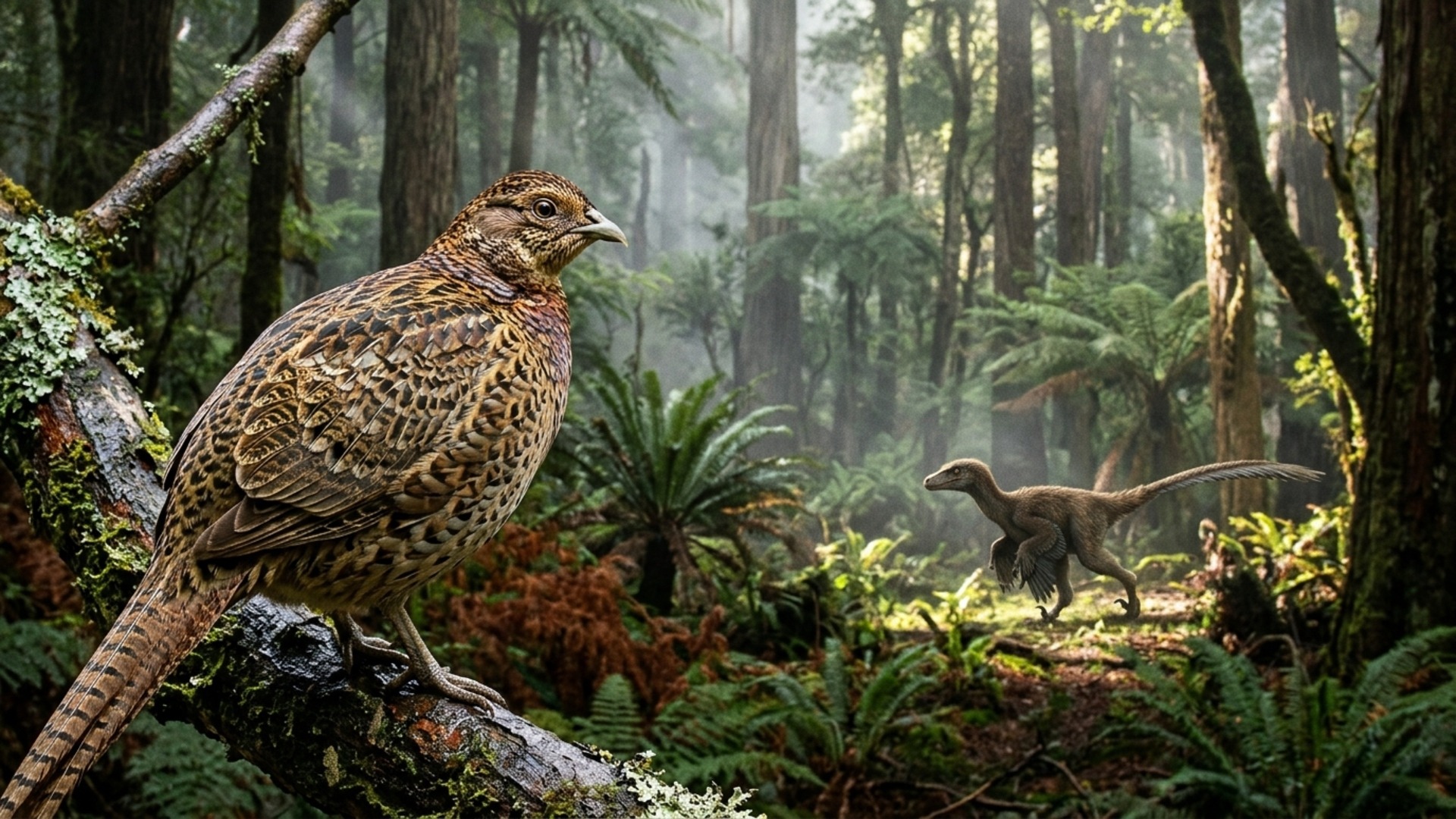
Long before birds crossed the skies, small dinosaurs began developing feathers, wings, and adaptations that would forever change the history of life on Earth.
Quick Summary
Modern birds are descendants of theropod dinosaurs and, from a scientific perspective, are part of the dinosaur group itself. This relationship is supported by fossils, shared anatomical features, and evolutionary studies.
The transformation began long before the first animals capable of true flight appeared. Feathers evolved in dinosaurs that did not yet have functional wings, probably serving purposes such as insulation, communication, and display. Over millions of years, some lineages developed modified forelimbs, lighter bodies, and other features that helped make flight possible.
Fossils such as Archaeopteryx, Microraptor, and several early birds reveal important stages in this story. Then, about 66 million years ago, an asteroid impact triggered a mass extinction that wiped out non-avian dinosaurs and many bird lineages. Some members of the broader lineage leading to modern birds survived and eventually gave rise to the remarkable diversity we see today.
The story of birds, therefore, is not simply about animals that learned to fly. It is also the story of a dinosaur lineage that survived one of the greatest crises in Earth’s history and remains present in nearly every environment on the planet.
A Story That Began Long Before the First Birds
When we see a sparrow perched on a wire, an eagle gliding above a mountain, or a penguin swimming through the ocean, it is hard to imagine that these animals share an evolutionary history with creatures such as Tyrannosaurus rex.
Yet that connection is real. Birds belong to the theropod dinosaur lineage, a group that also includes famous predators and many smaller dinosaurs. This means dinosaurs did not disappear completely 66 million years ago. Part of their history continued in the form of birds.
This relationship developed over millions of years. There was no sudden moment when a dinosaur stopped being a dinosaur and became a bird. Evolution works through changes accumulated across generations, gradually producing lineages with new characteristics.
What Are Theropod Dinosaurs?
Theropods are one of the major groups of dinosaurs. Many were carnivores that walked on two legs, but the group also included an impressive variety of body sizes, shapes, and lifestyles.
Tyrannosaurus rex and Velociraptor are familiar examples, but theropods also included much smaller animals, some of which had bodies covered in feather-like structures. The ancestors of birds emerged within this large dinosaur lineage.
By comparing fossils from different theropods, scientists have identified features also found in birds: a furcula, pneumatic bones, certain forelimb and shoulder characteristics, and several other skeletal similarities.
None of these features, by itself, tells the whole story. What makes the relationship so convincing is the combination of anatomical evidence, feathered fossils, and the evolutionary sequence observed across different species.
How Did Scientists Discover the Connection Between Birds and Dinosaurs?
The connection between birds and dinosaurs began to gain support in the nineteenth century, especially after the discovery of Archaeopteryx in Germany in 1861.
The fossil attracted attention because it combined features that, at the time, seemed to belong to very different groups. The animal had feathers and wings, but it also had teeth, claws on its forelimbs, and a long bony tail.
Over time, new discoveries strengthened this connection. Fossils of feathered dinosaurs found mainly in China revealed that feather-like structures were much more widespread among theropods than scientists had once imagined.
Discoveries of animals such as Sinosauropteryx, Caudipteryx, and Microraptor helped fill in important parts of this history. Instead of finding an isolated similarity between birds and a single dinosaur, scientists began recognizing a broad set of shared characteristics across different lineages.
Are Birds Dinosaurs or Just Descendants of Dinosaurs?
Birds are dinosaurs. That is the classification used in evolutionary paleontology.
In biology, a group can include its ancestors and all their descendants. Because birds originated within the theropod dinosaur lineage, they remain part of Dinosauria.
A common distinction is made between avian and non-avian dinosaurs. Avian dinosaurs are birds and their close relatives within that lineage. Non-avian dinosaurs include animals such as Tyrannosaurus, Triceratops, and Stegosaurus, which left no living descendants.
So when we say dinosaurs went extinct, we are referring to non-avian dinosaurs. Birds are the surviving branch of this remarkable evolutionary history.
Before Wings: When Dinosaurs Began Developing Feathers
For a long time, feathers were associated almost exclusively with birds. The discovery of feathered dinosaurs dramatically changed that view.
We now know that feather-like structures appeared in several groups of dinosaurs, including animals that could not fly. This reveals an important detail: feathers did not originally evolve as ready-made equipment for flight.
Evolution often repurposes structures that already serve a function. A feature may arise for one reason and, much later, be modified to perform a different task.
The Earliest Feather-Like Structures
Modern feathers are complex structures, formed by a central shaft and branching elements that create an organized surface. However, the earliest feather-like structures were much simpler.
Some fossils show filaments resembling fine hairs. Others preserve branched structures with different levels of complexity. The exact sequence through which these structures evolved is still being investigated.
Fossils such as Sinosauropteryx demonstrated that certain dinosaurs had filamentous coverings across their bodies. Others, such as Caudipteryx, had more developed feathers, particularly around their arms and tails.
These animals were not necessarily capable of flight. Their feathers show that the evolution of this structure began before it was used as an aerodynamic surface.
What Were Feathers Used for Before Flight?
Feathers probably served several different purposes throughout dinosaur evolution.
One possible function was thermal insulation. A covering of filaments or feathers could have helped reduce heat loss, which would have been especially useful for active animals living in environments with changing temperatures.
Appearance may also have mattered. Colorful or visually distinctive structures could have helped with communication, recognition between individuals, and courtship displays.
Camouflage is another possibility. Depending on their color and distribution, feathers may have helped an animal blend into vegetation or other elements of its surroundings.
It is important not to treat all these functions as equally proven for every species. Fossils preserve physical structures, but they do not always reveal exactly how those structures were used. Interpretations depend on anatomy, geological context, and comparisons with living animals.
Feathered Dinosaurs That Changed Our Understanding of Prehistory
Some discoveries have been especially important in revealing the variety of feathered dinosaurs.
Sinosauropteryx, found in China, helped demonstrate that filamentous structures were present in dinosaurs that were not birds. Caudipteryx had more organized feathers on its forelimbs and tail, but its anatomy indicates that it was not a flying animal.
Anchiornis had a relatively extensive feather covering, including on its hind limbs. Microraptor, meanwhile, had long feathers on all four limbs, a configuration that sparked considerable interest in the evolution of flight.
These fossils show that the history of feathers did not follow one simple, straight line. Different dinosaurs developed their own combinations of features, some of which may have been evolutionary experiments that did not continue in modern birds.
How Did Dinosaurs Learn to Fly?
Flight is one of the most remarkable transformations in bird evolution. For an animal to remain airborne, however, feathers and wings alone are not enough. Several parts of the body must work together.
Wings, muscles, the skeleton, balance, coordination, and energy production all need to function as an integrated system. These features did not appear at the same time. They changed gradually across different lineages.
The Transformation of Forelimbs Into Wings
The arms of the theropods ancestral to birds underwent important changes. Their forelimbs became modified, the fingers and wrist bones developed new arrangements, and feathers eventually formed surfaces that could contribute to lift and control.
In modern birds, wing feathers are arranged efficiently to interact with the air. They help generate lift, control direction, and allow precise movements during flight.
Fossils show that some of these features appeared in animals that were not yet capable of flying. This supports the idea that wings evolved gradually, with structures initially used for other purposes.
How the Body Adapted to Flight
Flight places considerable demands on the body. To work effectively, the body must combine strength, lightness, and the ability to generate energy.
Bird skeletons show several adaptations. Many bones contain internal spaces connected to the respiratory system, a feature known as skeletal pneumaticity. This does not mean that every bone is simply hollow or fragile. Rather, these structures can contribute to reducing weight and integrating the skeleton with a specialized respiratory system.
The furcula, formed by the fusion of the collarbones, is also present in birds and many theropods. It contributes to the shoulder structure and is associated with the mechanics of the forelimbs.
Other changes involved the muscles, chest, tail, and coordination of movement. In modern birds, many of these adaptations work together to make flight possible.
Did Flight Begin in the Trees or on the Ground?
One of the major questions about the origin of flight is where the earliest bird ancestors began developing behaviors that eventually led to powered flight.
Two traditional hypotheses help organize this debate.
The arboreal hypothesis proposes that small dinosaurs climbed trees and used jumps and gliding movements to travel between branches or reach the ground. In this scenario, wing-like structures may initially have been favored because they helped control descent.
The terrestrial hypothesis suggests that ground-running dinosaurs used their feathered forelimbs to improve stability, capture prey, or assist with movements associated with jumping and running.
Both ideas attempt to explain how flight-related features could have been favored before fully developed flight emerged. The debate continues, and fossils do not yet allow scientists to reconstruct every detail of the process.
It is also possible that different behaviors contributed to the evolution of flight-related structures, rather than a single hypothesis explaining every stage.
Microraptor: The Dinosaur With Four Wings
Microraptor is one of the most fascinating fossils in this story. This small dinosaur lived during the Early Cretaceous and had long feathers on both its forelimbs and hind limbs.
Its appearance suggests a configuration with four feathered surfaces, which has led to the popular description of a four-winged dinosaur.
Microraptor was not a modern bird, but its anatomy shows that different ways of using feathers and limbs to move through the air existed among dinosaurs close to the origin of birds.
The exact position of its legs during aerial movement and its aerodynamic performance are still being studied. Even so, Microraptor provides some of the most interesting evidence that the evolution of flight was experimental and diverse.
Archaeopteryx: The Fossil That Revealed an Extraordinary Connection
Few fossils have played such an important role in the history of paleontology as Archaeopteryx.
Found in limestone deposits in the Solnhofen region of Germany, this animal lived approximately 150 million years ago, during the Late Jurassic.
Its importance lies in the combination of features that help scientists understand the evolutionary transition between theropod dinosaurs and birds.
The Discovery That Astonished Scientists
When the first Archaeopteryx fossils were studied, the presence of feathers immediately attracted attention. At the time, the connection between birds and dinosaurs was still being established.
The fossil offered an unusual combination: it had well-developed wing feathers, but also teeth, claws on its forelimbs, and a long bony tail.
This combination made Archaeopteryx an important piece of evidence for understanding how birds were related to other dinosaurs.
An Animal With Both Dinosaur and Bird Characteristics
Archaeopteryx had organized feathers on its wings and a body structure that resembled that of birds. At the same time, its skeleton retained features found in theropod dinosaurs.
Its long bony tail, for example, differed from the reduced tail structure found in most modern birds. Its teeth also contrasted with the toothless beaks found in nearly all living species.
Its forelimbs had claws, and its skeleton preserved other features that help place the animal close to the evolutionary origin of birds.
Archaeopteryx was not an incomplete mixture of two animals. It was a real species adapted to its own environment, preserving a combination of features that are important for understanding evolution.
Could Archaeopteryx Fly?
The presence of feathers on its wings indicates that Archaeopteryx had structures capable of interacting with the air. However, determining exactly how it moved is more difficult.
Studies of its bones, joints, and feathers suggest that its flight performance was probably different from that of many modern birds.
It may have been capable of short flights, bursts of powered movement, and limited aerial travel, but its exact flight abilities remain debated. It would be inaccurate to assume that it flew as efficiently as a modern bird.
Why Archaeopteryx Should Not Simply Be Called the First Ancestor of All Birds
Archaeopteryx is often called the first bird, but that expression needs to be used carefully.
The fossil is one of the oldest and best-known examples of an animal with features very close to those of birds. That does not mean it was the direct ancestor of every living species.
Evolution produced many lineages of bird-like animals, some of which lived at the same time. A species can be extremely important for understanding an evolutionary transition without necessarily being the direct ancestor of all later descendants.
For this reason, Archaeopteryx is best understood as an important representative of the diversity of dinosaurs close to the origin of birds.
Early Birds Explored Different Environments
After the earliest animals close to the origin of birds, different lineages developed new combinations of features. Some retained teeth, others developed beaks, and many began occupying very different environments.
The fossil record shows that bird evolution was not a uniform march toward modern species. For millions of years, different groups coexisted, competed, and occupied a wide range of ecological niches.
Confuciusornis and the Development of New Features
Confuciusornis lived during the Early Cretaceous in what is now China. Its fossils reveal an early bird with a toothless beak and anatomical features that differed from those found in Archaeopteryx.
Some specimens preserve long tail feathers, possibly related to display. This species shows that features associated with modern birds began appearing in different combinations long before the end of the dinosaur era.
Ichthyornis and Birds That Still Had Teeth
Ichthyornis lived during the Late Cretaceous in marine environments in what is now North America.
Its anatomy included features similar to those of modern birds, but it still had teeth. This combination is important because it demonstrates that different bird characteristics appeared at different times.
The presence of teeth did not prevent these birds from developing advanced adaptations for flight.
Hesperornis and Birds Adapted to Aquatic Life
Hesperornis represents another evolutionary experiment. These ancient birds were highly adapted to aquatic life and had hind limbs specialized for swimming.
Unlike flying birds, Hesperornis had reduced wings and could not fly. Its body shows how the bird lineage explored aquatic environments and developed very different forms of locomotion.
Enantiornithes: A Group of Birds That Disappeared
Enantiornithes were an extremely diverse group of Mesozoic birds. Their fossils have been found in different parts of the world and reveal a wide range of sizes and body shapes.
Despite their success during the Cretaceous, this group disappeared during the mass extinction approximately 66 million years ago.
Their history is an important reminder that not all bird lineages survived the great crisis that ended the Cretaceous Period.
The Asteroid That Changed the Fate of Dinosaurs
Approximately 66 million years ago, an asteroid struck the region of what is now Mexico’s Yucatán Peninsula. The impact caused extreme environmental changes and triggered one of the largest mass extinctions in Earth’s history.
The event marked the end of the Cretaceous Period and profoundly changed terrestrial and marine ecosystems.
The Impact That Transformed Earth’s History
The impact created the structure known as the Chicxulub crater. The energy released caused fires, enormous waves in coastal regions, earthquakes, and the release of vast amounts of material into the atmosphere.
Dust and aerosols thrown into the air reduced the amount of sunlight reaching the surface. This affected photosynthesis and disrupted food chains.
The result was an ecological crisis on a global scale. Many species disappeared, including the non-avian dinosaurs.
Why Did Non-Avian Dinosaurs Disappear?
The extinction did not happen because all dinosaurs were incapable of surviving environmental changes. The impact triggered a chain of disruptions that affected food availability, habitats, and the functioning of ecosystems.
Animals that depended on disrupted food chains or resources that disappeared faced especially difficult conditions.
The consequences varied across regions and groups. Some lineages disappeared rapidly, while others had already been experiencing environmental pressures.
The Chicxulub impact is considered the main cause of the mass extinction at the end of the Cretaceous, although the environmental context of the period also included other factors, such as intense volcanic activity.
How Did Some Bird Lineages Survive?
The survival of birds was not the result of one miraculous characteristic. Different factors may have contributed to the ability of some lineages to endure the crisis.
Body size, dietary needs, ecological habits, and the ability to find resources in profoundly altered environments probably influenced their chances of survival.
Research also suggests that forest destruction had important consequences for birds. Species dependent on forest environments may have been especially vulnerable when those habitats were devastated.
Some birds with terrestrial habits and diets less dependent on specialized resources may have found relatively more favorable conditions. This interpretation is supported by studies of bird evolution after the extinction, but it should not be presented as a single, definitive explanation.
Early Birds Also Suffered Enormous Losses
It is easy to imagine that birds simply survived while all other dinosaurs disappeared. The reality was much more complicated.
Several groups of ancient birds became extinct, including Enantiornithes. The diversity of birds that existed before the impact was drastically reduced.
The surviving lineages represent only part of the earlier story. Today’s diversity emerged from those survivors, which underwent millions of years of evolution and diversification.
The Rise of Modern Birds
Modern birds, scientifically known as Neornithes, form the group that includes all living birds and their most recent common ancestors.
The origin and diversification of this group remain active research topics. Fossils, anatomical studies, and genetic analyses help scientists reconstruct when its main lineages appeared and how they were related.
Asteriornis: A Window Into the Earliest Modern Birds
Asteriornis maastrichtensis is a particularly important fossil. Found in Belgium, it lived approximately 66.8 to 66.7 million years ago, shortly before the impact that ended the Cretaceous.
Its anatomy indicates that it belonged to the crown group of birds, meaning it was related to the lineage that includes living birds.
The discovery showed that representatives of this group already existed before the mass extinction. Therefore, the origin of modern birds cannot be explained simply as a process that began after the asteroid impact.
How Birds Began to Spread Across the Planet
After the extinction, the surviving lineages underwent significant diversification.
As ecosystems changed and many competing groups declined, different birds began exploring new environments and food sources.
Over time, lineages emerged that were adapted to forests, grasslands, coastal regions, oceans, and freshwater habitats. Some developed remarkable flying abilities, while others became swimmers, divers, or runners.
This diversification did not happen instantly. It was a long process, with different groups emerging and changing over millions of years.
What Do Genetic Studies Reveal About the Origin of Today’s Birds?
The DNA of modern birds provides information that fossils alone cannot offer.
By comparing the genetic material of different species, scientists can reconstruct evolutionary relationships and estimate when certain lineages separated from common ancestors.
Recent genomic studies involving hundreds of species and numerous bird families have expanded our understanding of the group’s diversity. They also show that reconstructing the evolutionary tree of birds is a complex task.
Estimates can vary depending on the methods used, the fossils selected to calibrate analyses, and the interpretation of relationships between groups.
For this reason, the origin of the major modern bird lineages should be understood as an evolving field of research. Combining fossils and genetics is making this history increasingly detailed.
How Evolution Produced the Incredible Diversity of Modern Birds
Today, birds live in nearly every environment on Earth. Some inhabit tropical forests, others cross oceans, dive into icy waters, or travel great distances during migration.
This diversity is the result of millions of years of evolution, during which different lineages developed adaptations that allowed them to explore ecological opportunities.
Birds Adapted for Flying, Swimming, Diving, and Running
Modern birds display an impressive variety of body shapes and abilities.
Eagles and falcons have adaptations that help them hunt in the air. Swallows have bodies and wings suited to agile flight, while albatrosses can travel enormous distances by gliding over the oceans.
Penguins have transformed their wings into efficient swimming structures. Birds such as ostriches and rheas have powerful legs and are specialized runners, but they have lost the ability to fly.
These differences are not departures from an ideal form. Each set of characteristics reflects an evolutionary history shaped by environmental conditions and the way each lineage lives.
Why Did Some Birds Lose the Ability to Fly?
Flight requires energy and involves specific anatomical adaptations. In certain environments, however, the ability to fly may stop providing enough advantages to offset its costs.
On islands without many land predators, for example, some birds developed larger bodies and stronger legs while their wings became reduced over generations.
Ostriches, rheas, kiwis, and several island bird species illustrate different evolutionary paths associated with the loss of flight.
Penguins cannot fly through the air either, but their wings have been transformed into structures used for swimming. This shows how an evolutionary structure can acquire a function very different from the one it served in its ancestors.
Dinosaur Features That Birds Still Have Today
When we look at a modern bird, we can still recognize part of the evolutionary heritage it inherited from its theropod ancestors.
The furcula, features of the forelimbs, the arrangement of parts of the skeleton, and several anatomical details reveal this continuity.
Feathers are the most visible feature, but the evolutionary relationship goes far beyond them. The skeleton, muscles, and other parts of the body preserve signs of a shared history with ancient dinosaurs.
Every living bird, whether a tiny hummingbird or a large ostrich, represents the outcome of a lineage that has undergone profound transformations since the Mesozoic Era.
Dinosaurs Are Still Among Us
The idea that dinosaurs disappeared completely is one of the best-known images of prehistory, but it does not match what science tells us.
Non-avian dinosaurs went extinct approximately 66 million years ago. Birds, however, belong to the theropod dinosaur lineage and survived that great crisis.
This means that a hummingbird, an owl, a chicken, or an eagle is, in evolutionary terms, a living dinosaur.
This is not simply a way of saying that birds resemble dinosaurs. They are part of the same group, just as humans belong to the primate lineage.
This perspective changes the way we look at modern animals. A bird singing in a tree is not merely a modern creature far removed from prehistoric giants. It is the living representative of a lineage that began diversifying when dinosaurs dominated terrestrial ecosystems.
Conclusion: An Evolutionary Story That Is Still Taking Flight
The origin of birds reveals one of the most extraordinary transformations in the history of life. Over millions of years, a lineage of theropod dinosaurs developed feathers, modified its forelimbs, reshaped parts of its skeleton, and acquired adaptations that allowed it to explore the air.
Fossils such as Archaeopteryx, Microraptor, and several early birds show that this journey was long and full of evolutionary experiments. There was no sudden transformation, but rather a sequence of changes that produced increasingly diverse animals.
The extinction event approximately 66 million years ago wiped out non-avian dinosaurs and countless other lineages. Even so, some birds survived, and their descendants gave rise to the diversity we see today.
The next time a bird crosses the sky, remember that you are watching something far older than it may seem. Inside that small feathered body is a story that reaches back to the age of dinosaurs, survived a mass extinction, and continues to evolve.
Dinosaurs never completely disappeared. Some of them simply learned to fly.
What the Evidence Allows Us to Conclude
What is well established
- Birds belong to the theropod dinosaur lineage and are classified as avian dinosaurs.
- Several groups of dinosaurs had feathers or feather-like structures.
- Feathers evolved before fully developed flight.
- Archaeopteryx displays an important combination of features found in theropod dinosaurs and birds.
- The end-Cretaceous extinction, approximately 66 million years ago, eliminated non-avian dinosaurs and many bird lineages.
- Some lineages related to modern birds already existed before the Chicxulub impact.
What has meaningful supporting evidence but requires caution
- Feathers probably served functions such as insulation, display, and camouflage before being used for flight.
- Forest destruction may have influenced which bird groups survived the extinction.
- Different anatomical adaptations may have contributed to the evolution of flight at separate stages.
What remains debated
- The exact sequence in which the earliest feathers originated and developed.
- Whether the first behaviors associated with flight emerged mainly in tree-dwelling or ground-dwelling animals.
- The precise flight capabilities of Archaeopteryx.
- The exact timing of the emergence of the major modern bird lineages and how their diversification unfolded.
The most important conclusion is solid: birds are the living lineage of theropod dinosaurs. The details of how this transformation happened continue to be refined as new discoveries are made.
FAQ — Frequently Asked Questions
Are Birds Really Dinosaurs?
Yes. Birds belong to the theropod dinosaur group. In evolutionary classification, they are called avian dinosaurs. The dinosaurs that disappeared approximately 66 million years ago were the non-avian dinosaurs.
Which Dinosaur Gave Rise to Birds?
No single dinosaur has been identified as the direct ancestor of all birds. Birds emerged within a lineage of small theropods, and several species close to this evolutionary transition help scientists reconstruct their history.
Was Archaeopteryx the First Bird?
Archaeopteryx is one of the oldest and most important fossils of an animal with bird-like characteristics. However, it cannot be described with certainty as the absolute first member of the entire lineage or the direct ancestor of all living birds.
Did All Dinosaurs Have Feathers?
No. There is evidence of feathers or feather-like structures in several groups of dinosaurs, especially among theropods, but that does not mean every dinosaur had feathers.
Why Did Dinosaurs Develop Feathers?
Feathers probably began serving functions such as thermal insulation, communication, display, and camouflage. Later, in some lineages, they were modified and began contributing to flight.
How Did Dinosaurs Begin to Fly?
Flight evolved gradually. Changes in the forelimbs, feathers, muscles, and skeleton contributed to this transformation. The exact origin of the earliest behaviors associated with flight remains debated.
Why Did Some Birds Survive the Dinosaur Extinction?
Some bird lineages managed to survive the environmental crisis at the end of the Cretaceous. Ecological characteristics, diet, body size, and the ability to use available resources may have influenced survival, but there is no single definitive explanation.
Are Penguins Dinosaurs Too?
Yes. All living birds, including penguins, belong to the theropod dinosaur lineage. Penguins lost the ability to fly through the air, but their wings became specialized for swimming.
Were Pterosaurs Flying Dinosaurs?
No. Pterosaurs were flying reptiles belonging to a different evolutionary group. They lived during the age of dinosaurs, but they were neither birds nor theropod dinosaurs.
Do Dinosaurs Still Exist Today?
Yes, if we use evolutionary classification. Birds are the only living dinosaurs today. Non-avian dinosaurs became extinct at the end of the Cretaceous.
Glossary
Avian dinosaurs: Birds belonging to the theropod dinosaur lineage. The term helps distinguish this lineage from other dinosaurs.
Cretaceous: The final period of the Mesozoic Era, which ended approximately 66 million years ago.
Extinction event: An event during which a very large proportion of species disappears within a relatively short geological interval.
Furcula: A bone formed by the fusion of the collarbones, found in birds and several theropod dinosaurs.
Mesozoic Era: The geological era that includes the Triassic, Jurassic, and Cretaceous periods. It is often known as the Age of Dinosaurs.
Modern birds (Neornithes): The group that includes all living birds and their most recent common ancestors.
Non-avian dinosaurs: Dinosaurs that do not belong to the bird lineage and disappeared during the end-Cretaceous extinction.
Skeletal pneumaticity: The presence of air spaces in certain bones, a feature found in birds and several theropod dinosaurs.
Theropods: A group of generally two-legged dinosaurs that includes the evolutionary lineage of birds.
Chicxulub: The impact structure located in the Yucatán Peninsula region of Mexico, associated with the asteroid that triggered the end-Cretaceous extinction.
References
- Benson, R. B. J. et al. (2012). Air-filled postcranial bones in theropod dinosaurs: physiological implications and the reptile-bird transition. Biological Reviews.
- Chiappe, L. M. et al. (2016). The Origin and Diversification of Birds. Current Biology.
- Claramunt, S. et al. (2016). A new time tree reveals Earth’s history’s imprint on the evolution of modern birds. Science Advances.
- Field, D. J. et al. (2018). Early Evolution of Modern Birds Structured by Global Forest Collapse at the End-Cretaceous Mass Extinction. Current Biology.
- Field, D. J. et al. (2020). Late Cretaceous neornithine from Europe illuminates the origins of crown birds. Nature.
- Padian, K. & Chiappe, L. M. (1998). The origin and early evolution of birds. Biological Reviews.
- Wu, Y. et al. (2025). New fossils imply a deeper origin of modern birds in the Mesozoic. National Science Review.
- Xu, X. & Barrett, P. M. (2025). The origin and early evolution of feathers: implications, uncertainties and future prospects. Biology Letters.
- Complexity of avian evolution revealed by family-level genomes (2024). Nature.
- Natural History Museum. Educational resources on the evolution of dinosaurs into birds, the origin of flight, and Archaeopteryx.
- Australian Museum. Reference materials on bird-like dinosaurs and the evolutionary continuity of birds.
Related posts:
Arabian Horse: History, Characteristics, Temperament, and Endurance

Why Do People Procrastinate? The Psychology Behind Putting Things Off
The Maine Coon: History, Genetics, and Anatomy of the Gentle Giant of Cats
Tyrannosaurus Rex: The Life, Anatomy, and Secrets of the King of Dinosaurs

The Science Of Life: How Living Organisms Work

Leave a comment