
Blockbuster’s Peak Was Already a Warning
On September 3, 2004, Blockbuster Inc. paid its shareholders $905.6 million, or $5 a share. The money was not idle cash. The company had borrowed to find it: $650 million under a new credit agreement, plus $300 million of senior subordinated notes. Viacom, which still held about 81.5% of the shares, collected $738 million.
A month later, in early October, the exchange offer that cut Blockbuster loose from Viacom closed. What emerged was the largest videorental chain in the world: 9,094 stores, roughly 84,300 employees and annual revenue of $6.05 billion, a company record. Almost a third of that revenue, 30.5%, came from outside the United States.
Six years and twenty days after the dividend, on September 23, 2010, Blockbuster filed for Chapter 11 bankruptcy protection. Its petition listed assets of $1.02 billion and debts of $1.46 billion.
The popular explanation of what happened in between fits in one sentence: Blockbuster missed the internet, laughed at Netflix and was swept aside. The record is messier, and more useful. Blockbuster did not ignore the threat. It launched an online rental service, abolished its most lucrative fee, built a subscription program that fused its stores with mail rental, and later bought a download service. What it lacked, on the evidence, was the financial room to absorb a wrong guess, and a boardroom able to hold one course long enough to learn whether the guess was wrong.
.
The number: $905.6 million. The size of the dividend paid in September 2004, funded with about $950 million of new borrowing.
A software man’s video store
Blockbuster did not begin as a movie company. David Cook’s earlier business, Cook Data Services in Dallas, sold software and computer services to the oil and gas industries. He turned his data skills toward video rental instead, and the first Blockbuster store opened on October 19, 1985. According to a 2003 profile in FSB (CNN Money), Cook tailored each store’s inventory to its neighborhood and built a distribution warehouse in Garland, Texas, so that new stores could open quickly.
The scale came from someone else. In 1987 Wayne Huizenga, a co-founder of Waste Management, and a group of investors bought into 7 the company; Cook left that year. Huizenga moved headquarters to Fort Lauderdale and applied a roll-up playbook from the garbage business: open stores relentlessly, buy rivals. By 1988 Blockbuster was America’s leading video chain with about 400 stores, and by the early 1990s it had passed 1,000 and started expanding abroad. Acquisitions included the mid-Atlantic chain Erol’s in 1990, and music retailers and a stake in a media company along the way.
In 1994 Huizenga sold to Viacom, in a stock deal reported at between $7.6 billion and $8.4 billion depending on the source and the date of measurement. The Blockbuster purchase helped Viacom win a bidding war for Paramount. Viacom’s own hopes for the chain soured within a few years as growth slowed. In 1997 it hired John Antioco, then president of Taco Bell, as chief executive. In 1999 Viacom floated a minority stake in Blockbuster on the stock market while keeping control.
What the machine was built to do
To understand why Blockbuster was hard to reform, it helps to see what it optimized for.
A Blockbuster store was a hit machine. Shelf space went to a narrow range of new releases, stocked in depth, with covers facing outward so customers could scan quickly. Antioco, according to a Wall Street Journal profile reproduced in a 2005 company filing, revived the business after 1997 largely by negotiating supply deals with Hollywood studios that let the chain stock more copies of hit films. The economics of VHS rental had long relied on revenue-sharing arrangements with studios, which the company’s own filings describe.
The second pillar was the extended viewing fee, the late fee. Blockbuster’s later disclosures make its weight plain. When the company abolished the fees in January 2005, it projected that they would otherwise have contributed $250 million to $300 million of operating income that year. A presentation to shareholders put the revenue eliminated at about 10% of the total. Secondary sources cite a higher share for 2000, about $800 million or 16% of revenue, but the primary figures for that year were not located, so the 2005 numbers are the ones to trust.
The third element was a change in how movies reached consumers. When VHS tapes were priced for rental at high prices, only rental stores could afford to stock them, and consumers waited for the sale window to open. DVDs arrived at “sell-through” prices low enough for anyone to buy at launch. Blockbuster’s own filings say this cut both ways. Cheaper DVDs lowered the chain’s purchase costs and improved rental margins. They also let Walmart, Best Buy and Target sell the same discs on day one, which the company acknowledged as a competitive threat.
There is also a part of the story that the “missed the internet” account leaves out. In mid-2000 Blockbuster signed a 20-year video-ondemand partnership with Enron. Enron terminated it in March 2001, reportedly out of doubt that Blockbuster could supply enough films for the service. The attempt was real. It simply arrived before the infrastructure and the studios’ cooperation did.
The meeting that may not have gone the way you think
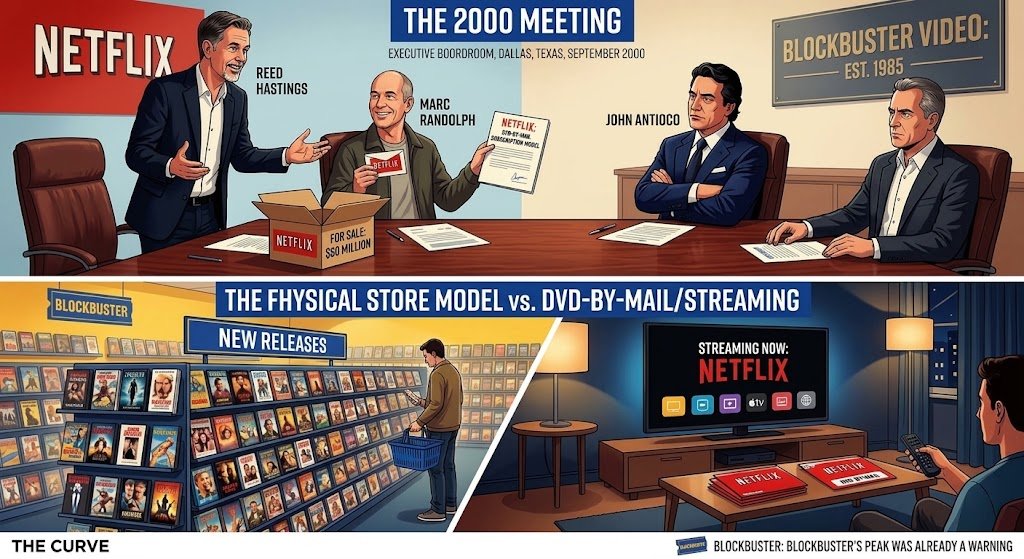
The scene that dominates the Blockbuster legend takes place in Dallas in September 2000. Netflix co-founders Reed Hastings and Marc Randolph, with then-CFO Barry McCarthy, visit Blockbuster’s headquarters and offer to sell their loss-making DVD-by-mail company for $50 million. In Randolph’s memoir, Antioco struggles not to laugh. Hastings later told a similar story.
Antioco’s version differs. He has confirmed that the Netflix team visited and apparently offered to sell, but says there were never serious acquisition talks in 2000. Both accounts are self-interested and neither is documented by a contemporaneous record we have seen.
What can be said is narrower than the legend: a small, unprofitable company proposed a sale at a time when dot-com valuations were collapsing, and Blockbuster did not pursue it. That fact is much weaker evidence of blindness than the story implies. What matters more is what Blockbuster did in the following four years, which is where the evidence gets substantial.
The peak, and the first crack
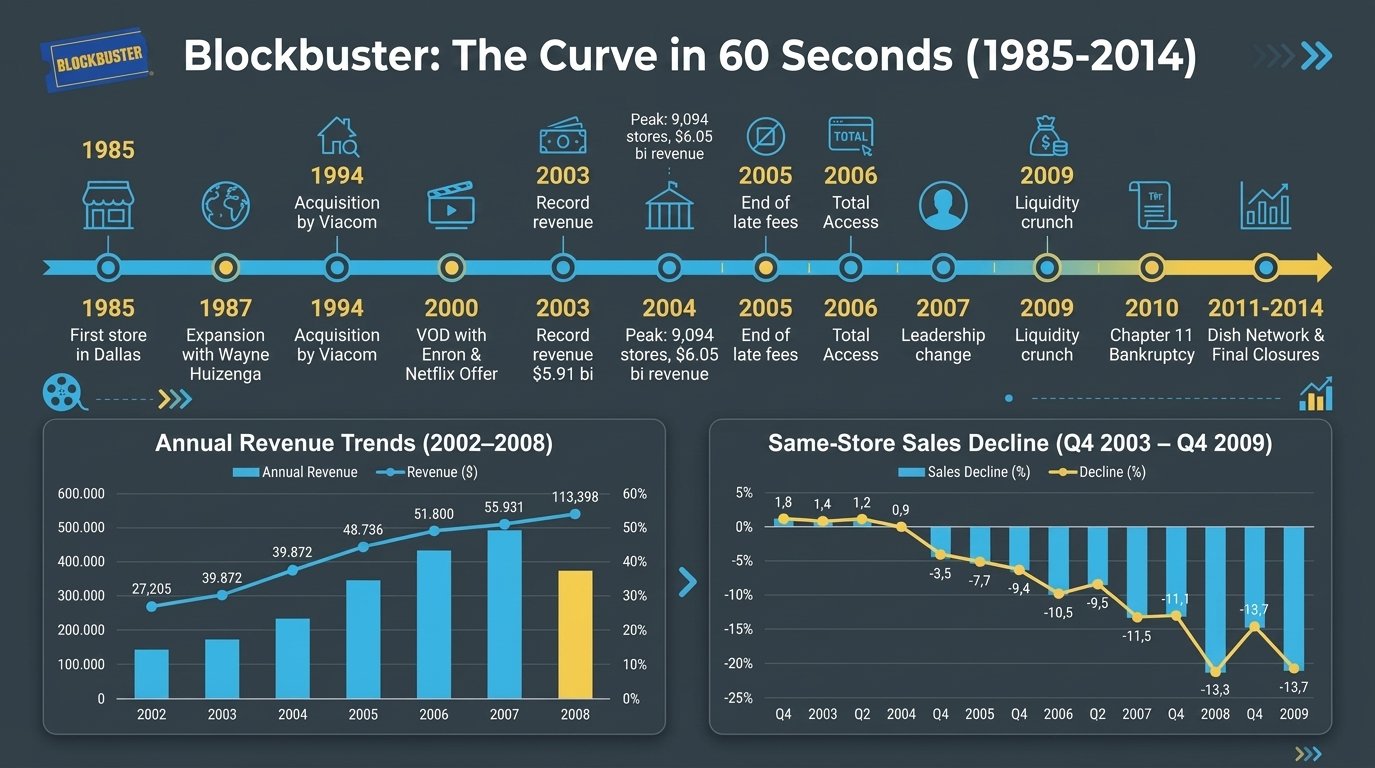
In the company’s own numbers, 2003 was a strong year. Revenue reached a record $5.91 billion, up from $5.57 billion, and management reported free cash flow above $400 million. Yet the same results included a non-cash writedown of $1.3 billion to reduce the carrying value of goodwill and other assets, and same-store revenue, the growth of stores open more than a year, fell 6.8% in the fourth quarter.
That gap, between revenue at record levels and same-store revenue falling, is the crack. In 2004 revenue rose another 2.4% to $6.05 billion, but the company’s own explanations show where the growth came from: more stores, retail sales of games and movies, and favorable currency movements. Worldwide same-store revenue fell 4.4% in the second quarter, and the company blamed weak rental traffic across the industry. Free cash flow for the first nine months of 2004 was $40.2 million, compared with $199.9 million a year earlier. Adjusted operating income fell 38.5% over the same period. For the full year, operating income excluding impairment charges was $256 million, against $460 million in 2003, in figures cited by the Wall Street Journal.
Growth, profit and cash were moving in different directions. Revenue said the company was at its peak. Cash generation said the core was weakening.
The moment: Record revenue in 2004, alongside a 38.5% drop in adjusted operating income over nine months
Three bets in six months
Blockbuster’s response arrived all at once, between August 2004 and January 2005.
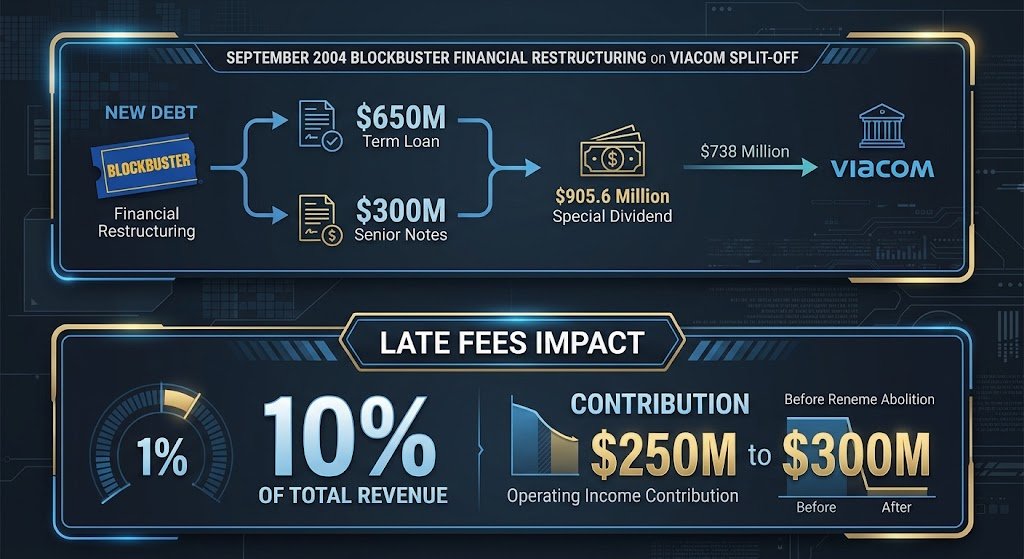
The separation. In its filings, Blockbuster said it believed it could compete effectively as an independent company and that the special dividend would not keep it from executing its plan. A special committee of independent directors backed the payout. The split-off also triggered an accounting adjustment. In the third quarter of 2004 Blockbuster reported a net loss of $1.42 billion, including about $1.5 billion in non-cash charges to write down intangible assets. Its debt and interest expense rose.
The online launch. On August 11, 2004, Blockbuster began renting DVDs by mail, at first for $19.99 a month for up to three discs. The company said it had built a base of more than 750,000 subscribers within seven months. It also said it planned roughly $90 million of extra operating expenses in 2004 for its new growth initiatives.
The end oflate fees. Effective January 1, 2005, Blockbuster stopped charging extended viewing fees at more than 4,500 companyoperated and participating franchise stores in the United States. Canada followed at the end of the month. The company expected to spend about $50 million on the change, mostly on advertising. Its first-quarter 2005 results showed extended viewing fee revenue down $145.3 million from a year earlier, though total revenue still rose 3.0% to $1.55 billion. In the second quarter, revenue fell 1.6% and the company reported a net loss of $57.2 million, against a profit a year earlier. By the fourth quarter, revenue was down 11% to $1.53 billion.
Management argued the policy was working: rental transactions were rising, and active membership grew for the first time in nearly two years. Attorneys general in dozens of states complained that the “no late fees” advertising was misleading, because customers who kept a film past a grace period could be charged its full price; Blockbuster agreed to pay $630,000 to 47 states.
Taken together, the three moves could each be defended on its own terms. Taken together, they meant that within about five months the company had loaded itself with nearly $950 million of new debt, started a new business that lost money as it grew, and given up a fee that had contributed a major share of profit. Whether the sequencing was avoidable is a fair question. The evidence does not settle it.
The decision: Abolishing late fees. Blockbuster’s own projection: $250 million to $300 million in lost 2005 operating income.
The boardroom. The activist investor Carl Icahn bought about 10 million Blockbuster shares in 2004. In May 2005 he won a proxy fight, a contest for shareholder votes, and took a board seat along with two allies. Icahn accused Antioco of overpaying himself and of gambling with shareholders’ money on the online strategy, and reportedly wanted a sale to a private equity firm.
The fight sharpened when Blockbuster launched Total Access in November 2006. Customers who rented online could return a disc to a store and pick up a new rental free. The company reported 2.2 million Total Access subscribers by the end of 2006 and passed 3 million in the first quarter of 2007, its strongest quarter of subscriber growth. But launch costs were higher than expected, and the first quarter of 2007 ended in a net loss of $46.4 million.
The dispute overAntioco’s pay came to a head at the same time. In March 2007 the board and Antioco agreed that he would leave by year-end. His 2006 bonus was set at about $3.05 million, between the $2.28 million the board had offered and the $7.65 million he said his contract entitled him to. On July 2, 2007, Blockbuster named James Keyes, the former chief executive of 7-Eleven, as its new chairman and chief executive.
Afterwards, the two men wrote competing accounts in Harvard Business Review. Icahn said Antioco’s pay was the “nail in the coffin” and said the board was not unhappy to see him go, though he also praised Total Access. Antioco wrote that Icahn’s board appointees wanted Blockbuster to sell greeting cards and adult movies and to hire Barnes & Noble to run a book section. Both accounts come from interested parties. What is documented is the outcome: the company that had funded an online push through 2004 to 2006 replaced its architect in 2007.
The inflection point: July 2007. The executive behind the online strategy left, and the direction changed.
The retreat
Keyes reversed course on the mail program. By the third quarter of 2007, Blockbuster’s online subscribers had fallen from 3.6 million to 3.1 million over the summer. Keyes said many of them had been costing more than they were worth. Revenue in that quarter fell 5% to $1.24 billion and the company lost $37.8 million. (Around 300,000 of the departing subscribers were on free trials.) Keyes pursued a wider retail and digital diversification. In August 2007 Blockbuster bought the film-download service Movielink for $6.6 million; the auditor PricewaterhouseCoopers had already raised going-concern doubt about the unit, citing an accumulated deficit of roughly $145 million. In February 2008 Blockbuster proposed a takeover of the electronics retailer Circuit City. It withdrew the offer in July after due diligence. Circuit City filed for bankruptcy in November 2008. Analysts had viewed the proposal as an effort to rescue two struggling retailers rather than a turnaround plan.
The numbers for 2008 were not simply grim. Revenue fell to $5.29 billion from $5.54 billion (the earlier year had 53 weeks), but adjusted EBITDA, a measure of operating earnings, rose 77.3% to $319.1 million. Domestic same-store sales grew 6.4%, and rental and retail same-store revenue both rose for the first time in eight years. A non-cash impairment charge of $435 million produced a net loss of $374.1 million. The annual report filed in April 2009 also carried a warning that mattered more: the revolving credit facility and a term loan were due to expire on August 20, 2009, and the auditors and management acknowledged substantial doubt that the company could continue as a going concern if the refinancing failed.
The liquidity trap
Refinancing closed on May 11, 2009. But in the months when it was in doubt, Blockbuster preserved cash. In the second quarter, the company said it had more than 25% lower unit availability, meaning fewer copies of films on shelves, and about 20% lower advertising spending. Revenue for the quarter was $1.02 billion, against $1.30 billion a year earlier. In the third quarter, revenue fell 21% to $910.5 million, with same-store sales down 14%, which the company attributed partly to a “temporary shift in focus” to managing the business for liquidity and partly to the economy.
Then came the holiday season, historically responsible for as much as 30% of annual EBITDA. Blockbuster raised inventory and
advertising to win customers back. Results still came in well below expectations. Fourth-quarter revenue fell to $1.08 billion from $1.31 billion, with same-store sales down 14.7%. For the full year 2009 the company reported a net loss of more than $550 million.
Competition had by then moved on. In October 2010, Time reported that Redbox had 24,000 rental kiosks, more than three times
Blockbuster’s 6,630 DVD dispensers. Redbox charged $1 a rental; Blockbuster’s stores charged three to five times that for new releases.
In March 2010 the auditor’s report on the 2009 accounts raised substantial doubt about Blockbuster’s ability to continue. The company said it was negotiating with the major studios on the terms under which they supplied discs, and warned that a tightening of studio credit terms could push it into bankruptcy. Debt stood at roughly $975 million. Icahn resigned from the board and sold nearly all of his stake in earlyApril. The New York Stock Exchange delisted the shares on July 1 after shareholders rejected a reverse split. Blockbuster missed a $42.4 million interest payment in August and, on September 23, filed for Chapter 11 with about 3,300 stores still open.
The company’s chief restructuring officer, Jeffrey Stegenga, told the bankruptcy court that revenue had been hurt by five forces: more competition, technology change, changing consumer preferences, the rise of disruptive competitors and the economy. A law-school case study of the filing adds a sixth: a heavy debt load taken on when revenues were much higher.
Keyes later offered a different diagnosis. Speaking to Management Today, he blamed media coverage that turned a debt problem into a panic. “When spin gets out there, it can create a run on the bank,” he said, as reported by Fortune. His point has some support: a third of Blockbuster’s roughly $1 billion of debt needed refinancing in 2009, and Moody’s had warned after the Lehman collapse that uncertainty had raised the probability of default. But the going-concern doubts that appear in the company’s own annual report were dated April 2009, a year before the headlines he describes.
What was left
Dish Network won the bankruptcy auction on April 6, 2011, paying $320 million and assuming about $87 million of liabilities. It planned at first to keep hundreds of stores open, and later launched a streaming and mail service under the brand, then abandoned the Netflixcompetitor idea in October 2012. Between November 2013 and January 12, 2014, Dish closed the remaining 300 company-owned stores in the United States. Blockbuster UK went through administration twice in 2013 and closed its last stores in December of that year.
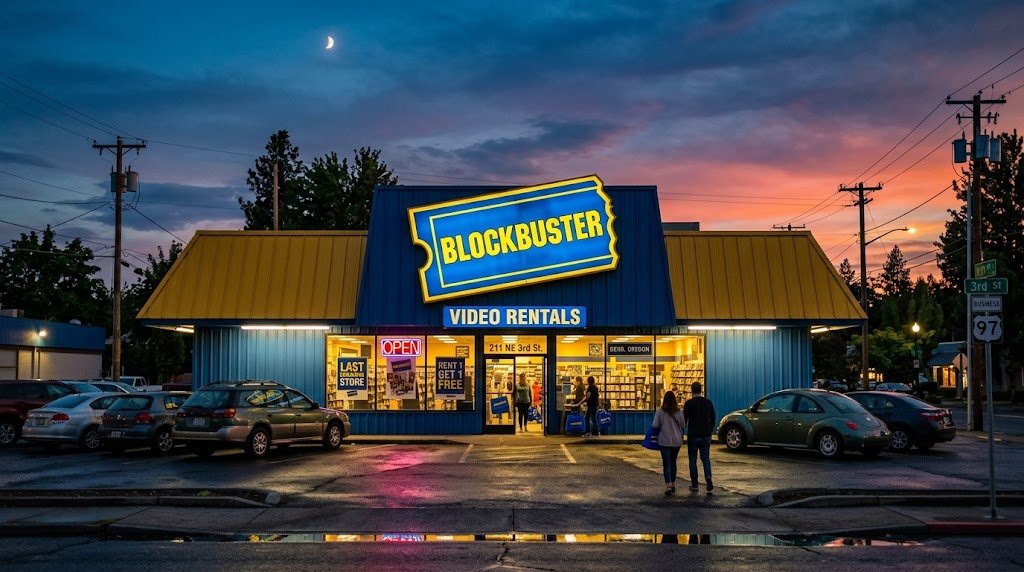
The name survives on a single franchised store in Bend, Oregon. Ken and Debbie Tisher opened it as Pacific Video in 1990 and
converted it to a Blockbuster franchise in 2000. Recent reporting shows it still open, staffed by a dozen people, selling more T-shirts than rentals, and running on decades-old software. It outlasted the company that licensed the name by more than a decade.
THE CURVE IN 60 SECONDS
– 1985: David Cook opens the first Blockbuster in Dallas.
– 1987: Wayne Huizenga’s investor group takes control; rapid store roll-out and acquisitions begin.
– 1994: Viacom buys Blockbuster in a stock deal reported at $7.6 billion to $8.4 billion.
– 1997: John Antioco becomes CEO and renegotiates studio supply deals.
– 1999: Viacom floats a minority stake.
– 2000: Blockbuster signs a video-on-demand deal with Enron (ended March 2001); Netflix visits Dallas, accounts of the meeting
conflict.
– 2003: Record revenue of $5.91 billion, but same-store revenue is falling and a $1.3 billion writedown is taken.
– 2004: Peak: 9,094 stores, $6.05 billion revenue. Blockbuster borrows about $950 million to pay a $905.6 million dividend,
separates from Viacom, launches online rental.
– 2005: Late fees abolished on January 1. Revenue slips; Carl Icahn wins board seats.
– 2006: Total Access launches in November.
– 2007: Antioco is out; James Keyes takes over and pulls back on online rental.
– 2008: Circuit City bid withdrawn; same-store sales improve, but going-concern doubt appears in the annual report.
– 2009: Liquidity squeeze, thinner shelves, revenue drops sharply.
– 2010: Chapter 11 on September 23.
– 2011: Dish buys the assets for $320 million.
– 2014: Last company-owned stores close. One franchise remains.
THE POSTMORTEM
What created growth. A repeatable format (many copies of new hits, database-driven inventory, fast openings), an acquisition-led rollout under Huizenga, and Viacom’s backing.
What sustained the peak. Studio supply deals negotiated from 1997, and a fee structure in which late fees contributed roughly a tenth of revenue and a much larger share of profit. DVD sell-through pricing lowered costs, though it also opened the market to retailers with lower prices.
Where the vulnerability first appeared. In the rental base, by late 2003. Same-store revenue was falling while total revenue kept rising through store openings, retail sales and currency. Cash generation fell sharply in 2004.
What changed the trajectory. Two things, and they overlap. The 2004 to 2005 package of debt-funded separation, online launch and end of late fees changed the company’s cost and risk profile all at once. The 2007 leadership change, after a bruising governance dispute, then reversed the online strategy midstream. The terminal phase began with the 2009 liquidity squeeze, when cash preservation and thinner inventory coincided with a sharp fall in sales.
Internalfactors. The dividend and debt structure; the timing and sequence of the three 2004 to 2005 moves; the governance conflict
and the stop-start strategy it produced; the choices to pursue Movielink and Circuit City.
Externalfactors. DVD sell-through pricing and mass-market retailers; Netflix and, later, Redbox; the shift to digital delivery; the 2008 financial crisis and credit tightening.
Controllable. Capital structure, pricing policy, the pace and sequencing of initiatives, board composition and pay disputes.
Largely not controllable. Studio pricing policy, the pace of consumer adoption of new channels, credit-market conditions after 2008.
LESSONS FROM THE CURVE
- Do not read a record as a peak of health. In 2004 Blockbuster’s revenue was at its highest, but same-store revenue and cash generation were already weakening. Growth, profit and cash can move apart.
- A profit built on customer penalties is a strategic dependency. Late fees made up roughly a tenth of revenue and a larger share of profit. Giving them up was expensive by the company’s own estimate, and it was also what customers disliked.
- Sequencing matters as much as direction. A debt-funded dividend, a new business and the loss of a major fee arrived within about five months. Each was defensible. Together they left little slack.
- Governance is part of strategy. A stop-start online strategy was built into the 2005 to 2007 boardroom conflict. It is hard to test an expensive plan when its sponsor is fighting for his job.
- Liquidity can become the business. In 2009 Blockbuster reduced inventory and advertising to protect cash, and sales fell sharply. Supplier credit terms and refinancing dates can set the pace of decline.
- Be careful with the single-scene story. The Netflix meeting is vivid and disputed. The documented record points to a longer, less cinematic decline.
SOURCES
Primary (SEC filings and company releases)
Blockbuster Inc., Form 10-K for fiscal 2004: https://www.sec.gov/Archives/edgar/data/1085734/000119312505063510/d10k.htm
Blockbuster press release, Feb. 10, 2004 (FY2003 results):
https://www.sec.gov/Archives/edgar/data/0001085734/000119312504017674/dex991.htm
Blockbuster/Viacom joint release on split-off terms, June 18, 2004:
https://www.sec.gov/Archives/edgar/data/1085734/000119312504105055/dex991.htm
Blockbuster Form 424B3 (special distribution details), 2004:
https://www.sec.gov/Archives/edgar/data/0001085734/000119312504154129/d424b3.htm
Blockbuster Form S-4 (late-fee elimination, sell-through pricing), 2005:
https://www.sec.gov/Archives/edgar/data/0001085734/000119312505017516/ds4.htm
Blockbuster Q1 2005 earnings release: https://www.sec.gov/Archives/edgar/data/0001085734/000119312505096553/dex991.htm
Blockbuster Q2 2005 earnings release: https://www.sec.gov/Archives/edgar/data/1085734/000119312505161643/dex991.htm
Blockbuster proxy materials (DEFA14A) containing WSJ profile, 2005:
https://www.sec.gov/Archives/edgar/data/0001085734/000119312505078619/ddefa14a.htm
Blockbuster 8-K on Antioco agreement, March 2007:
https://www.sec.gov/Archives/edgar/data/0001085734/000119312507058743/d8k.htm
Blockbuster 8-K on Keyes appointment, July 2007:
https://www.sec.gov/Archives/edgar/data/0001085734/000119312507147799/dex991.htm
Blockbuster FY2008 results release, March 2009:
https://www.franchising.com/news/20090320_blockbuster_reports_fourth_quarter_and_fiscalyear_.html
Blockbuster Form 10-K for fiscal 2008: https://www.sec.gov/Archives/edgar/data/0001085734/000119312509073613/d10k.htm
Blockbuster Q2 2009 and Q3 2009 releases:
https://www.sec.gov/Archives/edgar/data/0001085734/000119312509174422/dex991.htm and
https://www.sec.gov/Archives/edgar/data/0001085734/000119312509232831/dex991.htm
Blockbuster 2009 adjusted EBITDA outlook release, January 2010: https://www.prnewswire.com/news-releases/blockbusterprovides-2009-full-year-adjusted-ebitda-outlook-82198402.html
Press and analysis
Time, “How Blockbuster Failed at Failing” (Oct. 2010): https://time.com/archive/6597696/how-blockbuster-failed-at-failing/
TechCrunch, Blockbuster files for bankruptcy (Sept. 23, 2010): https://techcrunch.com/2010/09/23/blockbuster-goes-bust/amp/
NBC News/AP, Blockbuster Q3 2007 results: https://www.nbcnews.com/news/amp/wbna21586579
NBC News/AP, Q3 2004 results and split-off charges: https://www.nbcnews.com/news/amp/wbna6347155
Deseret News/AP, Antioco to leave (March 2007): https://www.deseret.com/2007/3/21/20008353/blockbuster-ceo-to-leave-withsettlement/
Home Media Magazine on the Icahn and Antioco HBR essays: https://www.homemediamagazine.com/blockbuster/icahn-antiocoopine-blockbuster-fall-23394
Fortune, Keyes on why Netflix did not kill Blockbuster (March 2024): https://fortune.com/2024/03/08/netflix-did-not-killblockbuster-former-ceo-james-keyes
Newsweek, fact check on the $50 million Netflix offer: https://www.newsweek.com/fact-check-did-blockbuster-turn-downchance-buy-netflix-50-million-1575557
Marc Randolph, That Will Never Work (2019), via Yahoo/The Independent: https://sports.yahoo.com/blockbuster-ceo-strugglednot-laugh-191553438.html
History.com, “First Blockbuster store opens”: https://www.history.com/this-day-in-history/october-19/first-blockbuster-storeopens
Encyclopedia.com, Blockbuster Entertainment Group: https://www.encyclopedia.com/economics/economicsmagazines/blockbuster-entertainment-group
University of Tennessee case study of the Blockbuster Chapter 11: https://ir.law.utk.edu/cgi/viewcontent.cgi?
article=1010&context=utk_studlawbankruptcy
Bend Blockbuster (About page): https://bendblockbuster.com/about/
ABC10 Bartell’s Backroads on the Bend store (Aug. 2025):
https://www.abc10.com/article/entertainment/television/programs/backroads/last-blockbuster-bend-oregon-bartellsbackroads/103-edbf2e25-1d88-48ae-820f-3bcaee355ae4
Wikipedia, “Blockbuster (retailer)”, used as a pointer to further sources (see editor’s notes):
https://en.wikipedia.org/wiki/Blockbuster_(retailer)