
Amazon — The Company That Turned Scale Into a Business Model
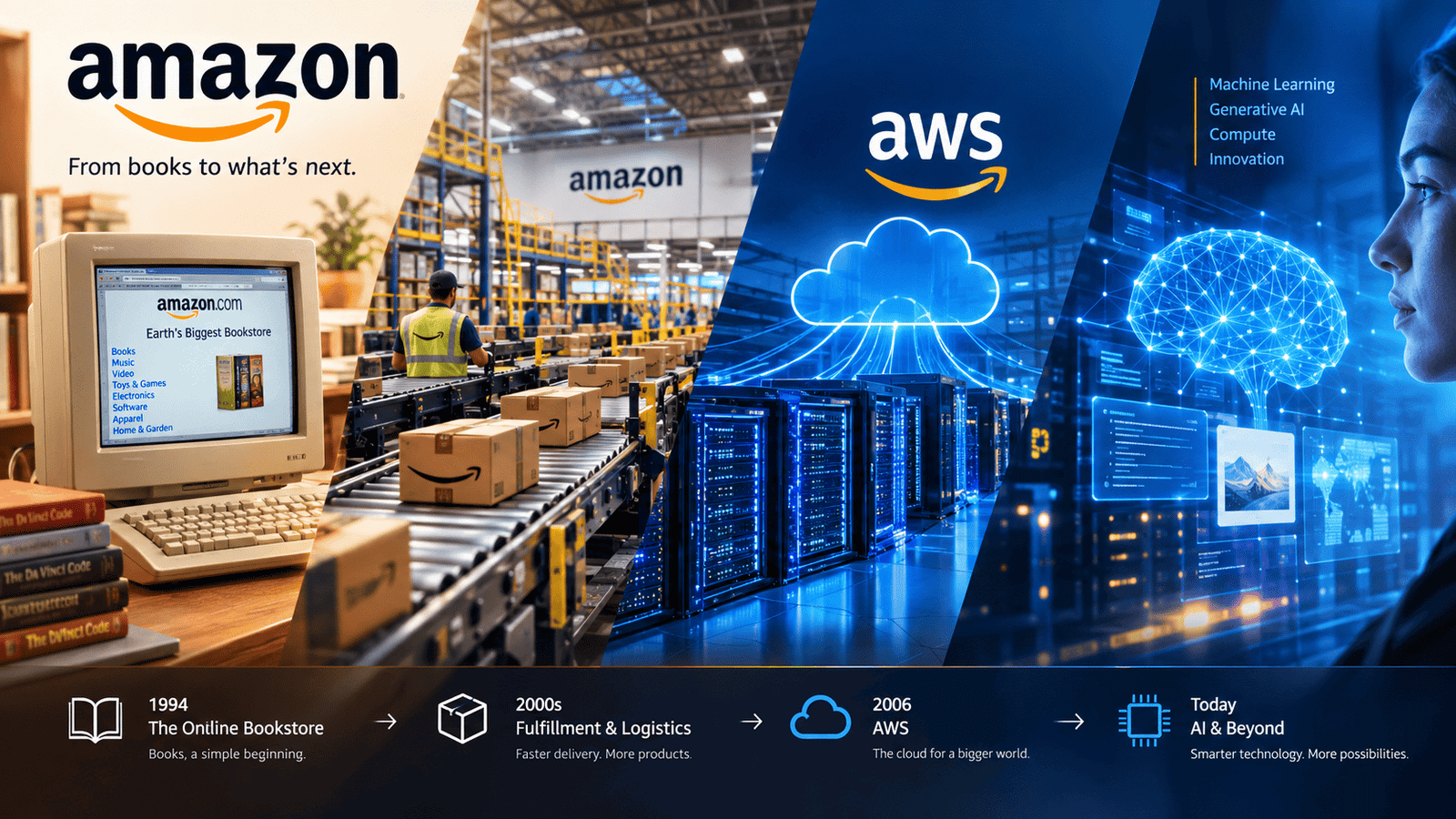
Amazon is often described as the company that changed retail. That description is accurate, but incomplete. Amazon did not become one of the world’s most consequential companies simply by moving shopping from physical stores to the internet. Its deeper achievement was building a business in which every new layer of scale could strengthen the next one: more customers attracted more sellers; more sellers expanded selection; greater selection attracted more customers; greater volume justified larger logistics investments; those logistics capabilities made Prime more valuable; the technology built to operate the marketplace became infrastructure that could be sold to other companies; and the resulting infrastructure eventually became one of the foundations of the modern internet.
That architecture explains why Amazon’s history cannot be understood as a straight-line e-commerce success story. The company repeatedly changed what it was. It began as an online bookstore, became a broad internet retailer, built a marketplace around third-party sellers, turned logistics into a competitive weapon, created a subscription ecosystem through Prime, entered digital media and devices, and then transformed internal technological infrastructure into Amazon Web Services. Later, advertising, physical retail, entertainment, artificial intelligence and custom computing hardware became additional layers of the same system.
The remarkable part is that the strategy was visible unusually early. In Amazon’s 1997 shareholder letter, when the company had only recently become public, Jeff Bezos described the internet as being at “Day 1” and explicitly argued that Amazon would prioritize long-term market leadership and customer growth over short-term profitability. At the end of 1997, Amazon had served more than 1.5 million customers and generated $147.8 million in revenue—an extraordinary 838% increase from the previous year.
The company that eventually emerged was therefore not simply a retailer that happened to become large. It was a company designed around the compounding effects of scale.
The beginning: choosing books because the internet made the impossible practical
Jeff Bezos founded Amazon in 1994 after recognizing that the rapidly expanding World Wide Web created a distribution medium unlike anything traditional retail had possessed. The initial idea was not “build the world’s largest company.” It was considerably narrower: use the internet to sell books.
That choice mattered because books had an unusual characteristic. A physical bookstore could display only a limited selection because shelf space was scarce. An online bookstore did not face the same physical constraint. Amazon could therefore offer a catalog vastly larger than any conventional store while allowing customers to search, compare and order titles without physically visiting a location.
Amazon opened as an online bookseller in July 1995, operating from Bezos’s Bellevue, Washington home. The company’s name reflected the ambition. The Amazon River suggested enormous scale, and Amazon wanted its bookstore to feel similarly expansive. Contemporary company material described its catalog as containing more than a million titles—an advantage that physical bookstores could not easily reproduce.
The early Amazon experience also established a pattern that would define the company for decades: remove friction. Search was central. Reviews mattered. Recommendations mattered. Price mattered. Convenience mattered. The website was open around the clock. Instead of forcing the customer to adapt to the limitations of a store, Amazon attempted to redesign the store around the customer.
That sounds obvious now because much of modern e-commerce works this way. In the mid-1990s it was not obvious at all.
Amazon was not merely digitizing a catalog. It was experimenting with what retail could become when inventory, information and customer interaction were mediated by software.
By 1997, the company was already introducing features that would later become ordinary components of digital commerce, including personalized recommendations, customer reviews and one-click purchasing. It was also deliberately lowering prices and expanding selection.
The critical insight was that convenience was not one feature. It was a system.
The first great test: surviving the dot-com collapse
Amazon went public in May 1997, at a time when internet businesses were beginning to attract enormous investor attention. The market would soon become intoxicated with the possibilities of the web, and Amazon would become one of the most recognizable symbols of that optimism.
But the optimism eventually collapsed.
The dot-com crash created a brutal test for internet companies. Many businesses that had been valued on future promises rather than durable economics disappeared. Amazon survived, but survival should not be mistaken for inevitability.
The company entered the new century carrying substantial ambitions, heavy investment requirements and persistent losses. Its revenue grew rapidly—from $1.64 billion in 1999 to $2.76 billion in 2000 and $3.12 billion in 2001—but the economics of internet retail were still being built.
This was one of the most important periods in Amazon’s history because the company had to demonstrate that growth could eventually become a defensible business system rather than an expensive pursuit of market share.
The popular version of Amazon’s history sometimes portrays Bezos as having possessed a perfectly formed master plan from the beginning. The evidence supports something more interesting. The company had a consistent philosophy, but it discovered the full economic structure through experimentation.
Bezos repeatedly pushed Amazon toward businesses that increased customer value and strengthened the platform. Some experiments failed. Others became foundations.
The important distinction was not whether every experiment worked.
It was whether the company could keep the successful ones and build new layers on top of them.
The marketplace changed what Amazon was
One of those layers was the third-party marketplace.
Initially, Amazon primarily sold products itself. But allowing outside merchants to sell through Amazon fundamentally changed the economics of the platform. Instead of Amazon having to purchase and hold every product it wanted to offer, independent sellers could expand the catalog themselves.
The result was a powerful feedback loop.
More sellers meant more selection. More selection made Amazon more attractive to customers.
More customers made Amazon more attractive to sellers. The marketplace could therefore grow faster than a conventional retailer whose inventory expansion depended entirely on its own purchasing and capital commitments.
Amazon’s filings from the mid-2000s show the growing importance of third-party sellers across its various marketplace programs.
This was a crucial strategic transition because Amazon was no longer simply a retailer.
It was becoming infrastructure for retail.
That distinction would eventually become the central theme of the entire company.
Prime: turning transactions into a relationship
In February 2005, Amazon introduced Prime.
At launch, the proposition was remarkably simple: customers paid $79 per year and received unlimited two-day shipping on eligible products, with no minimum order requirement.
The significance of Prime was much larger than free shipping.
Traditional retail had largely treated each purchase as a transaction. Prime began shifting Amazon toward a relationship.
Once a customer had already paid for membership, the psychological and economic calculation changed. Ordering another product became easier because the customer had already committed to the ecosystem. The more frequently the customer used Amazon, the more valuable the membership became. The more valuable Prime became, the more products Amazon could add to the ecosystem. And the greater the order volume, the more economically rational it became to build increasingly sophisticated fulfillment infrastructure.
Amazon was therefore creating a loop:
membership → more purchases → greater volume → better logistics → greater
convenience → stronger membership value.
Prime also helped transform delivery speed into part of Amazon’s product.
Amazon was no longer competing only on what it sold. It was competing on how quickly and easily the customer could obtain it.
That was a much harder advantage for competitors to reproduce.
The hidden transformation: Amazon builds a technology company inside a retailer
The most consequential transformation in Amazon’s history, however, happened behind the storefront.
Amazon had been forced to become exceptionally good at operating enormous technological infrastructure because its own business depended on it. Websites, databases, storage, computing capacity, payments, logistics systems and recommendation engines all had to work at massive scale.
Eventually Amazon realized that the infrastructure it had built for itself could become a product.
That insight produced Amazon Web Services.
In March 2006, Amazon launched S3, its Simple Storage Service, allowing developers to store data using Amazon’s infrastructure. Later that year came EC2, providing scalable computing capacity.
This was a profound strategic shift.
Amazon was taking a capability created to solve its own internal problem and turning it into an external business.
The underlying logic was familiar: Amazon could invest in enormous infrastructure because its own retail operation required it. Once that infrastructure became a service, other companies could rent the same capabilities without building their own data centers.
The consequence was larger than Amazon initially appeared to understand.
AWS helped change the economics of starting and scaling technology companies. Instead of purchasing large amounts of computing hardware before knowing whether a product would succeed, developers could rent capacity and scale it according to demand.
Amazon had begun as a company using the internet to sell books.
Now it was selling the infrastructure on which other companies could build their own businesses.
That is the point at which Amazon’s curve became fundamentally different from that of a conventional retailer.
Kindle and the expansion from commerce into ecosystems
Amazon also moved aggressively into digital content.
The Kindle, launched in November 2007 after more than three years of development, was not merely an electronic book reader. It combined hardware, software, wireless connectivity and Amazon’s digital bookstore into one customer experience. The original Kindle offered access to more than 110,000 books and allowed customers to download purchases directly to the device.
The strategic importance of Kindle was that Amazon was no longer simply selling books.
It was redesigning the relationship between the customer, the book and the store.
The company later expanded that logic through Kindle Direct Publishing, allowing independent authors to publish digitally through Amazon’s ecosystem. KDP launched alongside the first Kindle in 2007.
Again, the pattern repeated: Amazon created a system in which different participants could reinforce one another.
Readers created demand.
Authors created supply.
Amazon controlled the marketplace connecting them.
The company was increasingly becoming a platform rather than a retailer.
The Bezos era reaches its apex
During the 2010s, the cumulative effects of these decisions became visible.
Amazon’s revenue rose from $88.99 billion in 2014 to $232.89 billion in 2018. Operating income, meanwhile, increased from just $178 million in 2014 to $12.42 billion in 2018.
The numbers are revealing because they show how different the business had become.
In 2014, Amazon could generate almost $89 billion in sales while reporting only $178 million in operating income. Four years later, revenue had more than doubled while operating income had expanded dramatically.
The company was finally demonstrating that enormous scale could produce substantial operating leverage.
AWS was central to that transformation.
The cloud business had become an economic engine capable of generating high-margin revenue while Amazon’s retail operation continued to absorb enormous investments in fulfillment, technology and logistics.
At the same time, Amazon expanded physically.
In 2017, it announced the acquisition of Whole Foods for approximately $13.7 billion, including debt.
The acquisition was strategically important because it demonstrated that Amazon did not view physical retail as obsolete. Instead, it was attempting to combine physical stores with digital commerce, logistics, data and membership.
Amazon’s curve was no longer about replacing the physical economy with the digital economy.
It was about connecting them.
The company becomes a system
By the end of the 2010s, Amazon’s identity had become difficult to summarize in a single industry.
It operated an enormous online marketplace.
It sold its own products.
It hosted millions of third-party sellers.
It ran a global fulfillment network.
It offered Prime subscriptions.
It operated AWS.
It sold Kindle and Echo devices.
It operated streaming and digital entertainment businesses.
It generated advertising revenue.
It owned Whole Foods.
It was developing voice computing, artificial intelligence and machine-learning capabilities.
The individual businesses mattered, but the deeper competitive advantage came from their interaction.
A customer could discover a product through Amazon’s search system, purchase it through the marketplace, receive it through Amazon’s logistics network, use Prime benefits to reduce friction, watch related entertainment through Amazon’s media services, interact with Alexa through an Amazon device, and generate data that could improve the broader ecosystem.
This was not one business.
It was a connected economic system.
That system explains why Amazon was able to keep expanding without abandoning its original customer-centric logic.
COVID-19 accelerated the curve—and exposed its cost
The pandemic produced one of the largest accelerations in Amazon’s history.
As physical commerce was disrupted and millions of consumers moved more activity online,
Amazon’s sales surged. Revenue increased from $280.5 billion in 2019 to $386.1 billion in 2020 and then to $469.8 billion in 2021.
But extraordinary demand created extraordinary costs.
Amazon expanded fulfillment capacity, transportation, technology infrastructure and its workforce. The company emerged from the pandemic substantially larger, but also less efficient in the short term.
The post-pandemic normalization therefore became an important test.
In 2022, Amazon’s consolidated operating income fell to $12.2 billion from $24.9 billion in 2021.
North America posted a $2.8 billion operating loss, while international operations lost $7.7 billion. AWS remained highly profitable, generating $22.8 billion in operating income.
This was not the collapse of Amazon. It was something more revealing: evidence that scale itself could become a burden if the organization expanded faster than the underlying demand required.
The company responded by restructuring its cost base, improving fulfillment efficiency and becoming more selective about investment.
The result was striking.
In 2023, revenue reached $574.8 billion and operating income jumped to $36.9 billion. North America returned to a $14.9 billion operating profit, while AWS generated $24.6 billion in operating income.
Amazon had demonstrated another important characteristic of its model: the ability to use enormous scale not only to expand, but also to absorb and correct inefficiency.
The transition from Bezos to Jassy
In July 2021, Jeff Bezos stepped down as CEO and Andy Jassy became chief executive. Jassy was not an outsider. He had led AWS, the business that perhaps best represented Amazon’s transformation from retailer into technology infrastructure company.
That transition mattered symbolically.
Bezos had built Amazon around long-term experimentation, aggressive investment and customer obsession.
Jassy inherited a company that was already a vast ecosystem and had to make that system more efficient while continuing to invent.
The challenge was no longer simply discovering new businesses.
It was managing complexity without allowing complexity to destroy speed.
That became particularly important as Amazon entered its next major technological transition.
Amazon and the AI era
Artificial intelligence represents a new test for Amazon because it touches nearly every layer of the company.
AWS provides computing infrastructure and AI services to external customers. Amazon uses machine learning throughout search, recommendations, logistics, advertising and retail operations. Its devices and digital services depend increasingly on AI. And the company has invested heavily in its own chips, including Graviton and Trainium, while expanding its generative-AI infrastructure.
By 2025, Amazon generated $716.9 billion in consolidated revenue, including $128.7 billion from AWS. Operating income reached $80.0 billion, compared with $68.6 billion in 2024 and $36.9 billion in 2023.
The scale is extraordinary, but the more important figure is the structure beneath it.
AWS represented about $129 billion of revenue in 2025, while Amazon’s North American business generated $426.3 billion and its international business $161.9 billion.
At the same time, Amazon is making enormous capital investments in AI infrastructure. In 2025, capital spending contributed to a sharp decline in free cash flow, even as revenue and operating income increased. Amazon reported more than $50 billion of year-over-year growth in property and equipment purchases.
This is familiar territory for Amazon.
The company has repeatedly accepted substantial current investment in pursuit of future scale.
But AI is different from earlier expansions because the competitive landscape is moving extraordinarily quickly. Amazon is not merely trying to make its retail business more intelligent.
Through AWS, it is competing to provide the infrastructure and services on which other companies will build their AI businesses.
The same strategic pattern that created AWS is appearing again.
Amazon builds capabilities for itself.
Then it attempts to turn those capabilities into infrastructure for others.
The real curve of Amazon
Amazon’s history is often told as a story about relentless growth. The deeper story is about repeatedly converting scale into infrastructure, and infrastructure into new forms of scale.
The bookstore created customer traffic.
Customer traffic created marketplace power.
Marketplace power justified logistics investment.
Logistics created Prime.
Prime increased customer frequency.
Customer volume justified more infrastructure.
Internal infrastructure became AWS.
AWS created a new high-margin business.
The ecosystem created additional opportunities in advertising, devices, media, physical retail and artificial intelligence.
Each layer made the next layer possible.
That is why Amazon is difficult to compare with the companies that once dominated traditional retail. Walmart could build enormous stores. FedEx could build enormous logistics capabilities.
Microsoft could build enormous software platforms. Google could build enormous advertising infrastructure.
Amazon increasingly combined elements of all of these economic models inside a single organization.
Its greatest invention was therefore not the online bookstore.
It was the architecture that allowed one business to continually generate the raw material for another.
That architecture also explains Amazon’s greatest vulnerability.
A system this large can become extraordinarily difficult to manage. Every new business adds complexity. Every infrastructure investment creates fixed costs. Every expansion creates operational dependencies. The company must continuously decide which opportunities deserve enormous capital commitments and which should be abandoned.
Amazon’s own history demonstrates that scale does not automatically create efficiency.
Scale creates the possibility of efficiency.
Management still has to capture it.
Amazon’s story is not finished
The most interesting question about Amazon is therefore not whether it will continue to grow.
It is whether the company can preserve the mechanism that produced its growth while the technological environment changes underneath it.
The Amazon of 1995 competed with bookstores.
The Amazon of 2005 competed with retailers.
The Amazon of 2015 competed simultaneously in retail, cloud computing, digital media and logistics.
The Amazon of 2025 operates across commerce, infrastructure, advertising, entertainment, devices, logistics, physical stores and artificial intelligence.
The strategic center has moved repeatedly without the company abandoning its underlying philosophy.
That is the real curve.
Amazon survived the collapse of the dot-com economy because it was building something more durable than internet enthusiasm. It survived the transition from books to general merchandise because its real asset was not inventory but customer behavior and infrastructure. It turned an internal technology problem into AWS. It turned shipping into Prime. It turned third-party sellers into an enormous marketplace. And now it is attempting to turn its infrastructure, chips and computing capabilities into a foundation for the AI economy.
Amazon’s greatest competitive advantage has never been simply that it is large.
It is that the company has repeatedly found ways to make its existing scale useful in building the next business.
The central question of its next chapter is whether that mechanism can work again.
THE CURVE IN 60 SECONDS
- 1994–1997 – Online bookselling – Amazon exploits the internet’s virtually unlimited digital shelf space.
- 1997–2001 – Internet commerce – Rapid growth, IPO and aggressive expansion test the company during the dot-com crash.
- 2000–2005 – Marketplace + retail – Third-party sellers broaden selection and transform Amazon into a platform.
- 2005–2010 – Prime + digital – Subscription, logistics, Kindle and digital content deepen customer relationships.
- 2006 – onward AWS – Internal technology infrastructure becomes a global cloud business.
- 2010–2019 – Ecosystem – Retail, cloud, logistics, devices, media and advertising reinforce one another.
- 2020–2022 – Hyper-scale – Pandemic demand accelerates growth but exposes fulfillment and cost inefficiencies.
- 2023–2025 – Efficiency + AI – Amazon restores profitability while dramatically increasing investment in AI infrastructure.
- Next phase – AI infrastructure + ecosystem – The company attempts to make its next technological platform as consequential as its cloud platform.
THE POSTMORTEM
What created the growth?
Amazon combined enormous selection, low prices, convenience, software-driven personalization and increasingly sophisticated logistics. The company systematically reduced friction between customer intention and completed purchase.
What sustained the peak?
The key was not retail dominance alone. Amazon created multiple reinforcing businesses: marketplace, Prime, fulfillment, AWS, advertising, digital content and devices. This diversified the company’s economic engine.
Where did vulnerability appear?
The same scale that created advantages also created complexity and fixed costs. The pandemic demonstrated this clearly: Amazon’s infrastructure expanded rapidly, and the company later had to correct excess capacity and inefficiencies.
What changed the trajectory?
The most important changes were structural rather than cosmetic: marketplace expansion, Prime, AWS, logistics integration and the transformation from retailer into platform.
Internal vs. external
Internal: Amazon’s willingness to invest ahead of demand, its operating culture, technological capabilities and capital allocation.
External: the rise of the internet, the dot-com crash, broadband adoption, cloud computing, the smartphone era, COVID-19 and the emergence of generative AI.
Controllable vs. uncontrollable
Amazon could control its investment decisions, product development, logistics architecture and organizational response. It could not control the timing of technological transitions or macroeconomic shocks.
What remains uncertain?
The AI transition is still unfolding. Amazon enters it with extraordinary infrastructure and AWS scale, but the economics of AI computing, model development and enterprise adoption remain highly competitive and capital-intensive. Amazon’s 2025 results show both sides of the equation: record scale and profitability alongside exceptionally large infrastructure investment.
LESSONS FROM THE CURVE
1. A business model can be more valuable than a product. Amazon began with books, but books were never the complete business model. The deeper model was digital discovery, selection, convenience, customer data and scalable infrastructure.
2. Scale becomes powerful when it compounds across businesses. Amazon’s strongest advantages were not isolated. Marketplace, Prime, fulfillment, AWS and advertising became stronger because they interacted.
3. Internal problems can become external businesses. AWS emerged from Amazon’s own technological needs. The company turned an internal capability into infrastructure for the world.
4. Customer obsession works when translated into systems. Amazon’s customer focus was not simply a cultural slogan. It appeared in selection, prices, recommendations, delivery speed, reviews, Prime and interface design.
5. Growth can hide inefficiency. The pandemic demonstrated that enormous revenue growth does not automatically produce better economics. Amazon had to restructure its operating footprint after expanding rapidly.
6. Reinvention does not always require abandoning the original business. Amazon did not escape retail to become a technology company. It used retail to build technology, then used technology to create new businesses.
7. The hardest stage comes after success. Once a company has multiple enormous businesses, the problem changes from finding opportunities to allocating capital and attention without allowing complexity to overwhelm the organization.
FAQ
When was Amazon founded?
Amazon was founded by Jeff Bezos in 1994 and began operating as an online bookseller in July 1995 from Bellevue, Washington.
Why did Amazon start by selling books?
Books were particularly suited to internet commerce because an online store could offer vastly more titles than a physical bookstore without being constrained by conventional shelf space.
Amazon’s early strategy combined selection, search, convenience, reviews and low prices.
When did Amazon Prime begin?
Amazon Prime launched in February 2005 at $79 per year, initially offering unlimited two-day shipping on eligible products.
When did AWS launch?
Amazon Web Services began publicly with S3 in March 2006, followed by EC2 later that year.
Did Amazon ever experience a serious financial setback?
Yes. Amazon spent much of its early history operating with significant losses and faced enormous pressure during and after the dot-com crash. Much later, in 2022, operating income fell to $12.2 billion as the company absorbed higher fulfillment, transportation, labor and infrastructure costs.
What is Amazon today?
Amazon is a diversified technology and commerce company spanning online and physical retail, third-party marketplaces, logistics, subscriptions, advertising, digital entertainment, devices, cloud computing and artificial intelligence infrastructure. In 2025, it generated $716.9 billion in revenue and $80.0 billion in operating income.
Sources
● Amazon — Original 1997 Shareholder Letter
● Amazon — Shareholder Letters Archive
● Amazon — Origins of the First Office
● SEC — Amazon 2001 Annual Report
● SEC — Amazon 2018 Annual Report
● AWS — Launch of Amazon S3
● AWS — Launch of Amazon EC2
● Amazon — Kindle History
● SEC — Amazon 2021 Annual Report
● SEC — Amazon 2023 Annual Report
● SEC — Amazon 2024 Annual Report
● SEC — Amazon 2025 Annual Report