
Adobe — The Company That Turned Creativity Into Infrastructure
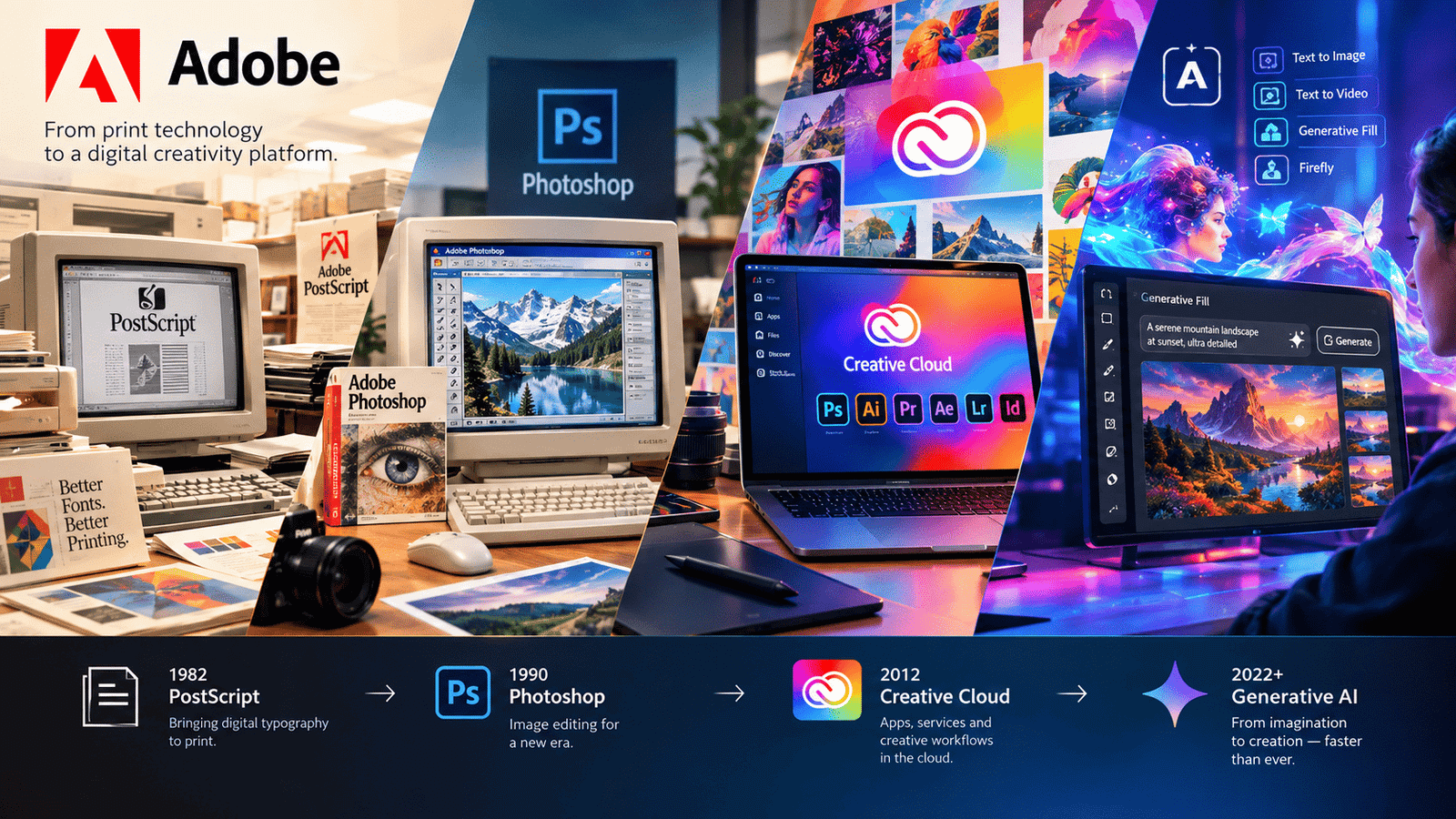
Adobe’s history is unusual because the company rarely depended on a single product remaining dominant forever. Instead, it repeatedly built or acquired the tools that became infrastructure for the next generation of digital communication.
PostScript helped computers speak to printers. Illustrator and Photoshop helped people create images on computers. Acrobat and PDF helped documents move from paper to digital networks. Flash helped define the interactive web before the web moved somewhere else. Creative Cloud transformed Adobe from a software vendor selling licenses into a subscription platform. And today, Firefly and Adobe’s broader AI strategy are forcing the company to answer a new question: what happens when some of the creative work that once required specialized software can be produced simply by describing what you want?
That question matters because Adobe’s greatest strength has always been its control over professional creative workflows. Its greatest strategic challenge is that artificial intelligence could simultaneously make those workflows more valuable and make parts of them easier to bypass.
The story of Adobe, therefore, is not simply the story of Photoshop.
It is the story of a company that repeatedly turned changes in how people create and communicate into new software categories — and then had to reinvent itself when the technology underneath those categories changed.
The Company Was Born From a Printing Problem
Adobe was founded in December 1982 by John Warnock and Charles Geschke, two researchers who had worked together at Xerox PARC. Their initial opportunity was not consumer creativity, photography or digital marketing. It was something more fundamental: getting computers to represent text and graphics accurately enough that they could be reproduced on paper.
Their answer was PostScript, a page-description language that allowed computers to describe text, shapes and images to printers in a precise, device-independent way.
This was a critical development because the emerging personal-computer revolution was creating a new possibility: documents could be designed digitally rather than assembled primarily through physical typesetting and traditional printing processes. Adobe’s PostScript became a foundation of the desktop-publishing revolution, and in 1985 Apple licensed it for the LaserWriter printer. Adobe had effectively inserted itself between digital information and physical publishing.
The strategic importance of PostScript was larger than the product itself. Adobe had not merely created another piece of software. It had created a standard.
That distinction would become one of the defining patterns of the company’s history.
When a company controls an important layer of a workflow, individual applications can become replaceable while the underlying ecosystem remains valuable. Adobe would repeatedly use this principle: create a technology, establish it within professional workflows, and then expand into the applications surrounding it.
Illustrator arrived in 1987, giving designers a powerful way to create vector graphics digitally. Photoshop followed in 1990 after Adobe acquired the rights to the program developed by Thomas and John Knoll. Premiere followed in 1991, expanding Adobe into professional video.
Adobe was no longer primarily a printing-technology company.
It was becoming the software layer through which creative professionals worked.
Photoshop Changed the Scale of Adobe’s Opportunity
Photoshop eventually became one of the most recognizable software products in the world, but its significance to Adobe was deeper than its popularity.
Image editing had previously been associated with specialized equipment, professional studios and highly technical workflows. Photoshop moved increasingly sophisticated image manipulation onto general-purpose computers.
The computer was no longer merely a machine for writing documents or calculating numbers. It was becoming a creative instrument.
Adobe kept expanding around this emerging environment. Illustrator addressed vector graphics. Premiere addressed video. InDesign, introduced in 1999, strengthened Adobe’s position in digital publishing. Acrobat and PDF addressed documents. By the end of the 1990s, Adobe was not selling a single application so much as accumulating control over multiple stages of digital content production.
The company’s acquisition strategy accelerated that process.
Adobe acquired Aldus in 1994, bringing PageMaker and other publishing technologies into the company. Later acquisitions expanded Adobe’s capabilities in web design, documents, marketing and digital experiences.
The logic was becoming clear.
If content was moving from physical media to digital media, Adobe wanted to own the tools used to create, edit, publish and distribute that content.
But the internet would test whether that strategy could survive outside the desktop.
PDF Turned Adobe Into a Document Company Too
In the early 1990s, Adobe introduced the Portable Document Format and Acrobat. The problem was different from PostScript but structurally similar: people needed a way to preserve the appearance and structure of documents as they moved between computers, operating systems and printers.
PDF solved that problem.
Acrobat created a commercial ecosystem around the format, while Acrobat Reader helped make PDF ubiquitous. Adobe later released PDF as an open standard in 2008, reinforcing its position as the company associated with a format that had become part of everyday digital communication.
This was another important strategic move.
Adobe did not need to make every document proprietary in order to benefit from the standard. Once PDF became a common language for digital documents, Acrobat could become the layer for creating, editing, signing, reviewing and managing those documents.
The company was learning an important lesson: a standard can be more valuable than a product when the company owns the tools around the standard.
That principle would later appear again in different forms.
The Internet Created Both an Opportunity and a Trap
Adobe entered the internet era with enormous creative-software assets, but the web changed what digital content meant.
The company acquired Macromedia in 2005 for approximately $3.5 billion, bringing together two major collections of creative and web technologies. Macromedia contributed products such as Flash and Dreamweaver, while Adobe brought Photoshop, Illustrator, Acrobat and its broader creative portfolio.
At the time, the combination made strategic sense.
Flash had become deeply associated with interactive web content, video and browser-based experiences. Dreamweaver was a major web-development tool. Adobe could now present itself as a broader platform for digital content creation.
But the history of Flash also contains one of Adobe’s clearest strategic warnings.
The web eventually moved toward open browser technologies, mobile platforms and standards that reduced the importance of proprietary plug-ins. Apple’s decision not to support Flash on the iPhone and iPad was especially consequential. The web moved toward HTML5, native mobile applications and more open technologies.
Flash, once one of the symbols of the interactive web, was eventually discontinued.
Adobe survived because Flash was never the entire company.
That distinction matters.
A weaker company might have treated its dominant technology as its identity. Adobe increasingly treated technologies as chapters.
The Hardest Transformation Was Financial, Not Technological
Adobe’s most important transformation did not begin with a spectacular new product.
It began with a business-model decision.
For decades, Adobe had sold software through perpetual licenses. Customers paid for versions of products such as Creative Suite and then decided when to upgrade.
That model had an attractive characteristic: large payments arrived when customers purchased new versions.
But it also created a structural problem. Revenue depended partly on upgrade cycles, while software increasingly needed continuous development, cloud infrastructure, security updates and connected services.
In May 2012, Adobe launched Creative Cloud.
The change was radical. Instead of treating Photoshop, Illustrator, Premiere and the rest primarily as individual boxed or perpetual-license products, Adobe increasingly packaged them as continuously updated subscription services.
The transition initially hurt the company’s reported financial performance.
Adobe explicitly warned investors that the rapid adoption of Creative Cloud would reduce traditional perpetual-license revenue and pressure revenue, net income and operating margins during the transition. In fiscal 2013, Adobe ended the year with approximately 1.4 million paid Creative Cloud subscriptions, compared with 0.3 million a year earlier. Subscription revenue represented 28% of total revenue, compared with 15% in fiscal 2012.
This was one of the most important strategic bets in Adobe’s history.
The company deliberately accepted short-term financial disruption to build a recurring-revenue model.
By fiscal 2014, the transition had accelerated dramatically. Adobe ended the year with approximately 3.45 million paid Creative Cloud subscriptions, up about 140% from the previous year, while subscription revenue reached 50% of total revenue.
Adobe had changed what it was.
It was no longer primarily selling software products.
It was selling continuous access to a creative ecosystem.
Creative Cloud Changed the Economics of the Company
The subscription model produced another strategic advantage: Adobe could maintain a direct and continuous relationship with customers.
Under the old model, a major software release created a purchasing event.
Under Creative Cloud, the relationship became continuous.
Features could be introduced more frequently. Applications could be integrated more tightly. Cloud services could become part of the workflow. Customers could move between products more easily. Adobe could measure engagement and retention more directly.
The economic transformation was substantial.
By fiscal 2025, Adobe generated $23.77 billion in revenue, of which $22.90 billion — approximately 96% — came from subscriptions. Digital Media alone generated $17.65 billion, while Digital Experience generated $5.86 billion. Adobe’s total annualized recurring revenue reached approximately $25.20 billion at the end of the fiscal year.
The company had achieved something that would have been difficult to imagine when Photoshop was sold as a traditional software product.
Its most important creative applications had become components of a recurring digital infrastructure.
Adobe Began Selling More Than Creativity
The next strategic shift was even broader.
Adobe realized that companies did not simply need tools to create content. They needed to understand what happened to that content after it was created.
That led Adobe deeper into digital marketing and customer experience.
The 2009 acquisition of Omniture was particularly important. Omniture specialized in analytics and optimization, and Adobe positioned the combination as a way to connect content creation with measurement and digital customer engagement.
Adobe subsequently developed what became Adobe Marketing Cloud and later Adobe Experience Cloud, bringing analytics, content management, commerce, advertising and customer-experience technologies into the company’s portfolio.
This changed Adobe’s competitive identity once again.
The company that had started by helping printers reproduce pages was now selling technology to large organizations trying to understand customers across websites, mobile devices and digital channels.
Adobe was moving from creation toward creation plus distribution plus measurement.
That expansion made the company less dependent on individual creative applications.
It also made Adobe much more deeply embedded in enterprise workflows.
The Cloud Became the Company’s New Center
Under Shantanu Narayen, who became CEO in 2007, Adobe’s transformation accelerated.
The company increasingly organized itself around recurring digital services rather than standalone software products. Creative Cloud became the core of its Digital Media business, while Experience Cloud became an important enterprise growth engine.
This was not simply a migration to the cloud.
It was a change in the company’s strategic center.
Adobe’s old identity was essentially:
software used by creative professionals.
Its newer identity became:
a platform for creating, managing, delivering and optimizing digital experiences.
That distinction explains why Adobe remained resilient through technological shifts that destroyed individual products and categories around it.
The company did not need the desktop publishing market to remain unchanged.
It needed the volume of digital content and digital experiences to keep expanding.
And that volume exploded.
Every website, advertisement, social-media campaign, video, photograph, mobile application and digital document created another potential use for Adobe’s tools.
Then Generative AI Changed the Question
Adobe entered the generative-AI era from an unusually strong position.
It already had millions of creative professionals using Photoshop, Illustrator, Premiere and other applications. It had enormous expertise in imaging, design, typography, video and document workflows. It also had a large enterprise customer base.
The obvious strategic response was not to build a separate AI product and ask customers to leave their existing workflows.
It was to put AI inside the workflows.
Adobe introduced Firefly in March 2023 as a family of generative AI models focused initially on images and text effects. Adobe subsequently integrated Firefly capabilities into Photoshop, Illustrator and Adobe Express.
Generative Fill in Photoshop illustrated the strategy perfectly.
Instead of asking users to replace Photoshop with an AI image generator, Adobe made generative AI another capability inside Photoshop.
That is a critical distinction.
If AI becomes a standalone competitor to creative software, Adobe risks disintermediation.
If AI becomes a feature inside Adobe’s ecosystem, AI can strengthen the ecosystem.
Adobe chose the second path.
But AI Also Creates Adobe’s New Strategic Threat
The paradox is that the same technology Adobe is integrating can reduce the value of specialized creative skills.
For decades, Adobe’s software benefited from a world in which professional-quality digital creation required professional tools.
Generative AI weakens that assumption.
A person who previously needed to know Photoshop may increasingly be able to describe an image, generate variations, remove objects, extend backgrounds or produce design concepts through natural language.
That does not make Photoshop obsolete.
It changes what Photoshop is for.
The application increasingly becomes a place where humans direct, refine, combine and control machine-generated content rather than manually producing every element.
Adobe’s response has been to make Firefly deeply integrated into existing workflows and to emphasize commercially oriented AI, creative control and content provenance. In 2023, Adobe expanded Firefly into Photoshop, Illustrator and Express and introduced generative credits across its offerings.
The strategy is consistent with Adobe’s historical pattern.
When technology changes the workflow, Adobe tries to move the new technology inside the workflow.
Figma Revealed Another Side of the Transformation
Adobe’s proposed acquisition of Figma in 2022 showed how seriously the company viewed the next generation of collaborative digital design.
Figma represented a different philosophy from the traditional desktop creative-software model: browser-based, collaborative, cloud-native and increasingly central to interface and product design.
Adobe agreed to acquire Figma in a transaction valued at approximately $20 billion.
The deal never closed.
In December 2023, Adobe and Figma mutually terminated the agreement after concluding there was no clear path to the necessary regulatory approvals in the European Union and United Kingdom. Adobe paid a $1 billion termination fee.
The failed transaction was strategically revealing.
Adobe had successfully moved its existing franchise into the cloud.
But the future of creative software was producing companies whose products were born in the cloud.
That is a different challenge.
Adobe had mastered transformation from desktop software to cloud subscriptions. Now it had to compete with companies that did not need to make that transformation because they started there.
Adobe’s Next Curve Is About AI, Not Software
By fiscal 2025, Adobe’s financial results showed no evidence of a company in immediate structural decline.
Revenue reached $23.77 billion, up 11% year over year. Net income reached $7.13 billion, operating cash flow exceeded $10 billion, and subscription revenue represented approximately 96% of total revenue. Digital Media ARR reached $19.20 billion.
These numbers matter because they separate strategic anxiety from financial reality.
Adobe is not a legacy software company struggling to survive.
It is a highly profitable subscription business confronting a technological transition while still growing.
But the next decade may be more difficult than the previous one because AI attacks the very boundary that historically protected Adobe: the complexity of professional creation.
The company’s answer is to make AI part of the Adobe ecosystem while using its installed base, workflows, brand, content tools and enterprise relationships as competitive advantages.
That strategy is now entering a leadership transition as well.
In September 2026, Adobe announced that Anil Chakravarthy will become president and CEO on December 1, 2026, succeeding Shantanu Narayen, who will become executive chair. Narayen had led Adobe for more than 18 years and oversaw the company’s transformation from traditional software toward subscriptions, cloud services and digital experiences.
The timing is significant.
Narayen’s defining transformation was the conversion of Adobe into a recurring cloud business.
The next CEO inherits a different problem: ensuring that artificial intelligence expands the value of Adobe’s ecosystem faster than it erodes the value of the workflows that ecosystem once monopolized.
The Real Adobe Curve
Adobe’s history can be understood as a sequence of strategic centers.
First came printing.
Then desktop publishing.
Then digital creativity.
Then documents and digital communication.
Then web content.
Then digital marketing and customer experience.
Then cloud subscriptions.
Now comes AI-assisted creation and digital experience orchestration.
The company’s remarkable achievement is not that Photoshop survived.
It is that Adobe repeatedly changed what Photoshop, Illustrator, Acrobat and its other products represented within a much larger system.
PostScript made Adobe part of the printing infrastructure.
Photoshop made it part of the visual-creation infrastructure.
PDF made it part of the document infrastructure.
Creative Cloud made it part of the subscription infrastructure.
Experience Cloud made it part of the enterprise digital-experience infrastructure.
Firefly is an attempt to make Adobe part of the AI creation infrastructure.
That is the real curve.
Adobe’s greatest competitive advantage has never been any individual application. It has been the accumulated position of those applications inside professional workflows.
And that is precisely why AI is such a consequential test.
If Adobe succeeds, AI will not destroy its historical model. It will become the next layer of it.
If it fails, the company could discover that the workflow it spent four decades owning has become simpler than the software ecosystem built to support it.
Adobe’s history suggests that the company understands this better than most.
Its survival has always depended on recognizing that the technology underneath creativity changes.
The question now is whether it can once again change with it.
A CURVE IN 60 SECONDS
1982 — John Warnock and Charles Geschke found Adobe.
1985 — PostScript becomes a major standard for computer printing.
1987 — Illustrator expands Adobe into digital illustration.
1990 — Photoshop transforms digital image editing.
1991 — Premiere expands Adobe into professional video.
1993 — PDF and Acrobat establish Adobe in digital documents.
1994 — Adobe acquires Aldus and strengthens desktop publishing.
1999 — InDesign strengthens Adobe’s publishing ecosystem.
2005 — Macromedia acquisition adds Flash, Dreamweaver and other web technologies.
2009 — Omniture pushes Adobe into analytics and digital marketing.
2012 — Creative Cloud begins Adobe’s decisive subscription transition.
2014 — Subscription revenue reaches 50% of total revenue.
2023 — Firefly brings generative AI directly into Adobe’s creative workflows.
2023 — Adobe and Figma terminate their proposed $20 billion merger after regulatory obstacles.
2025 — Adobe reaches $23.77 billion in revenue, with approximately 96% from subscriptions.
2026 — Anil Chakravarthy is announced as successor to Shantanu Narayen as CEO, effective December 1.
THE POSTMORTEM
What created Adobe’s growth?
Adobe grew by identifying technological bottlenecks in the production and distribution of digital content. PostScript addressed printing; Photoshop and Illustrator addressed creation; PDF addressed documents; Creative Cloud addressed software distribution and recurring workflows; Experience Cloud addressed the business layer surrounding digital content.
What sustained the company’s peak?
The strongest asset was not brand recognition alone. It was workflow integration. Professionals learned Adobe’s tools, companies built processes around them, educational institutions taught them and creative industries standardized on them. That created switching costs and a powerful ecosystem effect.
Where did vulnerability emerge?
Adobe’s vulnerabilities appeared whenever the underlying architecture of digital creation changed. Flash lost relevance as the web moved toward open standards and mobile ecosystems. The desktop model was challenged by cloud-native collaboration. Generative AI now challenges the assumption that professional creation must always require complex interfaces and specialized manual skills.
What changed the trajectory?
The most important internal decision was the transition from perpetual licenses to subscriptions. Adobe accepted near-term financial pressure to create a recurring-revenue business. That transformation eventually produced a much more predictable economic model and allowed the company to continuously evolve its products.
What was internal versus external?
Adobe controlled its product strategy, acquisitions, subscription transition and AI integration. It did not control the rise of mobile computing, the decline of browser plug-ins, regulatory scrutiny of the Figma transaction or the emergence of generative AI competitors.
What remains uncertain?
The central uncertainty is whether AI will primarily expand the Adobe market or compress the value of Adobe’s software. Adobe has strong distribution, professional workflows, enterprise relationships and a large installed base. But those advantages must now be translated into an environment where creating sophisticated content is becoming increasingly accessible.
LESSONS FROM THE CURVE
1. Standards can be more durable than products.
PostScript and PDF demonstrate the value of becoming part of the underlying infrastructure rather than depending entirely on one application.
2. A profitable business can still require radical reinvention.
Adobe did not wait for perpetual-license economics to collapse. It deliberately disrupted its own model through Creative Cloud.
3. Short-term financial pain can accompany a successful strategic transformation.
The early subscription transition reduced reported revenue and margins before the recurring model became economically powerful.
4. Acquisitions work best when they reinforce a strategic center.
Aldus, Macromedia and Omniture each expanded Adobe into adjacent layers of the digital-content economy. Figma showed the difficulty of acquiring the next generation when regulatory and strategic conditions no longer align.
5. Integration can be a stronger AI strategy than substitution.
Adobe’s decision to place Firefly inside Photoshop, Illustrator and Express attempts to turn AI from a threat to the existing workflow into another capability of that workflow.
6. The strongest competitive advantage can become the greatest strategic responsibility.
Adobe’s installed base is enormous. But protecting that base cannot mean protecting old workflows. It means continually redefining what those workflows become.
FAQ
Why was Adobe founded?
Adobe was founded in 1982 by John Warnock and Charles Geschke. The company’s initial breakthrough was PostScript, a technology that helped computers accurately describe text and graphics for printing.
Why is Photoshop so important to Adobe’s history?
Photoshop transformed digital image editing and became one of the company’s defining products. More importantly, it helped establish Adobe as a central provider of professional creative software.
When did Adobe move to subscriptions?
Adobe launched Creative Cloud in 2012 and accelerated the transition from perpetual software licenses to subscriptions. By fiscal 2014, subscription revenue represented 50% of Adobe’s total revenue.
What happened to Adobe Flash?
Flash was once a major technology for interactive web content, video and browser-based applications. The web subsequently shifted toward open standards, HTML5, mobile platforms and technologies that reduced the role of browser plug-ins. Adobe eventually discontinued Flash.
Why did Adobe abandon the Figma acquisition?
Adobe and Figma terminated their proposed acquisition in December 2023 after concluding that there was no clear path to the regulatory approvals required in Europe and the United Kingdom. Adobe paid a $1 billion termination fee.
Is Adobe declining because of AI?
The evidence does not support describing Adobe as a declining company. In fiscal 2025, revenue grew 11% to $23.77 billion and subscription revenue reached $22.90 billion. The more important question is whether Adobe can use AI to expand its ecosystem faster than AI reduces the value of traditional creative workflows.
SOURCES
- Adobe — Company history and milestones.
- Adobe — 2025 Annual Report / Form 10-K.
- U.S. SEC — Adobe FY2013 10-K, documenting the Creative Cloud transition.
- U.S. SEC — Adobe FY2014 10-K, documenting the acceleration of subscription adoption.
- U.S. SEC — Macromedia acquisition documentation.
- U.S. SEC — Omniture acquisition announcement.
- Adobe — Firefly introduction and commercial release.
- Adobe — Termination of Figma acquisition.
- Adobe — 2026 CEO succession announcement.