Apple: From $1B Losses to a $4 Trillion Platform
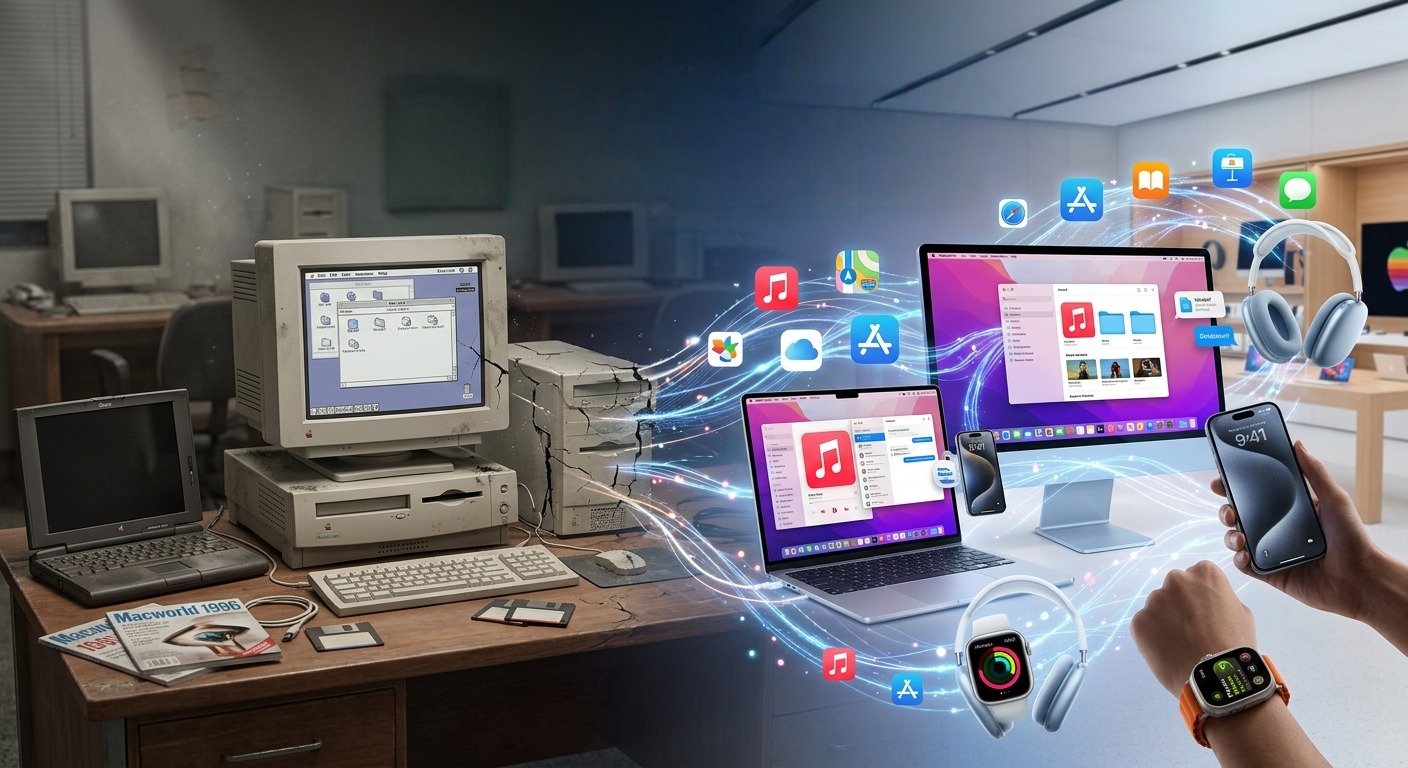
On August 6, 1997, Steve Jobs stood on a stage in Boston and told a room of Macintosh loyalists something they did not want to hear. Jobs, who still introduced himself that day as chairman and CEO of Pixar, announced that Microsoft would buy $150 million of non-voting Apple stock and hold it for at least three years. The crowd booed.
Apple’s most loyal customers were jeering the news that its oldest rival was putting money into the company. That tells you how far the company had fallen, and how little room it had left to be proud.
A record year, then a collapse
The numbers show how fast it happened. In fiscal 1995 Apple earned $424 million. In fiscal 1996 it lost $816 million, and in fiscal 1997 it lost $1.045 billion. In two years the company went from comfortably profitable to burning nearly $1.9 billion.
The trouble was visible even in Apple’s best year. Apple sold a record 4.5 million Macs in 1995, but Macworld’s retrospective describes a platform already losing ground, with a product line cluttered with underperforming Performas. The record year was a peak in volume, not in health.
The causes were plural, and several were self-inflicted:
- Clones. In 1995 Apple began licensing the Mac OS to third-party manufacturers such as Power Computing, Motorola and Umax, hoping to gain market share. Power Computing was consistently shipping faster, cheaper machines than Apple’s own. The clones were meant to expand the market. By most accounts they mostly cannibalized Apple’s own sales, though how much is hard to measure from public data.
- A stalled operating system. Copland, the effort to modernize the Mac OS, began in 1994 and was abandoned in August 1996. Apple had no modern software foundation, and nobody could say when it would.
- Leadership churn. The board replaced Michael Spindler with Gil Amelio on February 2, 1996. Amelio cut costs, and Fortune reported plans to eliminate 2,800 of 17,000 jobs, but he could not fix the product problem by cutting.
Amelio’s last move turned out to matter most. With Copland dead, Apple needed an operating system from outside. It chose NeXT, the company Jobs had founded after leaving Apple. Fortune put the price at roughly $400 million, and Jobs came bundled with it as an adviser. Other accounts give $427 million or $429 million. The figure varies by source, but the logic does not: Apple was buying software, and it got a leader along with it.
The rescue, and what it did not do
Jobs went from adviser to interim CEO within months. The Microsoft deal, announced in Boston, was more than an investment. The two companies settled outstanding litigation and cross-licensed patents. Microsoft also committed to keep making Office for the Mac and to ship Internet Explorer as the default Mac browser, though not the only one. The $150 million was small next to a billion-dollar annual loss. The settlement and the Office commitment arguably mattered more, because they removed two threats to Apple’s survival at once.
Jobs also ended the cloning experiment. In September 1997 Apple bought the core assets of Power Computing for $100 million in stock and terminated the Mac cloning business.
The turnaround was quick on paper. Apple returned to profitability in fiscal 1998 with net income of $309 million, and it was profitable in all four quarters. Net income reached $601 million in 1999 and $786 million in 2000. The iMac helped. It was a major commercial success at a moment when Apple badly needed a hit.
Then comes the part that chronologies tend to skip. Apple lost $25 million in fiscal 2001 and earned only $65 million in 2002. In fiscal 2003 it earned $69 million on revenue of $6.21 billion. Apple had survived and was making money, but it was still a small, niche computer company. The 1997 rescue stopped the bleeding. It did not create the growth curve that followed.
The curve that actually bent
The decisive inflection came from a different kind of product. On October 23, 2001, Apple
introduced the iPod, and the same year it opened its first retail stores. iTunes followed in 2003. Together they showed Apple how to sell hardware, software and content as a single system.
On January 9, 2007, Apple announced the iPhone. It went on sale on June 29, 2007, at $499 for 4 GB and $599 for 8 GB, tied to an AT&T contract. The company also dropped “Computer” from its name that year.
The scale of what followed is hard to overstate. Revenue went from $108.2 billion in fiscal 2011 to $416.2 billion in fiscal 2025. Compared with fiscal 2003, that is roughly a sixtyseven-fold increase in twenty-two years. Apple’s market value did not reach $100 billion until 2007. It became the first U.S. public company worth $1 trillion in August 2018, and passed $2 trillion in August 2020 and $3 trillion in January 2022.
The Cook decade: scale, and its limits
Tim Cook became CEO on August 24, 2011. His tenure turned an extraordinary product company into an extraordinary operating machine. CNBC reported that Apple’s market value grew more than twentyfold on his watch, closing at $4 trillion on the day his successor was named.
That multiple deserves a caveat. At the 2011 handover Apple’s market capitalization was around $360 billion, which makes the rise closer to elevenfold in total value. The twentyfold figure appears to track the share price, which climbed faster because Apple spent heavily on reducing its share count. Both numbers describe real growth, but they measure different things.
The business also had a structure that mattered. In fiscal 2025 the iPhone brought in $209.6 billion. That is just over half of total revenue. Services carried a gross margin of 75.4%, against 36.8% for products. Services is smaller than the iPhone but far more profitable per dollar, and it depends on the iPhone’s installed base to exist.
Growth was not smooth. Revenue was $383.3 billion in fiscal 2023, $391.0 billion in 2024 and $416.2 billion in 2025. Before the December 2025 quarter, Apple had not posted doubledigit revenue growth since 2021. China was part of the story. Net sales there fell from $72.6 billion in fiscal 2023 to $64.4 billion in 2025, a drop of about 11%.
Profit growth needs the same care. Fiscal 2025 net income rose 19.5% to $112.0 billion, but operating income rose only 8%, and the effective tax rate fell to 15.6% from 24.1%. Much of the headline profit jump came from taxes, not from the business itself.
The upswing, and three open questions
The latest numbers are strong. The December 2025 quarter brought record revenue of $143.8 billion, up 16%. The June 2026 quarter delivered $109.4 billion, also up 16%. iPhone sales rose 22%, and revenue in the China region climbed 22% to $18.82 billion. Apple guided to 9% to 11% growth for the next quarter.
Behind that, three questions are unresolved:
- Artificial intelligence. Apple showed a more capable Siri in 2024 but admitted in March 2025 that it was taking longer than expected. In January 2026 it confirmed a multi-year deal to use Google’s Gemini to build its foundation models, reportedly
costing around $1 billion a year. At WWDC26 in June, Apple introduced what it called an “all-new Siri AI.” The strategy depends partly on a competitor’s technology, and the terms are undisclosed. - The App Store. The U.S. Department of Justice sued Apple in March 2024 with 16 state attorneys general. In April 2025 the European Commission fined Apple €500 million under the Digital Markets Act. In the Epic Games case, the Supreme Court
agreed to hear Apple’s appeal of a contempt ruling over its 27% commission on linked-out purchases, while the district court is still deciding what commission Apple may charge. Services is Apple’s highest-margin business, so this is arguably where its profits are most exposed. That is an inference, not a reported finding. - Leadership and geopolitics. John Ternus, a hardware engineer who joined Apple in 2001, succeeded Cook as CEO on September 1, 2026, and Cook became executive chairman. The AP noted that Cook had built ties with the Trump administration while navigating a trade and tariff war aimed at Asia, where Apple’s supply chains are concentrated, and that he is expected to keep helping on that front. Tariff costs had already compressed product margins in fiscal 2025.
What the curve shows
Apple’s story is not a clean fall followed by a clean rescue. It has two inflection points. The first, in 1996–1997, was a survival decision: stop the clones, buy a modern operating system, bring back its founder. The second, from 2001 to 2007, turned a surviving computer company into a platform company. The second is why Apple is worth trillions today.
THE CURVE in 60 Seconds
- 1976: Apple founded by Jobs, Wozniak and Wayne.
- 1980: IPO at $22 per share.
- 1995: record Mac sales; net income $424M.
- 1995–97: clones, Performas, Copland cancelled, three CEOs.
- FY1996–97: losses of $816M and $1.045B.
- Dec 1996: NeXT acquired; Jobs returns.
- Aug 1997: Microsoft invests $150M; clones ended soon after.
- FY1998: return to profit ($309M).
- 2001: iPod and Apple Stores; FY2001 brings a small loss.
- 2007: iPhone launched; company renamed Apple Inc.
- 2011: Cook succeeds Jobs; revenue ~$108B.
- 2018 / 2020 / 2022: $1T, $2T and $3T valuations.
- FY2025: revenue $416B, net income $112B.
- Jan 2026: Gemini deal for Siri.
- Apr 2026: Ternus named CEO.
- Sep 1, 2026: Ternus takes over; Cook becomes executive chairman.
The Postmortem
- What created the growth: an integrated model of hardware, software, content and retail, first proven with the iPod and then scaled with the iPhone.
- What sustained the peak: the installed base, supply-chain mastery, and a highmargin Services layer on top of it.
- Where the vulnerability first appeared: in 1995–96, with a diluted product line, cloned hardware and an obsolete operating system. Today the comparable risks are dependence on one product (about half of revenue), exposure to China and tariffs,
and the App Store. - What changed the trajectory: in 1997, Jobs’s return and the ending of clones. In 2001–2007, the platform shift.
- Internal vs. external: the 1990s crisis was mostly internal (strategy, execution). Competition from Windows PCs was real but external. Today’s risks are largely external: regulation, tariffs, AI competition.
- Controllable vs. not: clones, Copland and product sprawl were controllable. Trade policy and antitrust rulings largely are not.
- What remains uncertain: whether Apple’s Gemini-based Siri closes the AI gap, how much commission it can keep on the App Store, and how Ternus’s leadership changes the strategy. As of this writing, none of the three has resolved.
Lessons from the Curve
- Survival and growth are different problems. Apple was profitable again by 1998, yet it earned only $69 million in fiscal 2003. The turnaround stopped the losses, and a new product category created the growth.
- Licensing away your differentiation is expensive. The clone program expanded the Mac platform, but it did so by taking sales from Apple’s own hardware.
- Record volume can hide a weak position. 1995 was a record sales year, and 1996–97 produced nearly $1.9 billion in losses.
- Check what a headline number measures. Fiscal 2025 net income rose 19.5%,
but operating income rose 8%. Market value rose roughly elevenfold, while the share price rose faster. - A profit engine inherits the risks of what it depends on. Services runs on the iPhone base and the App Store rules, and both are now under legal and regulatory pressure.
Sources
- Apple Inc., Form 10-K FY2025 and Q4 FY2025 earnings release (SEC)
- Apple Inc., Form 10-K FY1997 and 10-K405 FY1998; Form 10-K FY2002; Q4 FY2003 earnings release (SEC / annualreports.com)
- Apple Inc., Q1, Q2 and Q3 FY2026 earnings releases and 10-Q (SEC)
- Apple Newsroom, “Tim Cook to become Apple Executive Chairman, John Ternus to become Apple CEO,” April 20, 2026
- CNBC, April 20, 2026 and July 30, 2026; Al Jazeera, Sept 1, 2026; AP via PBS NewsHour, Sept 1, 2026
- Stratechery, transcript of Steve Jobs at Macworld Boston 1997; AppleInsider, Aug 6, 1997 retrospective
- Fortune, “Something’s Rotten in Cupertino,” March 1997; Macworld, “Reliving the Clone Wars”; CIO.com, Apple’s biggest failures
- Wikipedia entries on Copland, Power Computing and the iMac (secondary; crosschecked)
- MacRumors / AppleInsider, April 2026 (Google–Apple Gemini partnership); 9to5Mac and CNBC (Epic v. Apple, Supreme Court)