
How Kodak Invented the Future and Then Refused to SellIt
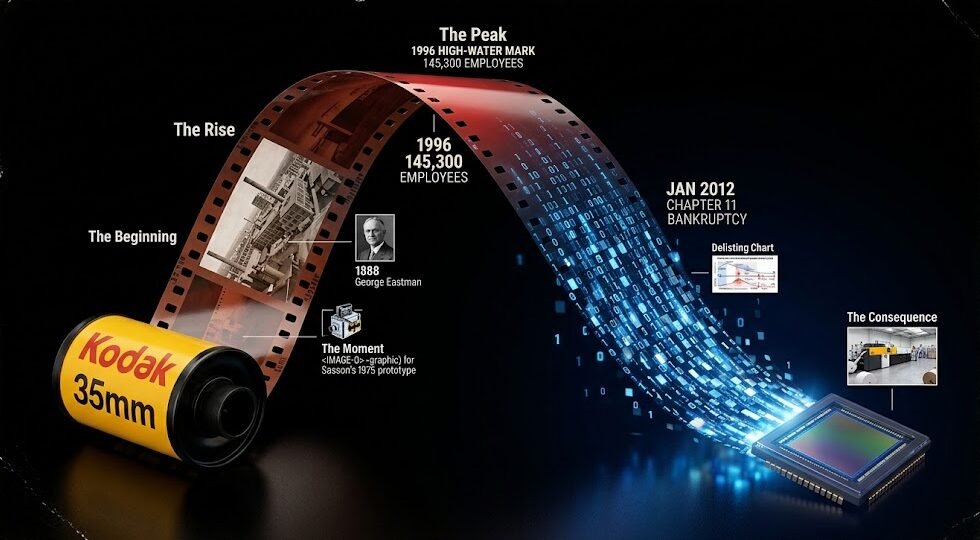
THE MOMENT
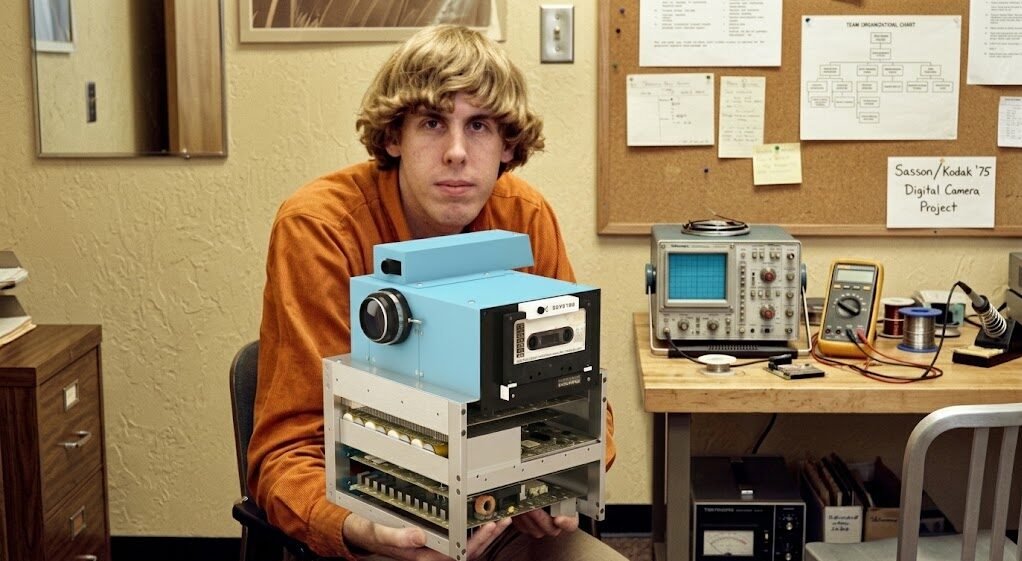
In December 1975, in a back lab in Rochester, New York, a 24-year-old Kodak engineer named Steve Sasson wired together a Super-8 camera lens, a cassette recorder, 16 nickel-cadmium batteries and a CCD sensor into an eight-pound, toaster-sized box. It took 23 seconds to record a single black-and-white image, at a resolution of 0.01 megapixels, onto magnetic tape. Sasson built the first selfcontained digital camera at Kodak in 1975. When he demonstrated it to executives the following year, the reaction was polite curiosity rather than alarm. Company executives decided to patent the technology but not develop it for sale.
That single decision — patent it, shelve it, protect the film business — sits at the center of one of the most cited case studies in corporate strategy. But the real story of Kodak’s rise and fall is longer, stranger, and less about a single missed moment than about a company that built an empire so profitable it could not imagine anything replacing it.

THE BEGINNING
Kodak’s origin has nothing to do with digital anything. George Eastman and Henry Strong founded the Eastman Dry Plate Company on January 1, 1881, after Eastman — a former bank clerk who had taught himself photographic chemistry at night — patented a machine that mass-produced dry photographic plates, replacing the wet-plate process that required photographers to coat their own glass on the spot. In 1885, Eastman patented the first practical film roll holder, allowing multiple exposures to be stored in a single camera, and in 1888 he launched the product that would define the company: a roll-film camera pre-loaded with enough film for 100 exposures, sold with a simple promise — the customer shot the photos and mailed the whole camera back to Rochester, where Kodak developed the film, made prints, reloaded the camera and returned it, all for ten dollars.
Eastman’s slogan, “You press the button, we do the rest,” was not just clever copywriting. It described the entire business model: sell the razor cheap, and control every downstream step — film, chemicals, paper, developing — where the actual margin lived. That model would carry Kodak through most of the twentieth century.
THE RISE

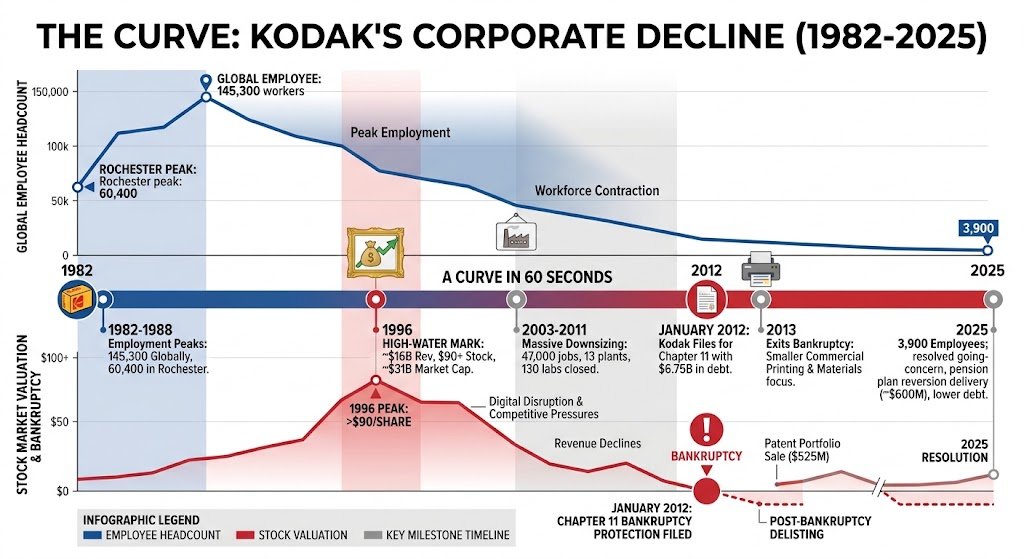
Kodak’s growth for the next hundred years was less a straight line than a near-monopoly. By the 1970s, Kodak controlled nearly 90% of U.S. film sales and 85% of the camera market. Employment in the Rochester area alone peaked at 60,400 workers in 1982, and globally the company topped out at 145,300 employees in 1988 — a workforce larger than many national armies, built almost entirely around chemistry, optics and mass manufacturing of film.
The peak came a few years later. 1996 was Kodak’s high-water mark: revenues near $16 billion, a stock price above $90, a market value over $31 billion, and a brand ranked the fifth most valuable in the world. This was a company that did not merely sell a product — it had become the word people used for a nostalgic memory. “A Kodak moment” entered the language as a synonym for something worth capturing forever.
THE FIRST CRACK
The crack had already opened twenty-one years earlier, inside Kodak’s own labs. Sasson’s prototype worked. Kodak understood, at the patent level, that a filmless camera was technically possible before almost anyone else on Earth did. But because the company held a lucrative monopoly on film photography, executives saw little reason to disrupt a business that was still making them extraordinary money. Kodak had also built quiet arrangements with camera manufacturers — Nikon, Canon, Hasselblad — under which Kodak stayed out of complex cameras and those companies stayed out of selling film, reinforcing a structure where nobody with power in the industry had an incentive to accelerate the shift away from chemistry-based imaging.
It is worth being precise here, because the popular version of this story oversimplifies it. Kodak did not “hide” the invention from the world — it patented it publicly, continued researching digital imaging afterward, and the technology genuinely was not ready for a mass consumer market in 1975. Sasson himself estimated it would take 15 to 20 years before digital photography could commercially rival film — and he was right. The failure was not in predicting the timeline. It was in what Kodak did with the two decades that timeline gave it.
THE INFLECTION POINT
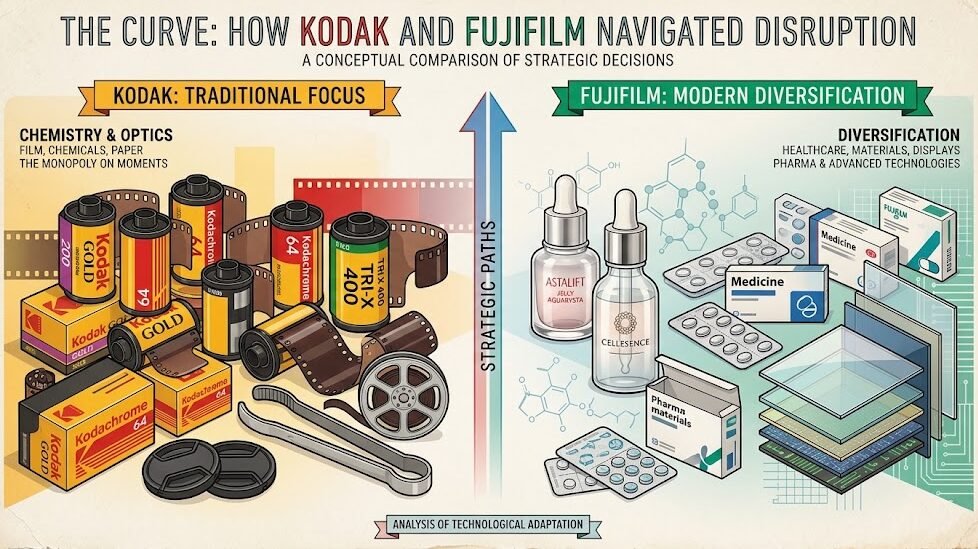
Instead of using its head start to become the company that owned the digital transition, Kodak spent the 1980s and 1990s managing the decline of film as gently as possible while dabbling in digital at the margins. Kodak’s own milestones show a company still organized in the 1990s around strategic product groups built for film, chemicals and paper even as competitors closed in. Japanese rivals, chiefly Fujifilm, began taking meaningful share through the 1990s — and unlike Kodak, Fujifilm diversified its chemical and materials expertise early into cosmetics, pharmaceuticals and flat-panel display materials, giving it a second business to stand on when film demand collapsed. Kodak, by contrast, kept trying to make film-adjacent businesses — and later, consumer inkjet printers — replace a cash engine that no product ever fully replaced.
From 2003 to 2011, Kodak shed 47,000 jobs, closed 13 manufacturing plants and shut 130 processing labs. It had not recorded an annual profit since 2004, and its cash reserves steadily drained away. The company earned roughly $3 billion in patent-licensing revenue between 2003 and 2010, but that income shrank to just $98 million in 2011 as the well of easily monetizable digital-imaging patents ran dry
THE CONSEQUENCE
In November 2011, Kodak warned it could run out of cash within a year if it failed to sell its trove of 1,100 digital-imaging patents. No buyer emerged at the price Kodak needed. On January 19, 2012, Eastman Kodak filed for Chapter 11 bankruptcy protection, listing roughly $6.75 billion in debt against a fraction of that in assets. CEO Antonio Perez pointed to the company’s transformation — 13 plants closed, 130 labs shut, 47,000 jobs eliminated since 2003 — as evidence of a business already restructured almost beyond recognition even before the filing.
Kodak did eventually find a buyer for its patent portfolio — just not on its own terms. A consortium including Apple, Google, Facebook, Microsoft and Samsung purchased Kodak’s digital-imaging patents for $525 million, a sum that helped fund its exit from bankruptcy but far below what the company had once hoped billions of dollars in licensing might deliver. Kodak emerged from Chapter 11 in 2013 as a much smaller company focused on commercial printing, expecting around $2.5 billion in revenue — a fraction of its 1996 peak — and separated its consumer film and photo businesses into an independent entity, Kodak Alaris, sold to the company’s British pension fund.
THE FINAL STATE
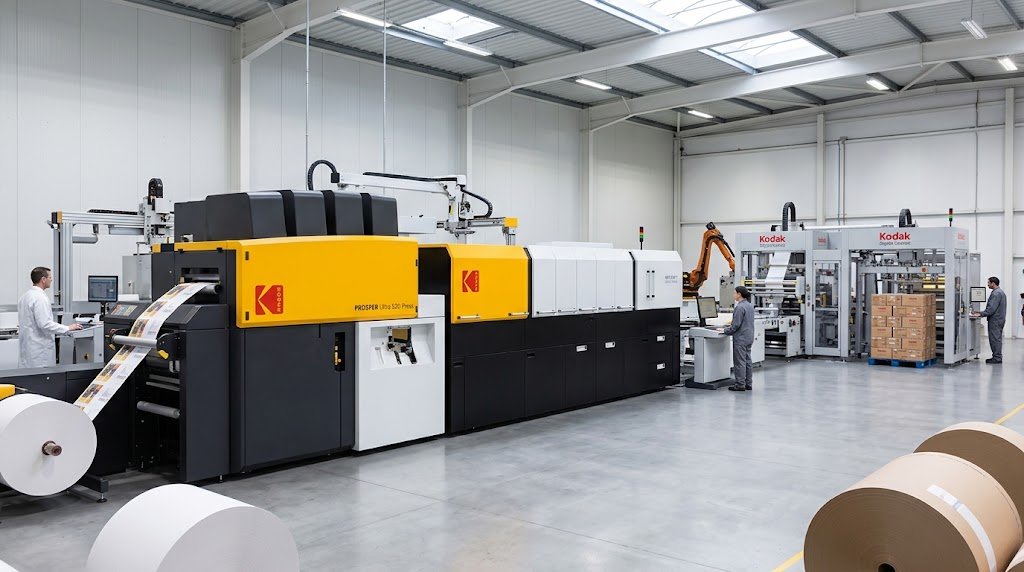
Kodak still exists — as a niche industrial and materials company, not the consumer giant it once was. By 2025, Kodak reported roughly $1.07 billion in annual revenue and a net loss of $128 million, with about 3,900 employees worldwide — down from the 145,300 it employed at its 1988 peak.
The company’s post-bankruptcy story has not been a clean recovery. In August 2025, Kodak disclosed “substantial doubt about the company’s ability to continue as a going concern,” warning it lacked committed financing to meet roughly $500 million in debt coming due within twelve months. Kodak pushed back hard on the alarm the disclosure caused, stating publicly it had “no plans to cease operations, go out of business, or file for bankruptcy protection,” and pinned its plan on terminating its U.S. pension plan to free up cash.
By November 2025, Kodak reported that the pension-plan reversion was on track to deliver proceeds of up to $600 million, and that the going-concern conditions had been “fully resolved,” with term debt expected to fall to roughly $200 million.
Whether that stabilizes the company for the long run is still an open question — the going-concern episode is exactly the kind of event this format flags as uncertain rather than settled, since the underlying business, print and materials, has shown continued revenue pressure in recent quarters.
A CURVE IN 60 SECONDS
- 1880–1888: George Eastman commercializes dry plates, then roll film and the first Kodak camera.
- 1892: Company formally becomes Eastman Kodak.
- 1975–1976: Kodak engineer Steve Sasson invents the first digital camera; Kodak patents it but does not commercialize it.
- 1982–1988: Employment peaks — 60,400 in Rochester, 145,300 worldwide.
- 1996: Revenue and market value peak: ~$16 billion in sales, ~$31 billion market cap.
- 2003–2011: 47,000 jobs cut, 13 plants and 130 labs closed as digital cannibalizes film.
- January 2012: Chapter 11 bankruptcy filed, $6.75 billion in debt.
- 2013: Kodak exits bankruptcy as a smaller commercial-printing and materials company.
- 2025: Going-concern warning over pension and debt obligations, later described by Kodak as resolved via a pension-plan reversion.
THE POSTMORTEM
What created growth: a genuinely novel business model — cheap cameras, expensive consumables — combined with real chemical and optical innovation, defended by strong patents and near-total market share.
What sustained the peak: brand trust built over a century, plus a razor-and-blades economics that generated enormous, durable margins on film and processing.
Where the vulnerability first appeared: as early as 1975, inside Kodak’s own research division, which had already proven a filmless future was technically possible.
What changed the trajectory: not one decision but a compounding one — Kodak kept treating digital imaging as a threat to be managed slowly rather than an opportunity to be seized quickly, even as the technology’s cost curve improved roughly on the timeline its own engineer predicted.
Internalfactors: an executive culture built around defending film margins; a licensing-heavy strategy that monetized patents instead of building market-leading digital products; heavy legacy pension obligations that constrained financial flexibility for years.
Externalfactors: aggressive competition from Fujifilm and other Japanese rivals who diversified earlier; the smartphone, which did to standalone digital cameras roughly what digital had done to film, arriving after Kodak had already spent its momentum trying to catch up.
What remains uncertain: how much of Kodak’s 2012 collapse was avoidable strategic failure versus the near-impossible task of any incumbent cannibalizing its own highest-margin business fast enough to survive a technology transition — a pattern later studied across other industries, not unique to Kodak.
LESSONS FROM THE CURVE
- Owning a technology first is not the same as owning the market it eventually creates.
- A monopoly’s greatest risk is often internal: no one inside a dominant business has an incentive to make it obsolete.
- Diversifying core technical capability — as Fujifilm did with its chemical expertise — can matter more than any single product decision.
- Corporate turnarounds funded mainly by selling intellectual property rather than building new demand tend to buy time, not a future.
- Even a documented, correct forecast (Sasson’s 15-to-20-year estimate) is worthless if the organization doesn’t use the warning time it’s been given.
Sources: Wikipedia (Kodak, George Eastman, Steven Sasson); Britannica Money; Kodak corporate history pages; Snopes fact-checks on the digital-camera invention; Rochester Business Journal (“Kodak’s decades of decline”); Fstoppers and TechRadar retrospectives on Sasson’s prototype; IEEE Spectrum on the 2012 patent sale; CBC, Fox News, NBC News and Gulf News coverage of the 2012 Chapter 11 filing; Kodak Q3 2025 earnings release and SEC 8-K filing; CBS News, CNN Business, DPReview and MarketBeat coverage of the August 2025 going-concern disclosure.