

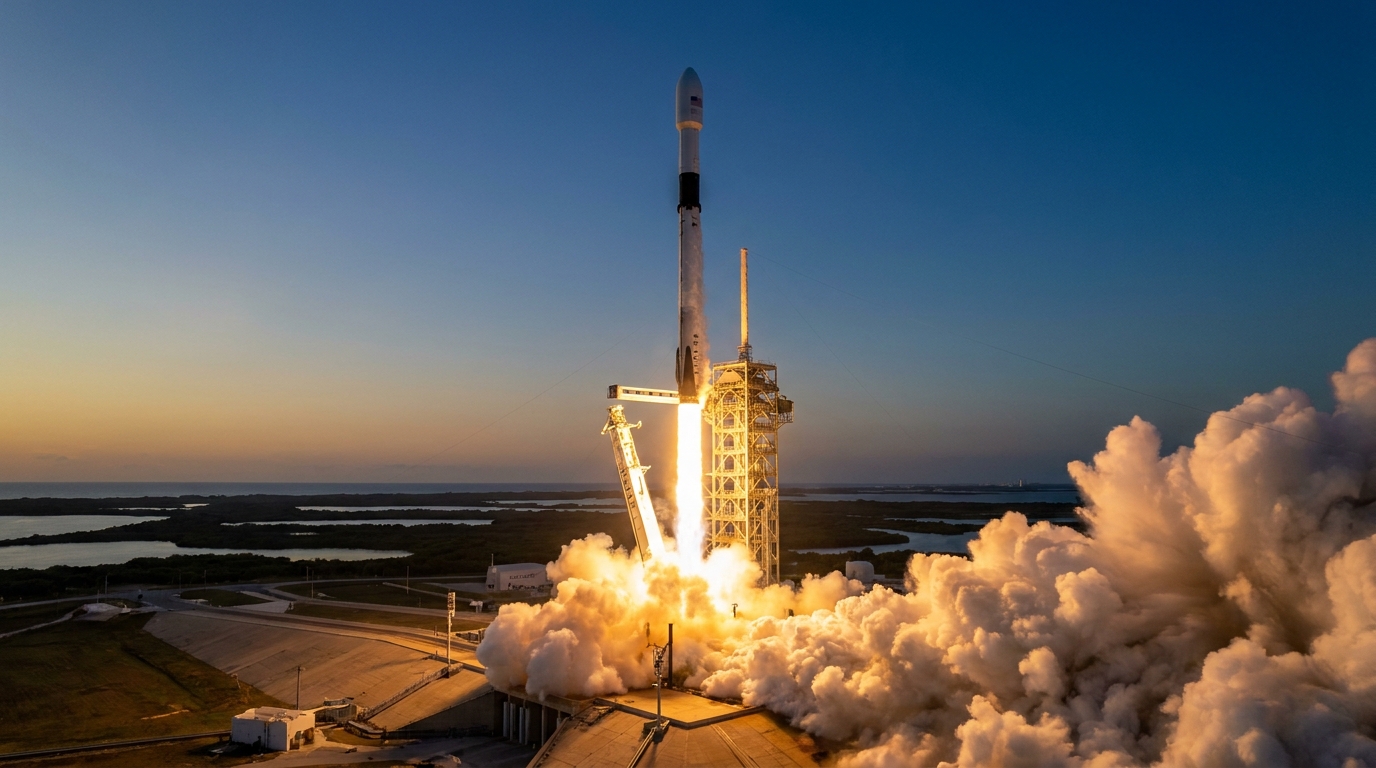
From the quest to reduce orbital costs to the development of Starship: understanding the engineering, engines, and the revolution of reusable launch vehicles.
QUICK SUMMARY
- Corporate Distinction: Tesla manufactures electric vehicles and does not design or build rockets. The rockets associated with Elon Musk belong strictly to SpaceX (Space Exploration Technologies Corp.), although both ventures share leadership and cross-industry material science synergies.
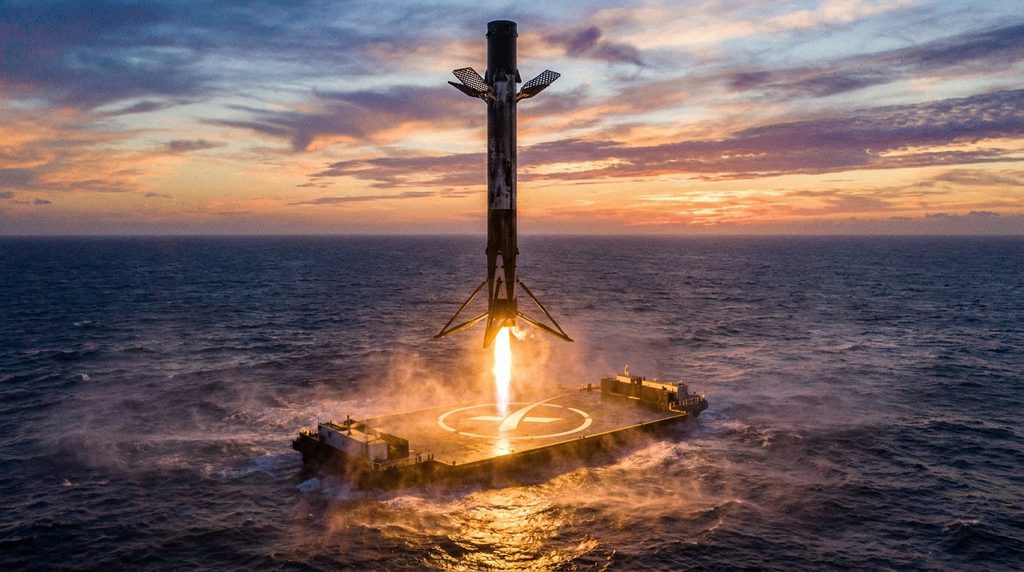
- The Paradigm Shift: Historically, space launch vehicles were expendable, costing hundreds of millions of dollars per launch. SpaceX introduced propulsive reusability with the Falcon 9, landing its first stage vertically on solid ground and autonomous ocean drone ships.
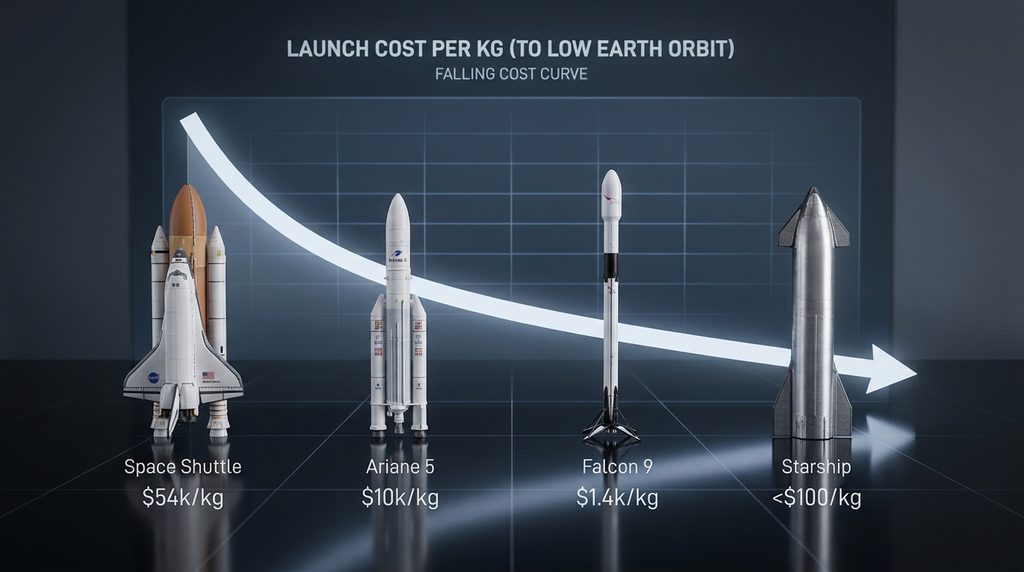
- Drastic Cost Reduction: The cost to deliver payload to Low Earth Orbit (LEO) plummeted from approximately $54,000/kg during the Space Shuttle era to under $1,500/kg with the Falcon 9, democratizing commercial space access.
- Engine Evolution: Merlin engines power the Falcon vehicle family using rocket-grade kerosene (RP-1) and liquid oxygen (LOX). Raptor engines power Starship using liquid methane (CH4) and liquid oxygen under a complex full-flow staged combustion cycle.
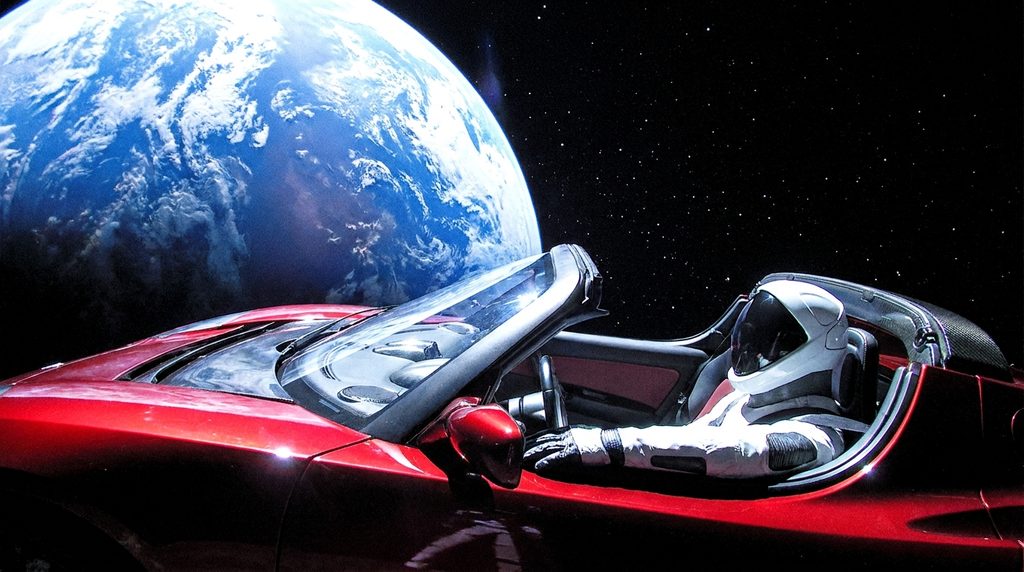
- The Tesla in Space: In 2018, during the maiden test flight of the super-heavy Falcon Heavy rocket, Musk’s personal cherry-red Tesla Roadster—occupied by the space-suited mannequin “Starman”—was launched into a heliocentric orbit extending past Mars.
- The Starship Era: The Starship/Super Heavy system represents the largest and most powerful launch architecture ever built, designed for 100% full reusability to support NASA’s Artemis lunar missions and eventual Mars colonization.
SpaceX Rockets: How Reusability Changed the History of Space Exploration
For more than half a century, access to outer space remained the exclusive domain of national governments equipped with multi-billion-dollar budgets. Space launch vehicles were constructed as bespoke masterworks of aerospace engineering: extraordinarily complex machines assembled over years, whose first and second stages plummeted into the ocean as unrecoverable scrap after only minutes of operation. A frequent analogy within space policy circles highlighted the absurdity of this paradigm: it was the functional equivalent of scrapping a brand-new commercial airliner after a single transatlantic flight between New York and London.
The pivotal shift in the twenty-first century arrived with the founding of SpaceX (Space Exploration Technologies Corp.) in 2002 by Elon Musk. Although public perception frequently conflates Musk’s ventures, the electric vehicle manufacturer Tesla does not design or manufacture rockets. Nevertheless, the technological ecosystem nurtured between the two companies fundamentally disrupted both terrestrial transit and space logistics, culminating in the iconic 2018 event when a Tesla Roadster was launched into deep space aboard the Falcon Heavy rocket.
1. The Origin of the Revolution: From the Idea of Mars to Falcon 1
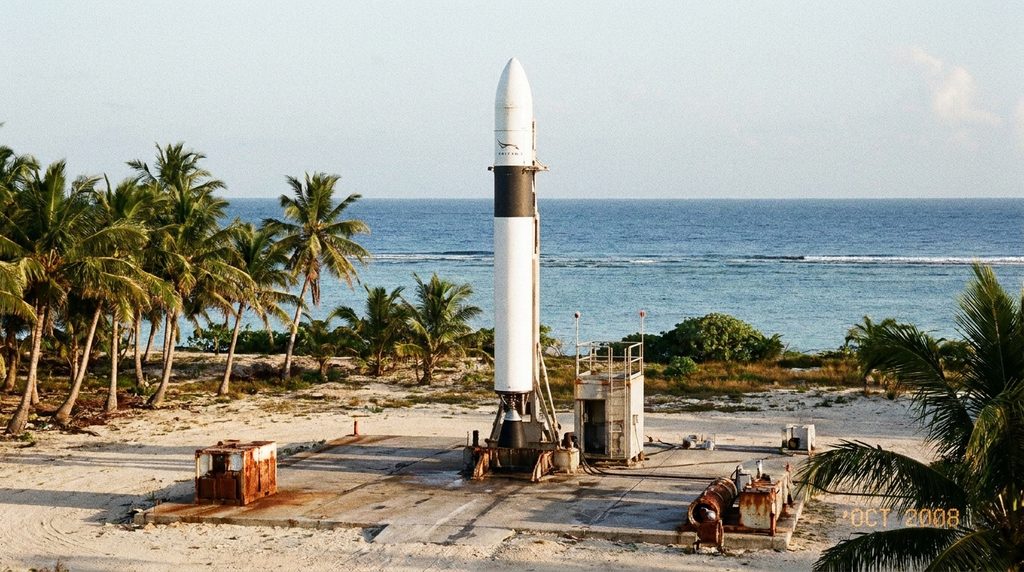
1.1 The Founding of SpaceX and the Pursuit of Low-Cost Access
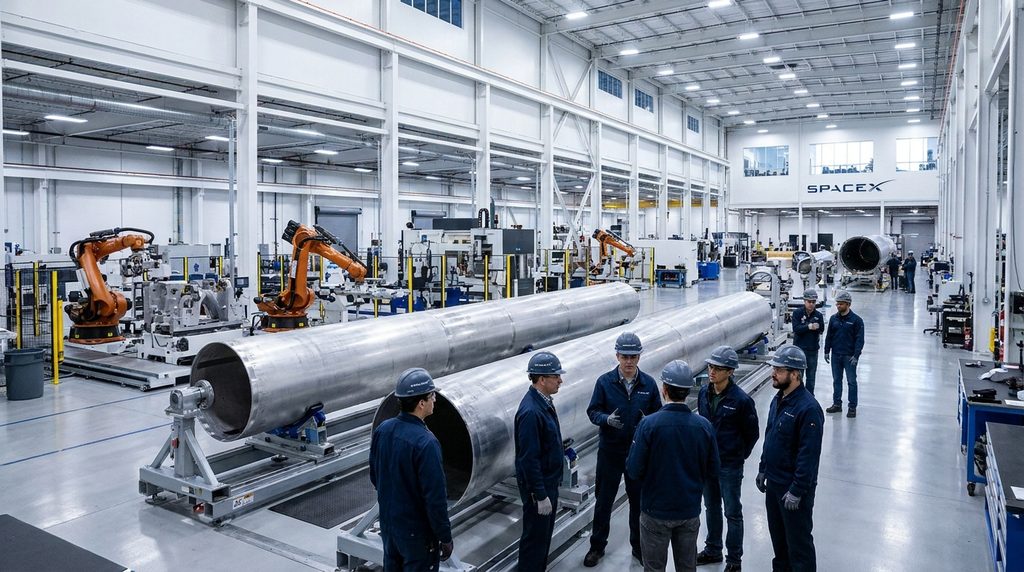
The concept of establishing a private aerospace enterprise originated from Musk’s frustration when attempting to purchase decommissioned intercontinental ballistic missiles in Russia to send a miniature greenhouse to Mars. Realizing that the fundamental barrier to interplanetary exploration was not political will or scientific ambition, but rather the astronomical cost per kilogram sent to orbit, Musk assembled a team of engineers to build rockets from scratch using first-principles engineering—prioritizing simplification, vertical integration, and structural reusability.
1.2 Early Failures and Falcon 1’s Historic 2008 Flight
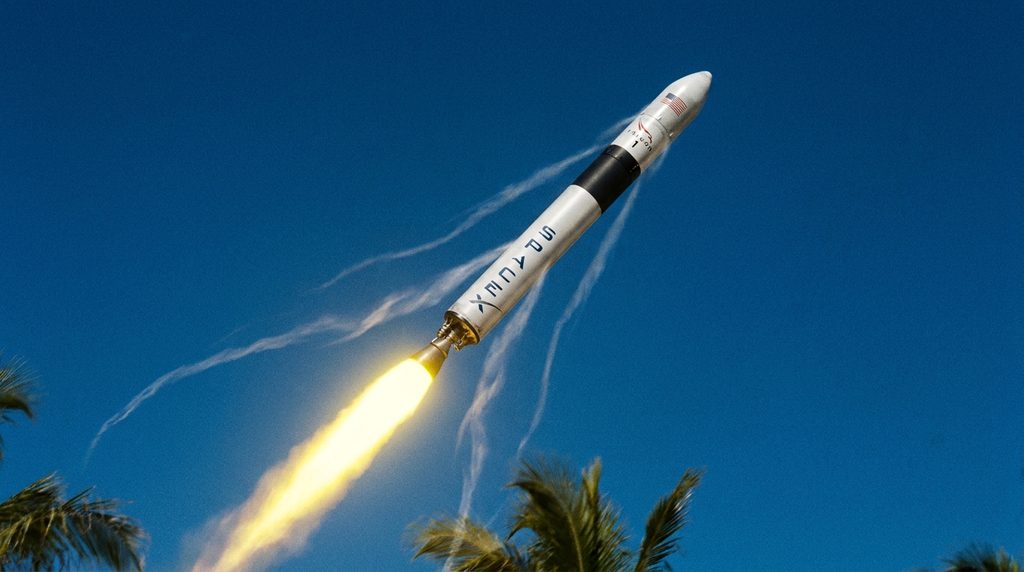
The initial operational phase brought SpaceX to the brink of bankruptcy. The company’s first vehicle, the Falcon 1—a light-lift two-stage rocket designed to place small payloads into orbit—failed in its first three launch attempts between 2006 and 2008 due to fuel line leaks, stage separation anomalies, and structural oscillations.
On September 28, 2008, departing from Kwajalein Atoll in the Pacific, the fourth launch of Falcon 1 successfully attained Earth orbit. It marked the first liquid-fueled, privately developed rocket to achieve orbit, securing the critical Commercial Resupply Services contract with NASA for the International Space Station (ISS).
2. The Falcon Family and Vertical Landing Engineering
2.1 Falcon 9: The Workhorse of the Aerospace Industry
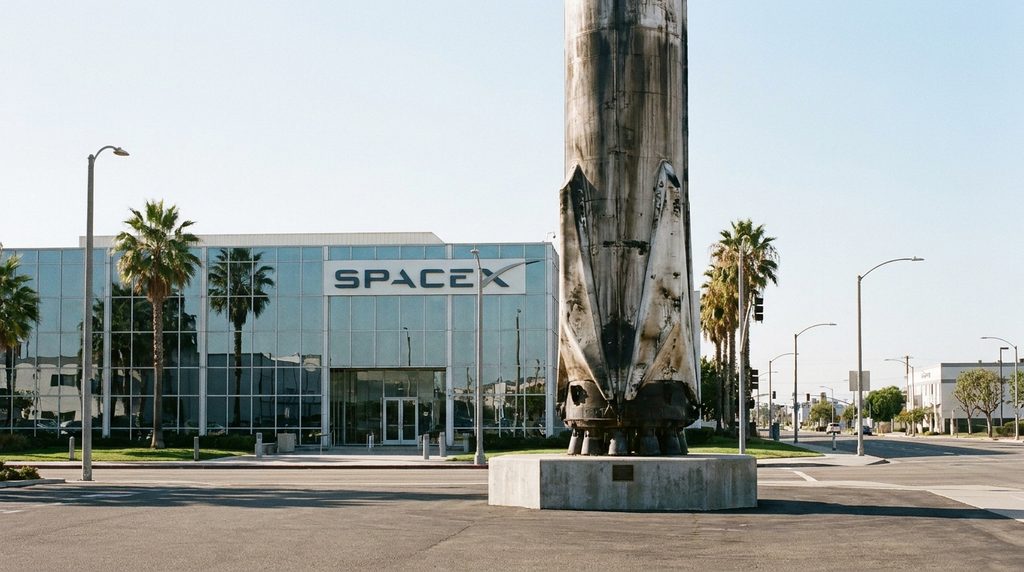
Following the retirement of NASA’s Space Shuttle fleet in 2011, the global space transportation market desperately required reliable orbital access. SpaceX engineered the Falcon 9, a 70-meter-tall two-stage launch vehicle propelled by nine Merlin engines on its first stage. Falcon 9 not only assumed cargo (and later crewed) missions to the ISS via the Dragon spacecraft, but rapidly evolved into the most active and reliable commercial launch vehicle in aerospace history.
2.2 Landing to Reuse: Grid Fins, Boosters, and Autonomous Spaceport Drone Ships
The structural breakthrough of Falcon 9 was the practical implementation of Vertical Takeoff, Vertical Landing (VTVL) architecture. Upon executing its primary mission of pushing the upper stage and payload beyond the dense atmosphere, the first-stage booster separates and initiates an autonomous sequence of propulsive maneuvers:
- Boostback Burn: Engine re-ignition to arrest downrange velocity and redirect trajectory toward the landing target.
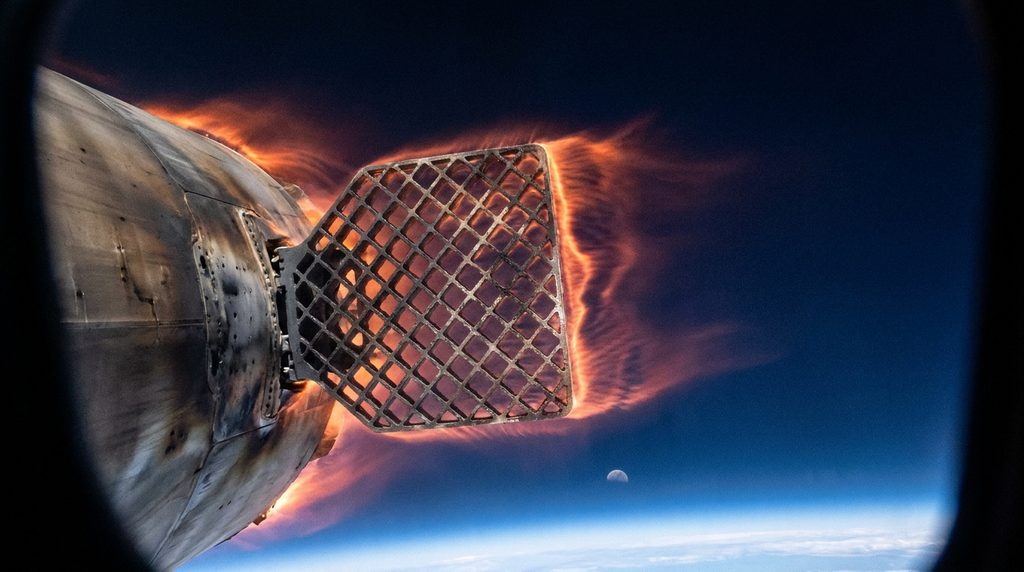
- Grid Fins: Hypersonic titanium grid fins deploy at the top of the booster to steer the vehicle through atmospheric entry.
- Reentry Burn: Multi-engine ignition to decelerate and shield the airframe from severe aerodynamic heating.
- Landing Burn and Touchdown: Final single-engine ignition to decelerate to near-zero velocity precisely as four carbon-fiber landing legs deploy over ground landing pads (Landing Zones) or autonomous ocean vessels (Autonomous Spaceport Drone Ships, famously named Just Read the Instructions and Of Course I Still Love You).
This flight architecture has permitted individual first-stage boosters to fly and land over 20 times each, dramatically lowering orbital delivery costs.
2.3 Falcon Heavy: Triple Power and the Symbolic Payload of the Tesla Roadster
For super-heavy payloads or deep-space trajectories, SpaceX engineered the Falcon Heavy, constructed by integrating three Falcon 9 first-stage cores side-by-side, generating over 5 million pounds of thrust at liftoff—equivalent to eighteen Boeing 747 aircraft operating at maximum thrust.
During the maiden demonstration flight of Falcon Heavy on February 6, 2018, the vehicle required a mass simulator payload. Rejecting traditional blocks of concrete or steel, Musk placed his personal cherry-red Tesla Roadster into the payload fairing, driven by a spacesuit-clad mannequin named “Starman” playing David Bowie’s “Space Oddity.” The launch served as a global engineering and branding milestone, demonstrating both Falcon Heavy’s super-heavy capability and the technological synergy of Musk’s ventures. The vehicle remains in a heliocentric orbit crossing the trajectory of Mars.
3. Propulsion Engineering: Merlin vs. Raptor Engines
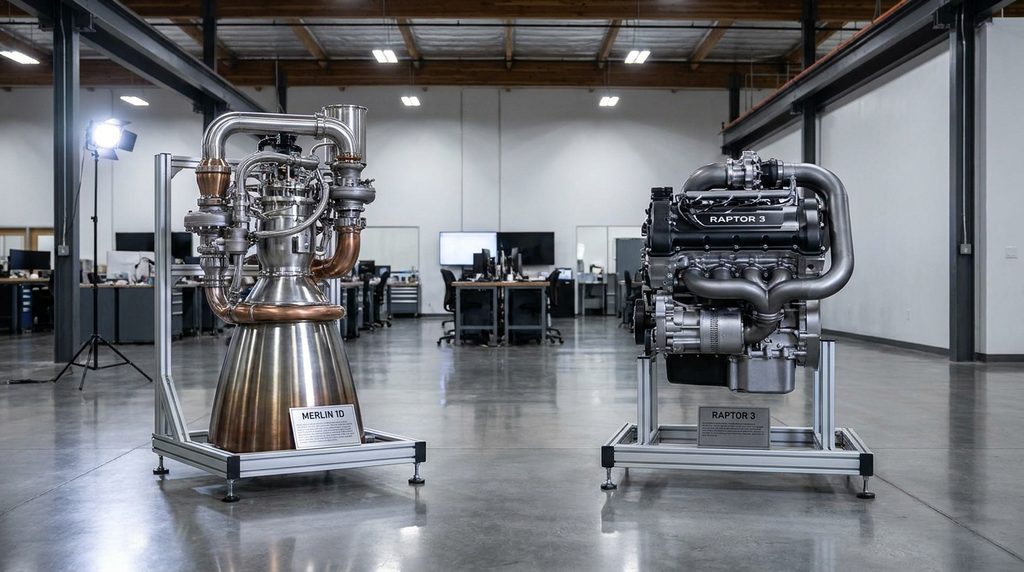
The operational boundary of any launch vehicle is governed by propulsive efficiency and engine cycle design. The evolution of SpaceX highlights the paradigm shift between two core propulsion architectures:
| Parameter | Merlin 1D Engine | Raptor 3 Engine |
| Primary Vehicle | Falcon 9 / Falcon Heavy | Starship / Super Heavy |
| Fuel | RP-1 (Highly refined rocket-grade kerosene) | CH4 (Liquid Methane) |
| Oxidizer | LOX (Liquid Oxygen) | LOX (Liquid Oxygen) |
| Engine Cycle | Gas-Generator (Open Cycle) | Full-Flow Staged Combustion (Closed Cycle) |
| Thrust (Sea Level) | ~845 kN (190,000 lbf) | ~2,700 kN (600,000+ lbf) |
| Chamber Pressure | ~9.7 MPa (97 bar) | ~35 MPa (350 bar) |
| Reusability Objective | Terrestrial / Regional orbital reuse | Rapid interplanetary reuse & in-situ resource utilization on Mars |
3.1 Merlin: Efficiency with Rocket-Grade Kerosene (RP-1) and Liquid Oxygen
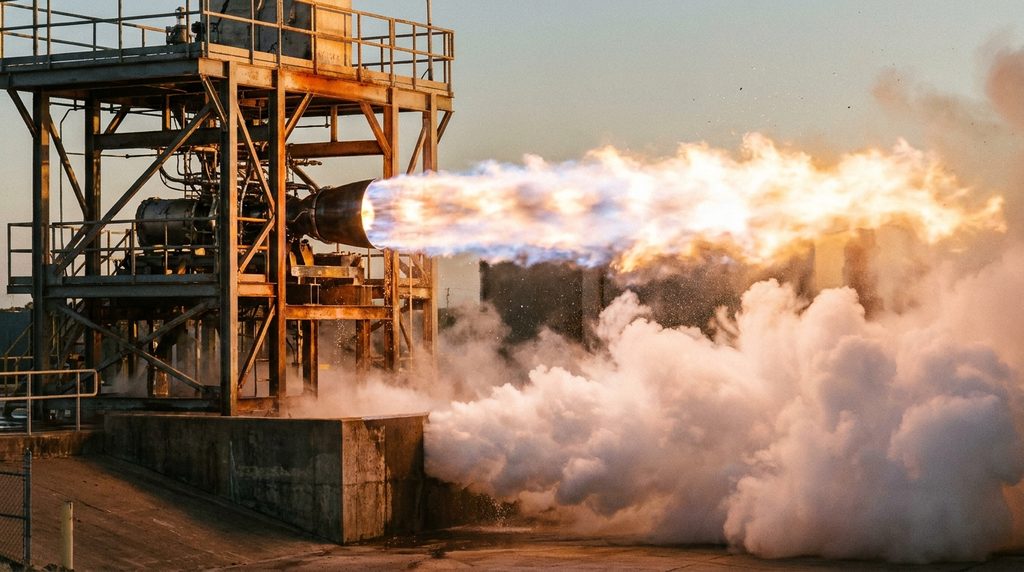
The Merlin 1D engine utilizes an open gas-generator cycle, where a fraction of unburned propellant powers the turbopumps and is exhausted overboard. While exceptionally reliable and power-dense, burning RP-1 generates soot deposits inside turbomachinery and injectors, requiring rigorous refurbishment between reflights.
3.2 Raptor: The Era of Methane and Full-Flow Staged Combustion
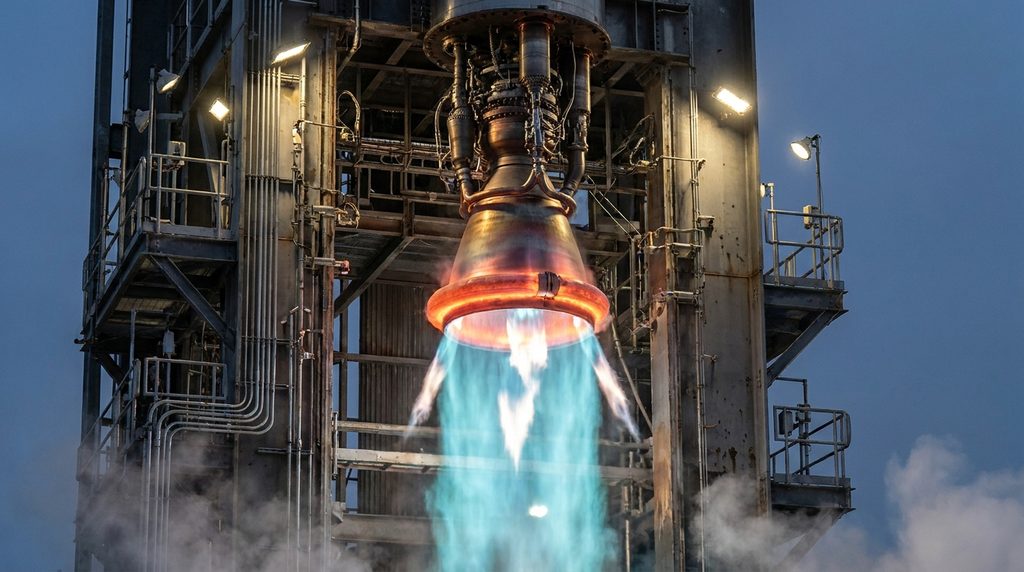
The Raptor engine represents a pinnacle in rocket propulsion design, operating on a full-flow staged combustion cycle. Historically deemed too complex for operational flight by Soviet and American programs, full-flow staged combustion routes all fuel and oxidizer through separate preburners into gaseous states before entering the main combustion chamber, achieving internal chamber pressures exceeding 350 bar.
Liquid methane (CH4) was selected deliberately: it burns without leaving coking deposits (enabling rapid reusability without deep engine cleaning) and can be synthesized on Mars from atmospheric carbon dioxide and subsurface water ice via the Sabatier reaction, enabling return transit to Earth.
4. Starship: The Largest Rocket in History and the Interplanetary Vision
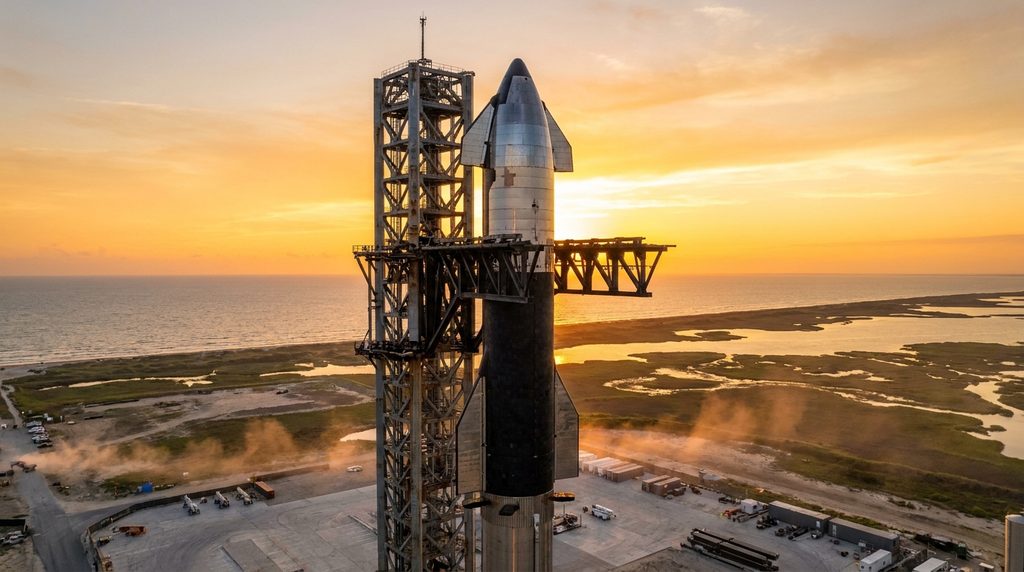
4.1 The Fully Reusable System: Super Heavy and Starship
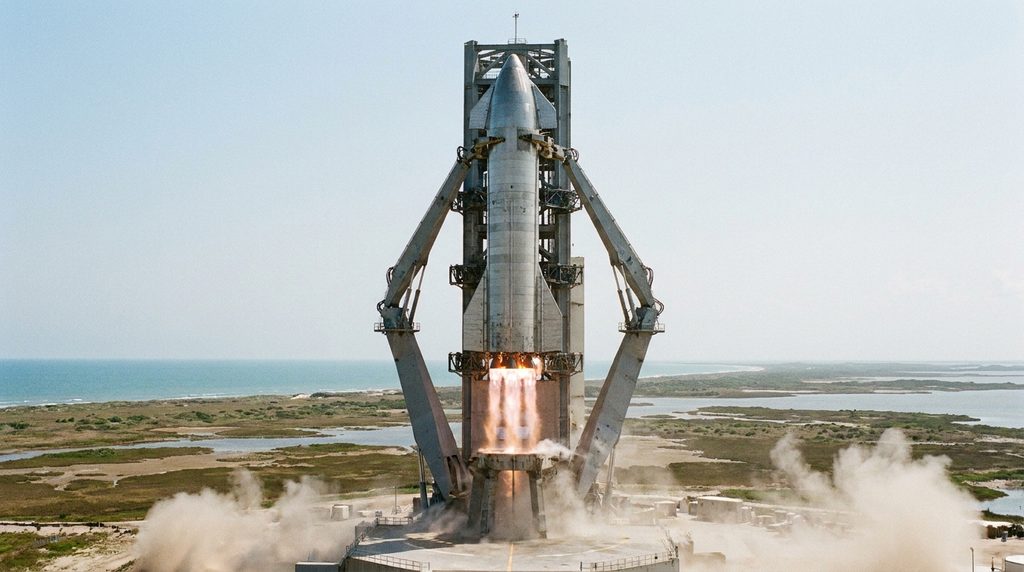
The Starship system is SpaceX’s core architecture for deep-space transportation. Composed of the Super Heavy first-stage booster (powered by 33 Raptor engines) and the Starship upper-stage spacecraft, the stacked stack stands 121 meters (397 feet) tall—surpassing NASA’s historic Saturn V and Space Launch System (SLS).
Unlike Falcon 9, where only the first stage is recovered, Starship is designed for 100% full and rapid reusability. The Super Heavy booster is caught mid-air upon return by giant mechanical arms (chopsticks) mounted to the launch tower (“Mechazilla”), while the Starship upper stage re-enters the atmosphere protected by thousands of hexagonal ceramic thermal tiles before performing a belly-flop landing maneuver.
4.2 Starship’s Role in NASA’s Artemis Program and Mars Colonization
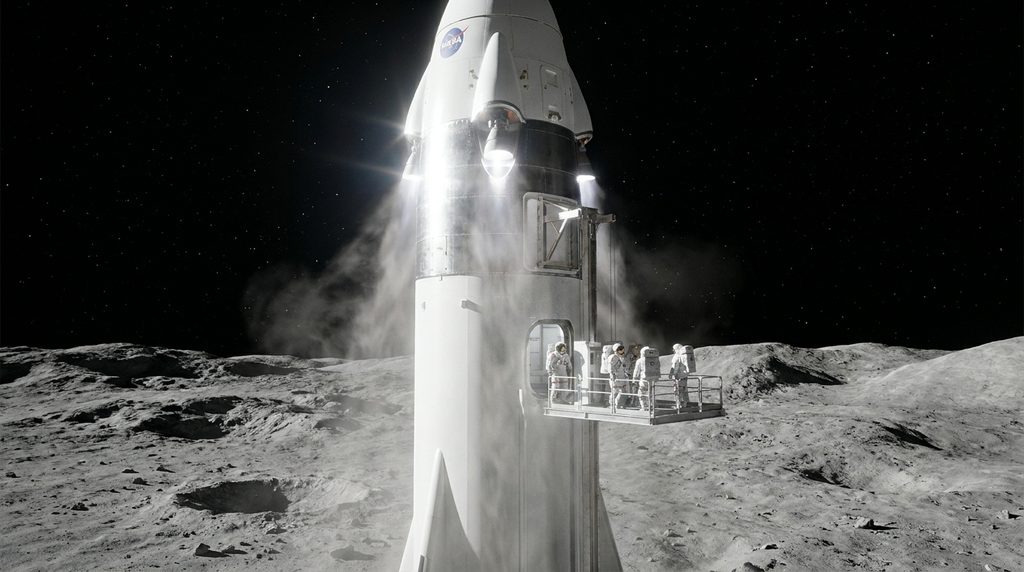
Starship’s operational deployment extends beyond commercial satellite delivery. NASA selected a dedicated lunar variant of Starship as the Human Landing System (HLS) for the Artemis III and Artemis IV missions to land astronauts back on the lunar surface. Simultaneously, Starship’s target payload capacity of 100 to 150+ metric tons in fully reusable configuration enables high-density deployment of Starlink constellations and the logistics architecture required for permanent human settlements on Mars.
5. Economic Impact, Controversies, and the Future of the Space Sector
5.1 The Dramatic Reduction of Cost per Kilogram to Orbit
The deployment of Falcon 9 and the development of Starship have reshaped space economics:
- Space Shuttle Era (NASA): Estimated launch costs of ~$54,000 per kilogram to Low Earth Orbit.
- Legacy Expendable Launchers (e.g., Ariane 5, Atlas V): $10,000 to $20,000 per kilogram.
- Falcon 9 / Falcon Heavy (SpaceX): $1,400 to $2,500 per kilogram.
- Starship Target Projection: Under $100 per kilogram in sustained, high-frequency operations.
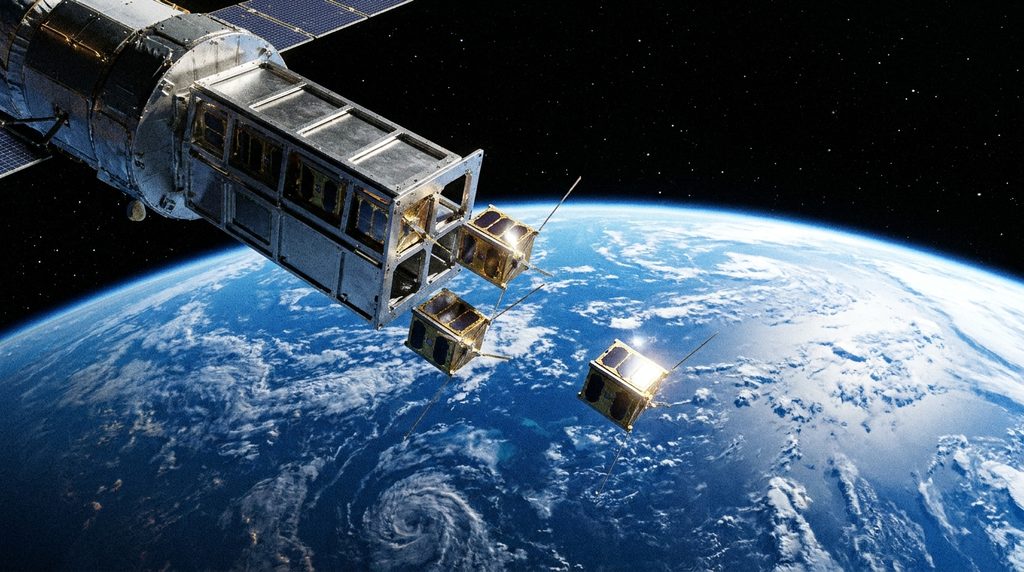
This economic shift catalyzed the “NewSpace” ecosystem, lowering barriers for commercial startups, research universities, and developing nations to place hardware in space.
5.2 Environmental Challenges, Orbital Debris, and Astronomical Observation
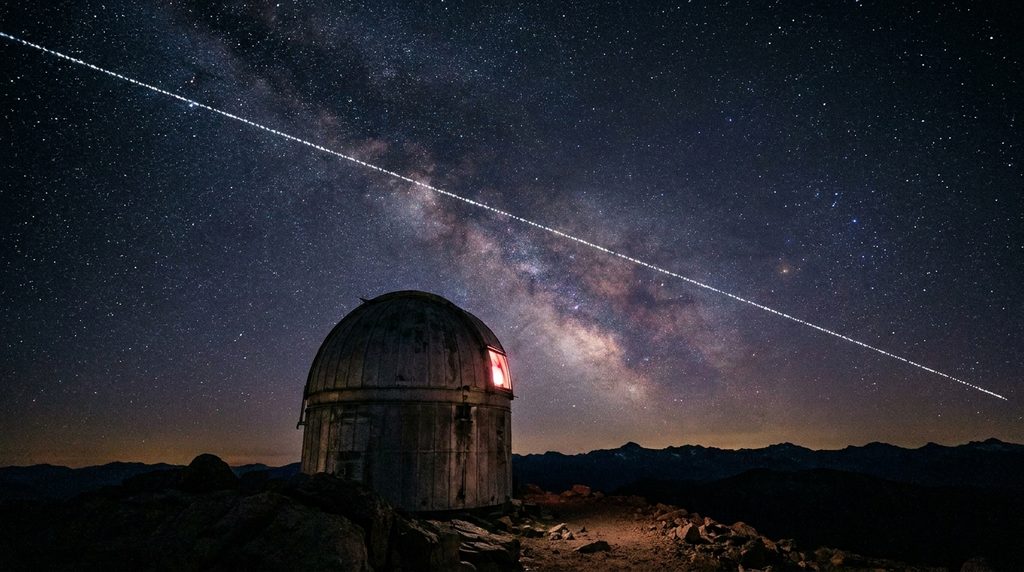
The high-frequency launch model has also generated notable environmental and scientific debates:
- Astronomical Light Pollution: Large satellite megaconstellations (Starlink) create reflective streaks in optical astronomical observations.
- Orbital Debris Management (Kessler Syndrome): Populating low Earth orbit with tens of thousands of active satellites demands automated collision avoidance systems and strict end-of-life deorbit protocols.
- Local Ecological Impact: Launch operations and test events at Starbase in Boca Chica, Texas, remain subject to regulatory oversight by the FAA and wildlife conservation groups regarding acoustic vibration, overpressure waves, and local habitat disturbance.
4. WHAT THE EVIDENCE ALLOWS US TO CONCLUDE
- Well-Established Facts: Propulsive first-stage reusability via vertical landing (VTVL) is operationally proven and has permanently altered launch logistics economics. Falcon 9 has completed hundreds of successful re-flights and landings.
- Limited / Developing Evidence: The long-term commercial efficiency of orbital propellant transfer (in-space refueling of liquid methane and liquid oxygen required for lunar and Martian Starship missions) has solid theoretical grounding and early flight testing, but awaits full operational validation.
- Ongoing Debates: The exact timeline for Starship to achieve full, rapid reusability with per-kilogram costs below $100, and the long-term regulatory frameworks balancing rapid launch cadences with environmental impact.
- Unsupported Claims: Assertions that Tesla Inc. manufactures or sells orbital launch vehicles are false. Tesla remains focused on ground electric transit and energy systems, though it shares material science insights (such as stainless-steel alloy development) and leadership with SpaceX.
5. FAQ — FREQUENTLY ASKED QUESTIONS
1. Does Tesla build space rockets? No. Tesla Inc. manufactures electric vehicles, battery energy storage systems, and solar technology. Launch vehicles such as Falcon 9, Falcon Heavy, and Starship are designed, manufactured, and launched exclusively by SpaceX (Space Exploration Technologies Corp.).
2. Why was a Tesla car launched into space in 2018? During the maiden test flight of the Falcon Heavy rocket in 2018, a mass simulator payload was required to validate performance. Elon Musk chose his personal cherry-red Tesla Roadster carrying a mannequin named “Starman” as a combined engineering test mass and marketing demonstration.
3. What is the most powerful rocket currently operating? The Starship/Super Heavy system is the tallest (121 meters / 397 feet) and most powerful rocket ever built, producing over 16 million pounds of liftoff thrust—more than double the thrust of the Apollo Saturn V.
4. How do Falcon 9 boosters land back on Earth? First-stage boosters use autonomous flight computers, hypersonic titanium grid fins for atmospheric steering, and cold-gas thrusters alongside controlled re-ignitions of their Merlin engines to decelerate and land vertically on ground pads or ocean drone ships.
5. What is the difference between Falcon 9 fuel and Starship fuel? Falcon 9 burns RP-1 (highly refined rocket-grade kerosene) and liquid oxygen. Starship burns liquid methane (CH4) and liquid oxygen. Methane burns cleaner without soot buildup, enabling rapid reuse, and can be synthesized on Mars.
6. GLOSSARY
- Booster (First Stage): The lower propulsive section of a launch vehicle that provides the primary thrust required to lift the rocket off the launch pad and through the thickest parts of Earth’s atmosphere.
- VTVL (Vertical Takeoff, Vertical Landing): Rocket architecture capable of launching vertically and executing a powered vertical landing back on Earth.
- LEO (Low Earth Orbit): Earth-centered orbit with altitudes ranging from 160 kilometers (99 miles) to 2,000 kilometers (1,200 miles).
- RP-1 (Rocket Propellant 1): Highly refined grade of kerosene formatted specifically for liquid rocket engines.
- Full-Flow Staged Combustion: Advanced closed rocket engine cycle where both propellant streams pass through separate preburners into gas states before main chamber combustion, maximizing efficiency and chamber pressure.
- Starbase: SpaceX’s primary manufacturing, testing, and launch complex located in Boca Chica, Texas.
- HLS (Human Landing System): Specialized lunar landing variant of the Starship spacecraft contracted by NASA under the Artemis program.
7. REFERENCES
- SpaceX. Falcon 9 Payload User’s Guide. SpaceX Commercial Launch Services Publication, Hawthorne, CA, 2023.
- National Aeronautics and Space Administration (NASA). Commercial Crew Program & Artemis Human Landing System Contract Specifications. NASA Public Reports, 2021–2024.
- Federal Aviation Administration (FAA). Final Programmatic Environmental Assessment for the SpaceX Starship/Super Heavy Launch Vehicle at Boca Chica, Texas. FAA Office of Commercial Space Transportation, 2022.
- Sutton, George P.; Biblarz, Oscar. Rocket Propulsion Elements. 9th Edition, John Wiley & Sons, 2016.
- American Institute of Aeronautics and Astronautics (AIAA). Reusability Metrics and Full-Flow Staged Combustion Architecture in Modern Launch Systems. AIAA Journal of Spacecraft and Rockets, 2022.
Leave a comment