
Microsoft Won the Browser War. TheNext Platforms Were Harder
From a small software company to the operating system at the center of the PC
In 1975, Microsoft did not look like the beginning of a technological empire. The company emerged from a much smaller opportunity: the arrival of the Altair 8800, an early personal computer whose appearance on the cover of Popular Electronics caught the attention of Bill Gates and Paul Allen. The two recognized that the machine needed software and developed a version of BASIC for it. They completed Altair BASIC and sold it to MITS in Albuquerque, New Mexico, creating the first commercial foundation of what would become Microsoft. At the end of 1975, the partnership had generated only $16,005 in sales. The scale was tiny, but the underlying insight was enormous: as computing hardware spread, software could become a reusable layer that travelled from machine to machine rather than being built into a single piece of hardware.
That distinction became increasingly important as the personal-computer industry developed.
Microsoft was not trying to manufacture the machines that would sit on people’s desks; it was positioning itself to supply the software that made those machines useful. The decisive opportunity arrived in 1980, when IBM was preparing its own personal computer. Microsoft supplied the operating system that became MS-DOS, and when the IBM PC was introduced in August 1981, Microsoft’s software became part of the foundation of a rapidly expanding PC ecosystem. Microsoft subsequently developed software for an industry that was becoming less about one manufacturer’s machine and more about a broad hardware ecosystem running compatible software.
The importance of this model is easy to underestimate from the present. Microsoft’s great early advantage was not simply that it produced popular software. It was that the company increasingly occupied a position between hardware manufacturers and software developers. Windows eventually transformed that position into something much more powerful. The first version of Windows, released in 1985, was a graphical environment built on top of MS-DOS. It did not immediately replace the importance of DOS, but it gave Microsoft a path toward controlling the user interface of the personal computer as computing moved toward graphical interaction. Microsoft moved its headquarters to Redmond in 1986, the same year it went public, as the company transitioned from a young software business into a major technology corporation.
The Windows era changed what Microsoft actually was
During the late 1980s and 1990s, Microsoft’s strategic center moved from individual software products toward an ecosystem. Windows became the common environment through which millions of users interacted with applications, while Microsoft Office became one of the most important productivity-software franchises in computing. The combination was powerful because each reinforced the other: Windows provided the platform, Office provided essential applications, and developers had strong incentives to build software for the platform with the largest installed base. The resulting network effects made Microsoft’s position extraordinarily difficult to challenge.
This was the period in which Microsoft became synonymous with the personal computer itself. Its business model benefited from the fact that Windows could be licensed to many hardware manufacturers rather than being restricted to machines produced by Microsoft. The company could therefore expand with the PC market without having to manufacture every PC. The economics were fundamentally different from those of a hardware company: once software had been developed, distributing another copy could be comparatively inexpensive, while the installed base created additional incentives for developers, businesses and consumers to remain within the ecosystem.
But the same dominance that made Microsoft extraordinarily powerful also created a strategic vulnerability. The PC was becoming the gateway to the internet, and the internet introduced a new possibility: what if the most important platform was no longer Windows?
The browser war was really a platform war
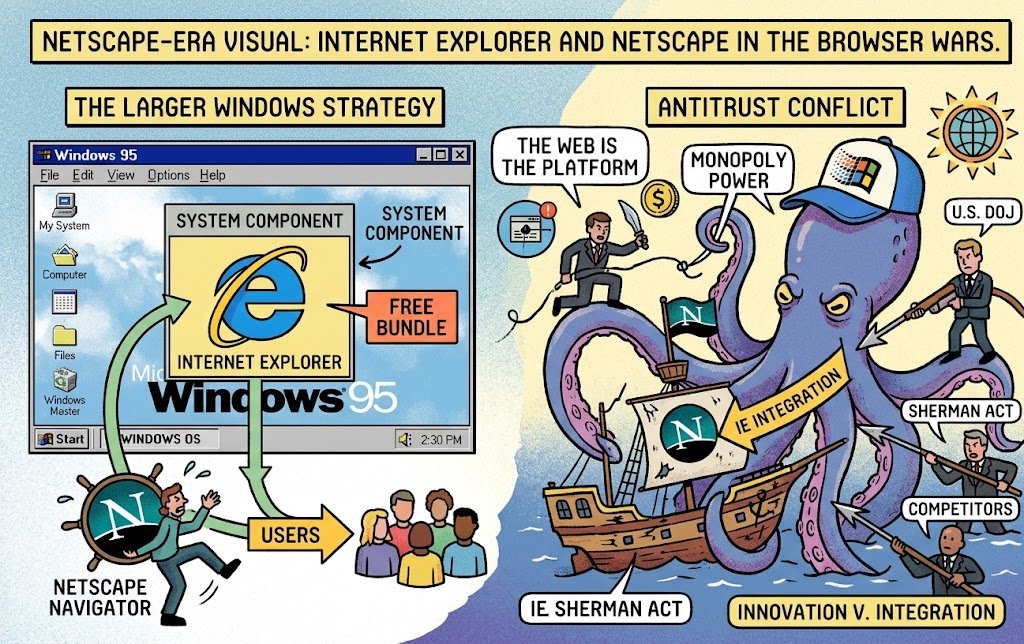
Microsoft initially treated the internet as a threat that had to be incorporated into its existing strategy. Internet Explorer was introduced in 1995, and the company subsequently moved aggressively to increase its browser’s usage by integrating it with Windows. The government’s antitrust case against Microsoft later documented how the company sought to prevent Netscape Navigator from becoming a platform capable of weakening Windows’ applications barrier to entry. The court found that Microsoft used its operating-system position in ways that restricted competitors, including tying Internet Explorer to Windows and imposing restrictions on OEMs and other distribution channels.
The significance of the episode extends beyond the legal dispute. Microsoft understood something important about the emerging internet economy: a browser could become more than a program for viewing websites. If developers began writing applications for a browser rather than for Windows, the browser could become an alternative platform. In that scenario, Windows would no longer be the indispensable layer between hardware and software. The browser war was therefore, from Microsoft’s perspective, partly a fight over whether the company’s existing economic architecture would remain relevant.
Microsoft ultimately succeeded in preventing Netscape from becoming the dominant platform layer it feared. But winning that battle did not mean Microsoft had won the internet. The company had protected the Windows ecosystem, yet the center of technological innovation was gradually moving beyond the PC operating system itself. Search, web advertising, social networks, online services and eventually mobile computing were creating new platforms with different economics. Microsoft’s ability to defend Windows did not automatically give it leadership over those new categories.
That distinction became critical in the following decade.
The company remained financially powerful while its strategic position became less secure
The post-2000 Microsoft is often described as a company that lost its way, but the financial record makes the story more complicated. Microsoft remained extraordinarily profitable. Windows and Office continued to generate substantial cash, enterprise software became increasingly important, Xbox created a significant consumer platform, and the company continued investing heavily in research and development. The problem was not that Microsoft suddenly stopped being a successful business. The problem was that the technology industry was changing faster than the strategic center of the company.
The arrival of Google, the rapid expansion of web services and the emergence of smartphones altered the competitive landscape. Microsoft had products in many of these categories, but possessing a product was not the same as controlling the platform around which the market was developing. The company had Bing in search, Windows Phone in mobile, Xbox in gaming, Internet Explorer in browsing, and numerous online services, yet these businesses did not reproduce the structural dominance that Windows had achieved in PCs.
This became particularly visible in mobile computing. Apple and Google established ecosystems around iOS and Android while the center of consumer computing moved from desktop PCs toward smartphones and tablets. Microsoft’s Windows Phone strategy never achieved the scale necessary to become a comparable mobile platform. The company’s 2014 annual report shows the tension clearly: Microsoft was still producing $86.8 billion in revenue and $27.8 billion in operating income, but it was also reorganizing around a changing technological environment and attempting to build a mobile strategy.
The Nokia acquisition in 2014 illustrates this transition particularly well. Microsoft completed the acquisition of substantially all of Nokia’s Devices and Services business on April 25, 2014, creating a new Phone Hardware segment. The company was attempting to strengthen its position in mobile hardware and integrate phones with its software ecosystem. Yet the acquisition did not reverse the broader market shift. Microsoft eventually reduced and reorganized its smartphone hardware ambitions rather than becoming a major rival to Apple’s and Google’s mobile platforms.
The deeper problem was strategic. Microsoft’s historic strength had been built around controlling the software layer of a dominant computing architecture. Mobile computing created a different architecture, and Microsoft did not control it.
Satya Nadella changed the center of gravity
The most consequential change in Microsoft’s modern history came in 2014, when Satya Nadella became chief executive. His significance was not simply that he introduced new products. The more important change was the strategic center he placed behind the company.
Under Nadella, Microsoft increasingly organized itself around cloud computing, productivity services and platforms that could operate across devices rather than requiring users to remain inside Windows. Office became a cloud service through Microsoft 365. Azure became a central infrastructure platform. Enterprise software, developer tools and cloud services increasingly reinforced one another. Microsoft’s own description of its strategy in 2016 explicitly framed the company around a “mobile-first, cloud-first” world, while emphasizing that mobility meant the movement of experiences across devices rather than ownership of a particular device category.
That was a crucial conceptual shift. Microsoft did not need to win the smartphone operating-system war if it could become indispensable to people and organizations regardless of which phone, tablet or computer they used. Word could run on an iPad. Office could be delivered through the cloud. Azure could support applications running on many different platforms. Microsoft’s relationship with customers could therefore become less dependent on Windows itself.
The financial evidence began to reflect the transition. In fiscal 2016, Microsoft’s commercial cloud annualized revenue run rate exceeded $12.1 billion, Azure revenue grew 113%, and the company reported more than 70 million commercial Office 365 monthly users. At the same time, Microsoft acknowledged that its phone strategy was being narrowed and that its smartphone hardware business was being streamlined. The company was effectively abandoning the idea that it needed to control every layer of computing.
This was one of the defining differences between Microsoft’s earlier and later strategies. The old Microsoft sought to make the world conform to Windows. The new Microsoft increasingly sought to make Microsoft services valuable wherever the customer already was.
From Windows to an ecosystem of ecosystems
The transformation was reinforced through acquisitions and partnerships. Microsoft acquired LinkedIn in 2016, GitHub in 2018 and later Activision Blizzard, announced in 2022. These acquisitions expanded the company’s reach across professional networking, software development and gaming. Microsoft’s acquisition history shows how its portfolio increasingly extended beyond the traditional Windows-and-Office identity into developer communities, professional networks, cloud infrastructure and interactive entertainment.
GitHub was particularly revealing because it represented a relationship with developers that was not dependent on Windows. Developers could use GitHub with many operating systems and technologies, while Microsoft’s Azure platform could provide infrastructure for applications built by those developers. LinkedIn similarly expanded Microsoft’s position inside professional workflows rather than merely inside the desktop operating system. The company was assembling a network of products and services in which each could strengthen another without requiring Windows to remain the center of everything.
Azure became the most important expression of this new architecture. Cloud computing transformed software from something customers purchased and installed into something they could consume continuously as infrastructure and services. Microsoft already possessed decades of relationships with corporations, developers and IT departments. Azure allowed the company to convert those relationships into a new computing model.
The transformation was gradual rather than instantaneous. In 2016, Microsoft said its commercial cloud annualized revenue run rate had exceeded $12.1 billion. By fiscal 2025, Microsoft’s total Microsoft Cloud business had surpassed $168 billion in revenue, while Azure exceeded $75 billion in revenue after growing 34%. The numbers reveal the scale of the strategic migration: Microsoft had moved from selling primarily software licenses tied closely to the PC era toward operating one of the world’s largest cloud platforms.
Artificial intelligence created the next test
The arrival of generative artificial intelligence created another strategic transition, and Microsoft entered it from a substantially different position than it had entered the smartphone revolution. The company had Azure, enterprise customers, developer tools, productivity applications and enormous infrastructure investments. Its long-term partnership with OpenAI became an important part of this strategy, and Microsoft’s 2026 regulatory filing states that the relationship continued under a new definitive agreement signed in October 2025. The filing also reports that Microsoft recognized $24.1 billion in fiscal 2026 revenue from commercial arrangements with OpenAI, while disclosing an approximate 25% interest on an as-converted basis.
AI therefore fits into Microsoft’s existing strategic architecture in a way mobile never fully did.
Artificial intelligence requires enormous computing infrastructure, model access, developer platforms, enterprise distribution and applications. Microsoft already operates across those layers. Azure supplies infrastructure; its developer ecosystem supplies customers; Microsoft 365 supplies a huge installed base of knowledge workers; GitHub connects the company to software developers; and its enterprise relationships provide distribution into organizations.
The scale of the modern company illustrates how far the transformation has gone. In fiscal 2025, Microsoft reported $281.7 billion in revenue and $128.5 billion in operating income. Server products and cloud services generated $98.4 billion, while Microsoft 365 commercial products and cloud services generated $87.8 billion. These figures describe a company whose economic engine is no longer centered on Windows licensing.
The irony is that Windows remains enormously important, but it is no longer the complete explanation for Microsoft.
The real curve of Microsoft
Microsoft’s history is therefore not a simple story of rise, decline and comeback. It is a story of repeated changes in what the company considered its strategic center.
The first Microsoft sold software for emerging personal computers. The second Microsoft became the platform company behind the PC, with Windows and Office reinforcing one another. The third Microsoft fought to protect that platform when the internet threatened to move computing beyond the operating system. The fourth Microsoft entered the mobile era without establishing a comparable position in smartphones. The fifth Microsoft changed its definition of the customer: instead of requiring people to use Microsoft hardware or Windows everywhere, it increasingly sought to provide indispensable services across whatever devices and platforms customers chose. The sixth Microsoft built around cloud infrastructure, developer ecosystems, enterprise software and, increasingly, artificial intelligence.
That sequence explains why Microsoft’s story is more interesting than the familiar narrative that the company “almost lost the internet.” Microsoft did lose strategic ground in important areas of the internet economy. It also failed to establish itself as a major smartphone platform. But neither episode destroyed the company because the organization possessed something deeper than any individual product: an enormous installed base of customers, relationships with enterprises and developers, intellectual property, financial resources and the ability to shift its business model when the economics of computing changed.
The company’s greatest vulnerability appeared when it confused dominance in one layer of computing with permanence of that layer. Windows was extraordinarily powerful, but the internet demonstrated that computing could move above the operating system. Smartphones demonstrated that it could move into entirely different hardware ecosystems. Cloud computing demonstrated that infrastructure itself could become a service. Artificial intelligence is now changing how software is created and consumed again.
Microsoft’s survival across these transitions was not guaranteed by its size. Size can preserve an old business, but it can also make an old business harder to abandon. Microsoft’s more consequential transformation came when it stopped treating Windows as the destination and began treating Microsoft’s broader ecosystem as the destination.
That is the central curve of the company: Microsoft became dominant by controlling the platform, nearly became strategically constrained by that dominance, and rebuilt itself by becoming less dependent on controlling the platform at all.
A CURVE IN 60 SECONDS
● 1975: Bill Gates and Paul Allen develop Altair BASIC for the Altair 8800.
● 1981: MS-DOS becomes part of IBM’s PC launch, placing Microsoft at the center of the emerging PC industry.
● 1985: Microsoft releases the first version of Windows.
● 1990s: Windows and Office become the foundation of Microsoft’s dominant PC software ecosystem.
● 1995–1998: Microsoft fights Netscape and integrates Internet Explorer into Windows; the browser conflict becomes the center of the U.S. antitrust case.
● 2000s: Microsoft remains highly profitable but struggles to establish comparable leadership in emerging internet and mobile platforms.
● 2014: Satya Nadella becomes CEO; Microsoft acquires Nokia’s Devices and Services business while beginning a broader strategic transformation.
● 2016: Microsoft explicitly frames its strategy around mobile-first, cloud-first computing; Azure and Office 365 become increasingly central.
● 2016–2018: Microsoft acquires LinkedIn and GitHub, expanding its ecosystem beyond Windows.
● 2022: Microsoft announces the acquisition of Activision Blizzard, extending its position in gaming and interactive entertainment.
● 2025: Microsoft reports $281.7 billion in annual revenue, with Azure surpassing $75 billion.
● 2026: AI becomes an increasingly important layer of Microsoft’s cloud, productivity and developer strategy, while its OpenAI partnership remains strategically significant.
THE POSTMORTEM
What created the growth: Microsoft recognized early that software could become the scalable layer of the personal-computer revolution. Its licensing relationships, Windows platform and Office franchise created powerful network effects between users, hardware manufacturers and developers.
What sustained the peak: The Windows installed base, Office, enterprise relationships and developer ecosystem generated extraordinary financial strength. Even while Microsoft’s strategic position was being questioned, fiscal 2014 produced $86.8 billion in revenue and $27.8 billion in operating income.
Where the vulnerability appeared: The internet challenged the idea that the operating system would remain the primary platform layer. Microsoft successfully defended Windows against Netscape, but the broader technological center was moving toward web services, search, advertising and eventually mobile computing.
What changed the trajectory: The transformation under Satya Nadella shifted Microsoft’s strategic center from Windows toward cloud infrastructure, productivity services, enterprise software, developers and cross-platform experiences.
Internal vs. external: External changes—the internet, smartphones, cloud computing and AI—created the new environments. Microsoft’s trajectory depended on how successfully it reorganized itself around those environments.
Controllable vs. uncontrollable: Microsoft could not control the emergence of the smartphone or cloud computing. It could control where it invested, which platforms it supported, how it structured its businesses and whether it continued defining itself around Windows.
What remains uncertain: AI is the newest transition, and its long-term economics are still developing. Microsoft’s current position is substantially different from its position before the cloud transition, but the final shape of AI’s competitive structure remains unresolved.
LESSONS FROM THE CURVE
- A dominant product can become a strategic constraint when the market changes.
Windows created enormous value, but its centrality could not guarantee that the next computing architecture would revolve around Windows. - Financial strength and strategic weakness can coexist. Microsoft did not need to be collapsing financially for its position in technology to require fundamental change. Platforms can survive by moving up the stack. When Microsoft could no longer depend on owning the dominant device platform, it built relationships through cloud infrastructure, productivity software and developer services.
- Ecosystems can matter more than individual products. Azure, Microsoft 365, GitHub, LinkedIn, gaming and AI are more powerful together than as isolated businesses because they create multiple points of connection with customers and developers.
- Transformation is often a change in the definition of the company itself. Microsoft’s most important strategic decision was not simply to launch Azure or Office 365. It was to stop defining Microsoft’s future around the assumption that Windows had to remain the center of computing.
FAQ
Did Microsoft really almost miss the internet?
Microsoft responded aggressively to the internet and successfully defended Windows against Netscape, but its broader strategic position was challenged as computing shifted toward web services, search, advertising and later mobile platforms. The browser battle was fundamentally connected to the threat that web technologies could weaken Windows’ role as the central application platform.
Why did Microsoft struggle in smartphones?
Microsoft entered mobile computing with Windows Phone, but it did not establish a mobile ecosystem on the scale of iOS or Android. The company acquired Nokia’s Devices and Services business in 2014, but subsequently narrowed its smartphone hardware ambitions.
What changed when Satya Nadella became CEO?
The strategic emphasis shifted toward cloud computing, productivity services, enterprise software, developer platforms and experiences that worked across devices. Microsoft’s 2016 annual report explicitly described the strategy as building platforms and productivity services for a mobile-first, cloud-first world.
When did Azure become important?
Azure was already part of Microsoft’s cloud strategy before Nadella became CEO, but its importance accelerated substantially during the subsequent transformation. Microsoft’s 2016 annual report reported 113% Azure revenue growth for the fiscal year, while Microsoft reported more than $75 billion in Azure revenue in fiscal 2025.
Is Microsoft still primarily a Windows company?
No. Windows remains an important Microsoft product, but the company’s current financial structure is much broader. In fiscal 2025, Microsoft reported $98.4 billion from server products and cloud services and $87.8 billion from Microsoft 365 commercial products and cloud services, compared with a company-wide revenue total of $281.7 billion.
What is Microsoft’s next strategic test?
Artificial intelligence is the current major transition. Microsoft is integrating AI into Azure, Microsoft 365, developer tools and other services while maintaining a major partnership with OpenAI. The company reported that its Microsoft Cloud business exceeded $168 billion in fiscal 2025, with Azure growing 34% to more than $75 billion.
Sources
● Microsoft Learn — The History of Microsoft, including the 1975 origins of Altair BASIC and the company’s early development.
● Microsoft — About Microsoft, historical timeline covering MS-DOS, Windows and the company’s development.
● Microsoft — 2014 Annual Report, financial results, Nokia acquisition and mobile strategy.
● Microsoft — 2016 Annual Report, cloud strategy, Azure, Office 365 and Nadella’s mobile-first/cloud-first strategy.
● U.S. Department of Justice — U.S. v. Microsoft: Findings of Fact, documenting the browser and Windows platform conflict.
● U.S. Department of Justice — Microsoft Corporation v. United States, summary of the antitrust proceedings and rulings.
● Microsoft Investor Relations — Acquisition History, including LinkedIn, GitHub and Activision Blizzard.
● Microsoft — 2025 Annual Report, current financial structure, Azure and Microsoft Cloud performance.
● U.S. SEC — Microsoft fiscal 2025 results.
● U.S. SEC — Microsoft fiscal 2026 filing, including the OpenAI strategic relationship.