

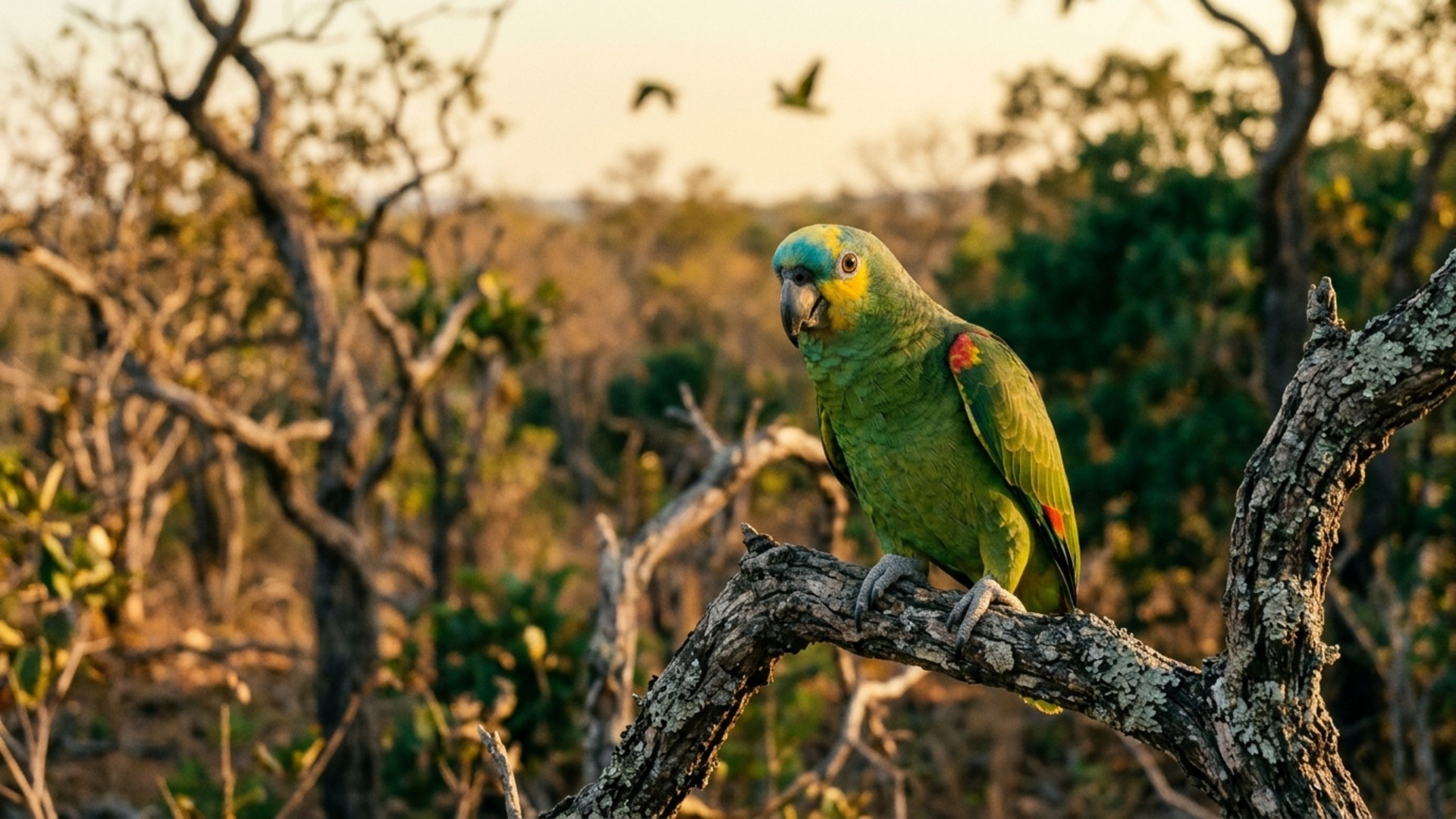
From ancient origins to wildlife trafficking in Brazil’s Cerrado: biology, intelligence, law, and care for the turquoise-fronted Amazon and its relatives.
Summary
- In Brazil, “papagaio” usually means birds of the genus Amazona, relatives of macaws, parakeets, and cockatoos in the order Psittaciformes.
- Parrots can talk because their brains have a vocal system built “inside” another vocal system, found only in this group. Not every parrot learns to speak, though.
- The case of Alex the African grey shows that a parrot can link words to categories. Scientists still debate whether that is “language” or understanding comparable to ours.
- The turquoise-fronted Amazon is listed as “Near Threatened” in Brazil and on the IUCN Red List, and chick trafficking is one of its biggest pressures.
- Keeping a parrot legally in Brazil requires proof of origin (an authorized breeder, an invoice, and identification marking), and it is a commitment that can last decades.
- A diet of sunflower seeds alone is a common mistake. Parrots need varied food, mental stimulation, and avian veterinary care.
The Bird That Talks, Thinks, and Lives for Decades
Few animals are as famous as the parrot. The scene is a classic: the bird blurts out a sentence in the middle of the living room, the whole family freezes, and someone asks what everyone is thinking. Does it know what it just said?
The honest answer is more interesting than a plain yes or no. Behind the talking parrot is a brain with a structure found in no other bird, a family of species with tens of millions of years of history, and one of the animals most coveted by wildlife traffickers in Brazil. In this guide, we cover it all: what a parrot really is, how it learns to talk, what science has found (and still debates) about its intelligence, how the turquoise-fronted Amazon is doing in the wild, and what the law and common sense ask of anyone who lives with one.
What Is a Parrot, Really?
Parrots, Parakeets, Macaws, and Cockatoos: Where Each One Fits
Parrots, macaws, parakeets, lovebirds, and cockatoos all belong to the same order of birds, the Psittaciformes. National Geographic Brasil places macaws, parrots of the genera Amazona, Trichoglossus, and Agapornis, and cockatoos in this order. How many species there are depends on who is counting: the Encyclopedia of Life lists 426 species in 108 genera and 8 families, while National Geographic Brasil mentions more than 350 species. The numbers reflect different classification criteria, so it is wiser to say “a few hundred species” than to commit to a single figure. www.nationalgeographicbrasil.com +2
The group varies widely in size: from about 3.5 inches (9 centimeters) to 3.3 feet (1 meter) long, and from 2.2 ounces (63 grams) to 3.5 pounds (1.6 kilograms). Even so, parrots of every branch remain remarkably similar to one another, which is why you can recognize one at a glance. nationalgeographicbrasilbritannica
On the family tree, the New Zealand parrots (kakapo, kea, and kaka) form the oldest branch, followed by the cockatoo lineage, and only then all the rest. si
A quick note on the name. Loosely, “parrot” can mean any bird in this order. In Brazil, though, the word papagaio points to a more specific group: ICMBio, Brazil’s federal biodiversity agency, explains in its educational material that parrots are known by the genus Amazona. That is the sense this article follows from here on, with the turquoise-fronted Amazon (the papagaio-verdadeiro, Amazona aestiva) as its lead. imasul
Brazil’s Parrots
ICMBio counts 12 species of parrots in Brazil, and other sources say 13. They are spread unevenly across the country’s biomes: the Amazon holds about seven species and the Atlantic Forest six, and some occur in more than one biome. The Pantanal and the Cerrado are home to three species, the Caatinga to two, and the Pampa to just one. ano papagaio +3
Six of them are the focus of ICMBio’s National Action Plan for the Conservation of Parrots (PAN Papagaios). Three are listed as “Vulnerable” on Brazil’s official list, two as “Near Threatened,” and one as “Least Concern,” although that last one is in a worrying state in the Atlantic Forest. gov.br
| Brazilian name | English name | Species | National category |
|---|---|---|---|
| Papagaio-charão | Red-spectacled Amazon | Amazona pretrei | Vulnerable |
| Papagaio-chauá | Red-browed Amazon | Amazona rhodocorytha | Vulnerable |
| Papagaio-de-peito-roxo | Vinaceous-breasted Amazon | Amazona vinacea | Vulnerable |
| Papagaio-de-cara-roxa | Red-tailed Amazon | Amazona brasiliensis | Near Threatened |
| Papagaio-verdadeiro | Turquoise-fronted Amazon | Amazona aestiva | Near Threatened |
| Papagaio-moleiro | Mealy Amazon | Amazona farinosa | Least Concern |
Source: ICMBio, PAN Papagaios.
An Ancient Lineage: Where Parrots Come From
Science is still debating where the group came from, and the debate is a good example of how DNA and fossils do not always tell the same story.
A 2008 study compared the DNA of parrots from 69 of the 82 genera recognized at the time and concluded that the data support a Gondwanan origin during the Cretaceous, with roots in the Australasian region. Compilations of molecular estimates point to about 59 million years ago, within a range of 66 to 51 million. siWikipedia
The fossils tell a different chapter. The oldest record cited by Britannica is an upper-arm bone found in Denmark, about 55 million years old, which means the Northern Hemisphere. Meanwhile, most living parrots and the oldest lineages live in the remnants of Gondwana, in the Southern Hemisphere. One study proposes a way to reconcile the two: land connections between Laurasia and Gondwana in the early Cenozoic would explain both the living and the fossil distributions. And the debate is far from closed: a 2026 paper notes that the relationships of several early Eocene fossil birds are still resolved in conflicting ways. As for modern-looking parrots, the earliest records are 23 to 20 million years old. Evolution and classification +4
In short: parrots are old, they probably arose in the south, and the exact date and route remain in dispute.
How a Parrot Lives
Beak, Feet, and Feathers
A parrot’s beak is a multitool. It is short and hooked, used to crush hard seeds and also as an anchor for gripping branches. The upper beak is movable and the lower one can slide forward and back, which makes it easier to hull seeds and peel fruit. The claws work as grippers for holding branches and picking fruit and seeds. Adults of the turquoise-fronted Amazon have a brightly colored patch on the head, and the species is also known as the blue-fronted Amazon. www.infopedia.pt +4
What Parrots Eat in the Wild
Most parrots feed on fruit, flowers, buds, nuts, and seeds, along with small creatures such as insects. In the forest, a parrot typically eats quietly in the upper branches, in search of fruit, seeds, flowers, and buds. Keep that in mind: it changes everything when we get to feeding parrots in captivity. nationalgeographicbrasilinfopedia
Pairs, Tree-Hollow Nests, and Chicks
According to National Geographic Brasil, parrots form pairs for life, and the female lays her eggs in a nest built in a cavity of a tree trunk. That is the pattern for the group: few species in the order nest outside cavities. Conheça quatro curiosidades sobre os papagaios +2
The chicks hatch featherless and blind, and need prolonged care from their parents. The parents feed them softened, partly digested fruit and seeds stored in the crop, and the young leave the nest with bare foreheads and faces, which keeps the feathers from getting soiled by the sticky food. Conheça quatro curiosidades sobre os papagaios +2
This dependence on tree hollows has a direct consequence: without trees that have cavities, there is nowhere to raise chicks. It is no accident that one front of the Blue-fronted Amazon Project (Projeto Papagaio-verdadeiro) is restoring nesting cavities. birdlife
How Parrots Learn to Talk
Vocal Learning: A Rare Talent
Most birds are born with a repertoire of sounds that is practically ready-made. Parrots, songbirds, and hummingbirds are exceptions: they learn their songs by listening to other individuals, in a process similar to speech development in children. Imitating complex sounds is a rare ability, and among birds it has been found only in these three groups. exameuv
The “Core and Shell” Brain
What makes the parrot special on the inside was shown in a 2015 study in PLOS ONE, led by researchers at Duke University. Until then, only the budgerigar had had its brain examined in detail for vocal learning. The new team analyzed eight more species, including lovebirds, two Amazon parrots, a macaw, a kea, and an African grey parrot. eurekalertneurosciencenews
The finding: the parrot brain contains a song system within a song system. The “core” resembles that of songbirds and hummingbirds, and the “shell” is unique to parrots. The kea, from a very ancient branch, has only a rudimentary shell, which suggests the system arose at least 29 million years ago. Curiously, these structures went unnoticed in studies published over 34 years. dukespace.lib.duke.edu +2
There is also a clue about each species’ talent: the authors suggest that differences in the relative size of the core and shell may be linked to differences in vocal and cognitive abilities. That is a hypothesis, not a settled conclusion. duke
What Imitation Is For in the Wild
In the wild, imitation is a social tool. Chicks learn by listening to and repeating their parents’ sounds, to communicate with family and with other individuals. At home, birds that live in groups or interact often with people tend to be more communicative. A plausible reading is that a parrot raised with a family uses the same social tool as always, only with whatever “flock” is at hand. petzolhardigital
Why Not Every Parrot Talks
Despite their reputation, not every parrot learns to talk; the outcome depends on constant stimulation, the individual bird, and its environment. Species differ, too: the African grey parrot is described as the most talented imitator of the human voice in the animal world, and macaws and Amazon parrots also stand out at imitation. In other words, talking is not mandatory for a parrot, and a quiet parrot is not a “defective” one. Belo Horizonte +2
Are Parrots Intelligent? The Case of Alex
What Alex Did
No parrot is more famous in science than Alex. He was an African grey who took part in 30 years of research by psychologist Irene Pepperberg, and he died in 2007 at the age of 31. Pepperberg bought him in a pet store in 1977, when she was a doctoral student at Harvard. brandeisaudubon
Using the model/rival method, in which two humans demonstrate to the bird what it is supposed to learn, Alex came to identify 50 objects, 7 colors, and 5 shapes, recognize quantities up to 6, and show a zero-like concept. About that zero, Pepperberg said Alex’s concept was not identical to the human one, but that he showed he understood the absence of quantity. Later accounts cite bigger numbers: Audubon mentions about 150 words and the ability to sort them into categories. The figures vary by source and by when the account was written. Alex the African Grey parrot +3
What the Skeptics Say
Some academics see Alex’s responses as operant conditioning. Herbert Terrace, who worked with the chimpanzee Nim Chimpsky, believes Alex worked by rote, not by language. Pepperberg herself avoided the word: she said Alex used a two-way communication code, not “language.” And she was the first to deflate the “super-parrot” myth: she considered Alex to be of average intelligence. As for his skills, she thought it unlikely they were merely trained, and more likely that they rested on simple abilities useful for survival, such as recognizing more versus less. Alex (parrot) +4
What the Evidence Lets Us Conclude
The picture that remains is this: parrots learn sounds with a brain specialized for the task, and under controlled experimental conditions some can consistently link labels to categories. What remains unresolved is how deep that understanding goes and whether it deserves the name “language.” Imitation is not the same as understanding, but based on the work with Alex, it is not mere repetition either.
The Turquoise-Fronted Amazon: Brazil’s Star Parrot
The turquoise-fronted Amazon (Amazona aestiva) is the most common parrot of the genus Amazona in Brazil. Its basic numbers, according to PAN Papagaios: ecycle
| Trait | Data |
|---|---|
| Length | about 14 in (36 cm) |
| Weight | about 14 oz (400 g) |
| Sexual maturity | 3 to 4 years |
| Incubation | 24 to 28 days (average 26) |
| Eggs per clutch | 1 to 6 (average 2.44) |
| Lifespan | average of 60 years, up to 80 |
The table data come from ICMBio, which also reports that the species occurs in the Atlantic Forest, the Caatinga, the Cerrado, the Pantanal, and the Chaco. Its overall range includes Brazil, Paraguay, Bolivia, and northern Argentina. Estimates of size and lifespan vary somewhat between sources; the values above follow the official document. gov.brbirdlife
Threats and Conservation
Chick Trafficking
The collection of turquoise-fronted Amazon chicks and eggs in the Cerrado by traffickers is one of the most predictable environmental crimes in Brazil, and the animals that reach rescue centers are thought to be only a small share of those taken from the wild. In BirdLife’s figures, in Mato Grosso do Sul the turquoise-fronted Amazon is the species most often rescued by authorities, with about 6,500 chicks seized since 1988 (900 in 2008 alone). Internationally, the World Parrot Trust records that nearly 500,000 wild blue-fronted Amazons have been recorded in international trade since 1981. comercio ilegal de papagaios abastece mercado de animais de estimacao +3
The problem goes beyond one species: capture of wild individuals, combined with hunting, habitat destruction, and competition from exotic species, has made parrots the most exploited group of birds in the world. And according to the World Parrot Trust, one in three species in the order is threatened with extinction. gazetaspnationalgeographicbrasil
Conservation Status
On the IUCN Red List, the turquoise-fronted Amazon was rated “Least Concern” in 2009, 2012, and 2016, and moved to “Near Threatened” in 2019. The rationale is that anecdotal information and small-scale studies indicated a population decline, although the population is still estimated at between 1 and 10 million mature individuals. The category has a precise meaning: it applies to species that are close to becoming threatened or are likely to get there. In Brazil, the species is also considered nationally Near Threatened and is listed in CITES Appendix II. datazone.birdlife.org +4
PAN Papagaios and the Blue-Fronted Amazon Project
PAN Papagaios was launched in 2010 as a set of actions to conserve threatened species, and it included the turquoise-fronted Amazon because it is a target of trafficking. On the civil society side, the Blue-fronted Amazon Project was created in 1997 by researcher Gláucia Seixas, in response to chick traffickers operating in Mato Grosso do Sul, and today it monitors populations and trade, restores nesting cavities, and develops conservation agreements with state and federal governments. Papagaio: tráfico ameaça espécies brasileiras +3
Can I Keep a Parrot at Home? What Brazilian Law Says
This is educational information, not legal advice. For a specific case, consult Brazil’s environmental authorities or a lawyer.
Legal Origin, Invoices, and Article 29
The foundation is Article 29 of Law 9,605/98 (Brazil’s Environmental Crimes Law), which makes it illegal to kill, pursue, hunt, capture, use, keep, or hold in captivity wild fauna without a license or permission from the competent authority. The penalty is detention of six months to one year plus a fine, for anyone who captures, sells, or stores wild fauna without authorization. garrastazuagenciaminas
There is only one legal route: buy from a commercial breeder authorized by Ibama (Brazil’s federal environmental agency) or by a state environmental agency, with an invoice and an identification band. One legal article adds that home keeping does not require Ibama authorization, but the agency requires proof of the bird’s legal origin. Ibama advises buyers to check the paperwork: breeders and shops authorized in SisFauna must provide a Certificate of Origin, and the animal’s marking (band or microchip) must match the documentation. You can also confirm the certificate’s authenticity on Ibama’s services website. Pode criar pássaros em casa? Veja o que diz a lei e quais espécies são permitidas +3
“I Already Have One Without Papers”: What We Know
This is a common question, and the answer is not comfortable. According to a specialized law firm, only animals acquired legally can be regularized. A recent report on the subject reinforces that years of living with the family do not make the bird legal. On the other hand, Article 29 allows a judge to waive the penalty in cases of domestic keeping with no intent to traffic and no mistreatment. There is also a discussion among legal scholars: some argue that the verb “to raise” does not appear among the conduct listed in Article 29, which would make certain infraction notices void. That is a legal debate, not a safe path. Anyone in this situation should contact their state’s environmental agency or a lawyer before making any decision. The federal government lists turning in a wild animal to a Wild Animal Screening Center (Cetas) among its services. Posse de animal silvestre: riscos, precauções e defesa +4
A Commitment of Decades
Remember the numbers in the fact sheet: a turquoise-fronted Amazon can live 60 to 80 years. Ibama’s own brochure warns that these species live for decades and may pass into the care of the next generation of the family. Before you think about a cage, ask who will look after this bird when you no longer can. gov.br
Care: Diet and Well-Being
The Sunflower Myth
In the wild, parrots eat a little of everything, as we saw. At home, the temptation is to fill the bowl with sunflower seeds. The Merck (MSD) Veterinary Manual recommends that birds on seed-based diets be gradually moved to a formulated, nutritionally complete diet. And swapping in another “healthier” seed does not help: safflower seeds actually contain more fat than sunflower seeds, and insufficient amino acids and calcium. There are records of obesity linked to a high-energy, sunflower-based diet, little physical activity, and the stress of captivity. Sunflower is not forbidden: it should be just one item on the menu, in small amounts. Any change of diet should be gradual, guided by an avian veterinarian. VERSÃO PARA DONOS DE ANIMAIS DE ESTIMAÇÃO +3
Environmental Enrichment and Signs of Stress
A smart, social bird in a monotonous environment suffers mentally. Ibama describes parrots as highly intelligent, social animals that need stimulation to maintain their well-being. Environmental enrichment, with varied foods and ways of offering them, toys, and challenges, prevents monotony and the stereotyped behaviors that follow, such as self-mutilation, feather plucking, and excessive vocalization. And if the bird’s behavior or feather color changes, it is important to see a veterinarian right away, since it may signal a serious nutritional deficiency. Belo Horizonte +2
Conclusion
The parrot is both more and less than its fame suggests. Less, because talking does not prove it understands every word, and science is still debating where imitation ends. More, because behind a repeated phrase in the living room is a brain with unique structures, a history stretching back tens of millions of years, and a social life that lasts decades.
It is also a warning: one of the most charismatic groups of birds is among the most exploited. World Parrot Day, on May 31, exists precisely to draw attention to this. The best way to admire a parrot may be to leave it where it talks with its real flock. And if you decide to have one, do it with an invoice, a band, a real diet, and a plan for the next few decades. nationalgeographicbrasil
What the Evidence Allows Us to Conclude
Well established
- Parrots are vocal learners, an ability that is rare among birds. uv
- The parrot brain has a “core and shell” song system unique to the group, described in a peer-reviewed study. duke
- The turquoise-fronted Amazon is Near Threatened in Brazil and on the IUCN Red List, and is listed in CITES Appendix II, with chick trafficking as a central threat. birdlifeecycle
- Keeping a parrot legally in Brazil requires origin from an authorized breeder, with an invoice and a band. atarde
Limited evidence
- The link between the size of the “shell” and imitation skill, which the authors only suggest. duke
- The global population trend of the turquoise-fronted Amazon, estimated from anecdotal information and small studies. birdlife
- The exact vocabulary and test results for Alex, which vary between accounts.
Uncertain or controversial
- Whether Alex’s performance was “language,” conditioning, or something in between, as Terrace and Pepperberg debate. wikiwandwikipedia
- The exact origin of the group: molecular dates and fossils point to different hemispheres. usp
- The legal regularization of birds kept for years without documents.
FAQ
1. Does a parrot understand what it says?
Partly. Experiments with the African grey Alex showed the bird linking labels to objects, colors, and quantities. Science still debates whether that equals human understanding or “language,” and the lead researcher herself avoided that word.
2. How long do parrots live?
ICMBio reports that the turquoise-fronted Amazon lives 60 years on average and can reach 80. Estimates vary between sources and between the wild and captivity.
3. Which parrot talks the most?
The African grey is the species most associated with imitating human speech, and macaws and Amazon parrots also stand out. Even so, results vary a great deal from bird to bird.
4. Why doesn’t my parrot talk?
Because not every parrot learns to talk. Learning depends on constant stimulation, the individual bird, and its environment.
5. Is it a crime to keep a parrot at home in Brazil?
It is a crime to keep a wild bird without legal origin, under Article 29 of Law 9,605/98. Keeping one is possible with a bird bought from an authorized breeder, with an invoice and identification marking. Specific cases call for guidance from the environmental agency or a lawyer.
6. Is the turquoise-fronted Amazon facing extinction?
It is listed as “Near Threatened,” both in Brazil and on the IUCN Red List, which means it is close to becoming threatened. Chick trafficking is one of the main pressures.
7. Can parrots eat sunflower seeds?
Yes, in small amounts and as one item on the menu. A diet built only on sunflower seeds is linked to obesity and nutritional deficiencies, and any diet change should be gradual and supervised by an avian veterinarian.
Glossary
- Psittaciformes: the order of birds that includes parrots, macaws, parakeets, lovebirds, and cockatoos.
- Psittacid: a bird of the parrot family (Psittacidae) or, in broad use, of the parrot group in general.
- Vocal learning: the ability to learn sounds by listening and imitating, rather than being born with a ready-made repertoire.
- Core and shell system: the organization of the parrot brain’s vocal center, with a “core” region shared with other song-learning birds and a “shell” region unique to parrots.
- Gondwana: the ancient southern supercontinent that broke apart over the course of the Mesozoic.
- Operant conditioning: learning through the association between a behavior and its consequence (a reward, for example).
- CITES: the international convention regulating trade in threatened species; Appendix II lists species whose trade requires control.
- IUCN Red List: the global inventory of species’ conservation status; “NT” means “Near Threatened.”
- PAN (National Action Plan): an ICMBio instrument setting conservation strategies for threatened species.
- Commercial breeder: an enterprise authorized to produce and sell wild fauna.
- Band (anilha): an identification ring placed on a bird’s leg.
- Cetas: a Wild Animal Screening Center, a facility that receives and evaluates seized or surrendered wild animals.
- Environmental enrichment: strategies that encourage natural behaviors in captive animals.
References
Conservation and biology
- ICMBio. National Action Plan for the Conservation of Parrots (PAN Papagaios), summary. gov.br/icmbio/pt-br/assuntos/biodiversidade/pan/pan-papagaios/2-ciclo/pan-papagaios-sumario.pdf
- BirdLife International. Species factsheet: Turquoise-fronted Amazon, Amazona aestiva. datazone.birdlife.org/species/factsheet/turquoise-fronted-amazon-amazona-aestiva
- World Parrot Trust. Blue-fronted Amazon. parrots.org
- Britannica. Psittaciform: Evolution and classification. britannica.com/animal/psittaciform/Evolution-and-classification
- Wright, T. F. et al. (2008). A Multilocus Molecular Phylogeny of the Parrots (Psittaciformes). Mol Biol Evol 25(10): 2141-2156. doi:10.1093/molbev/msn160
- Mayr, G. (2026), article on early Eocene fossil birds. vertebrate-zoology.arphahub.com/article/182505
- USP Repository, study on the pantropical biogeography of Psittaciformes. repositorio.usp.br
- eCycle. Papagaio: tráfico ameaça espécies brasileiras; Comércio ilegal de papagaios. ecycle.com.br/papagaio
- National Geographic Brasil. Psitaciformes; Conheça quatro curiosidades sobre os papagaios. nationalgeographicbrasil.com
- Infopédia. Papagaio. infopedia.pt
- Gazeta SP. 4 curiosidades sobre papagaios. gazetasp.com.br
Speech and cognition
- Chakraborty, M. et al. (2015). Core and Shell Song Systems Unique to the Parrot Brain. PLOS ONE 10(6): e0118496. doi:10.1371/journal.pone.0118496
- Duke University (2015). Study hints at why parrots are great vocal imitators. eurekalert.org/news-releases/780206
- Brandeis University (2007). Alex the African Grey parrot. brandeis.edu/now/2008/january/alex.html
- APA Monitor (2009). Thinking outside the cage. apa.org/monitor/2009/02/pepperberg
- Audubon. How Irene Pepperberg Revolutionized Our Understanding of Bird Intelligence. audubon.org
- LiveScience. No Birdbrain, Parrot Grasps Concept of Zero. livescience.com/3907-birdbrain-parrot-grasps-concept.html
- Wikipedia, Alex (parrot) (secondary source). en.wikipedia.org/wiki/Alex_(parrot)
- National Geographic Brasil. Como os papagaios conseguem falar? nationalgeographicbrasil.com
- Exame. Como o cérebro de pássaros pode ajudar a entender a fala humana. exame.com (secondary source)
- Itatiaia, Petz, and Olhar Digital (secondary sources, used only as supporting points).
Legislation
- Law 9,605/98, Art. 29 (Environmental Crimes Law), as described by Garrastazu Advogados, Posse de animal silvestre. garrastazu.adv.br
- Jus.com.br. Saiba como legalizar um papagaio ou ave silvestre; Criar animal silvestre em casa não pode configurar infração ambiental. jus.com.br
- A Tarde. Pode criar pássaros em casa? atarde.com.br
- Agência Minas. Saiba como ter um animal silvestre em casa de forma legal. agenciaminas.mg.gov.br
- Ibama. Brochure: Criadouros legalizados. gov.br/ibama
- Gov.br. Wildlife services (Sispass and Cetas). gov.br/pt-br/servicos
Care
- MSD Veterinary Manual. Nutritional disorders in pet birds. msdvetmanual.com
- Redalyc. Article on obesity in psittacines. redalyc.org/pdf/2890/289021868018.pdf
- Centro Universitário FAG. Environmental enrichment in turquoise-fronted Amazons. www2.fag.edu.br
- Petlove. Alimentando aves com girassol. petlove.com.br
Leave a comment